
Hawthorn lace bug
Corythucha crataegi
Description
How to identify
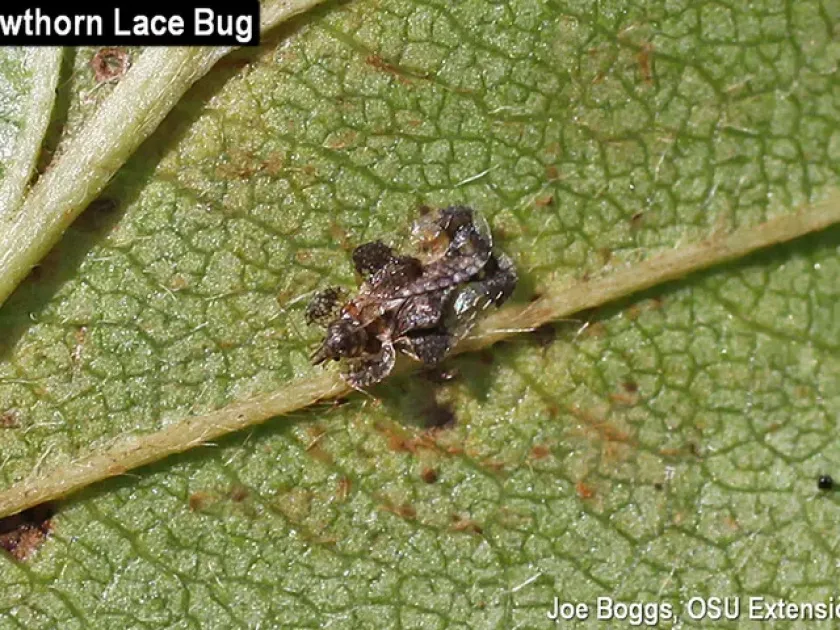
The hawthorn lace bug belongs to the order Hemiptera and the family Tingidae. The insect derives its common name from the intricate, lacy, reticulated pattern found on its pronotum and wings.
Adults are very small, usually measuring about 3 to 4 millimeters in length. Their bodies are flattened, and they exhibit a whitish to yellowish-brown coloration with characteristic dark markings on the wings.
The nymphs undergo several developmental stages, during which they differ significantly from adults by having numerous spines covering their bodies. They are often difficult to spot due to their camouflage.
The life cycle is closely tied to the host plants. Fertilized females hibernate during the winter, seeking shelter in bark crevices or under leaf litter around the base of the trees.
As spring temperatures rise, the adults emerge to feed on young foliage and begin laying eggs on the undersides of the leaves.
What it damages
This pest primarily attacks plants in the Rosaceae family. Hawthorn, various ornamental apple trees, pear trees, and cotoneasters are the most frequent hosts for these insects.
Damage is caused by both adults and nymphs. They use their piercing-sucking mouthparts to extract cell sap, which disrupts the normal photosynthetic activity of the plant tissues.
Heavy infestations lead to premature yellowing and leaf drop, which significantly stresses the tree before it enters its winter dormancy period.
Damaged tissues lose their integrity, negatively affecting the plant's ability to produce flower buds and reducing the overall growth rate of new shoots throughout the season.
Severe infestations also create entry points for secondary fungal infections, which further deteriorate the health and vigor of the infested trees.
When it appears
The first signs of lace bug activity are typically observed in late spring when average daily temperatures reach 15 to 18 degrees Celsius.
The population peaks in mid-summer as the second generation emerges. During hot and dry weather conditions, the damage potential increases significantly due to rapid reproduction.
Activity gradually decreases as autumn approaches, with the shortening of the photoperiod and the cooling of nighttime temperatures signaling the end of the active season.
The complete life cycle from egg to adult takes approximately one month, allowing for multiple generations to develop during a single growing season.
In years with fluctuating weather, the development rate may vary, but persistent drought remains a critical driver for population outbreaks in garden settings.
Signs of infestation
The most distinct sign of an infestation is the appearance of tiny light spots on the upper leaf surface, which eventually merge into larger, mottled, discolored patches.
On the undersides of the leaves, one can often find clusters of nymphs along with small black droplets of excrement, which may look like speckles of dirt or soot.
A silvery or bronzed appearance on the foliage is characteristic, resulting from the destruction of chlorophyll and the bleaching effect caused by the feeding activity.
Leaves often become distorted, curled, and eventually turn brown, starting from the lower parts of the canopy where the insect density is typically highest.
- Mottled light spots on the upper leaf surface.
- Black fecal spots on the underside of leaves.
- Premature curling and shedding of the foliage.
Control measures
Effective control of the hawthorn lace bug usually involves the application of systemic insecticides that are absorbed by the plant and target sucking insects directly.
Applications should be made during early morning or late evening hours, ensuring thorough coverage of the leaf undersides where the nymphs reside.
Cultural control measures include the removal and destruction of fallen leaves in autumn, as these serve as the primary overwintering sites for the adult bugs.
Maintaining proper plant hydration and utilizing beneficial insects (natural predators) can significantly reduce pest populations without the need for heavy chemical intervention.
When an infestation is detected, it is recommended to rotate insecticides from different chemical classes to prevent the development of resistance within the lace bug population.
Taxonomy
- Latin name
- Corythucha crataegi
- Order
- Hemiptera (bugs, aphids, leafhoppers)
- Family
- Tingidae
- EPPO code
- CRTHCR
Discussion
No discussions yet — be the first.