
Sycamore lace bug
Corythucha ciliata
Description
How to identify
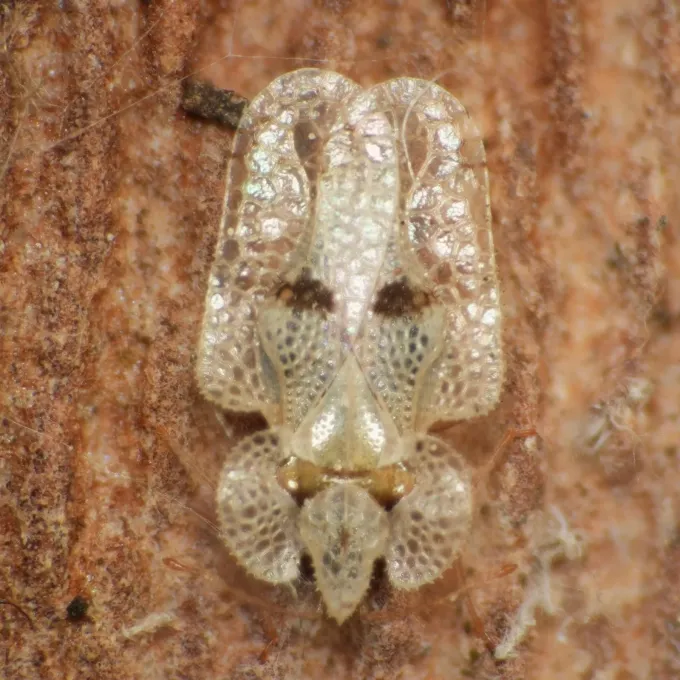
The sycamore lace bug (Corythucha ciliata) is a member of the Hemiptera order and the Tingidae family. These insects are small, typically measuring 3–4 mm in length, and are named for their unique, intricate, lace-like wing structure.
Adult bugs are generally whitish or translucent, often featuring dark brown markings on their wings. This camouflage helps them blend into the leaf surface, making them difficult to spot with the naked eye during casual inspection.
Nymphs, or immature stages, are distinct from adults; they have spiny, dark-colored bodies. These spikes act as a defense mechanism against potential predators while the nymphs develop on the underside of the leaves.
Eggs are deposited in small, dense clusters along the main veins on the underside of sycamore leaves. They are often covered with a dark, sticky excretion that acts as a protective shield against desiccation and natural enemies.
Overwintering occurs at the adult stage. These bugs seek shelter in the crevices of sycamore tree bark or under thick layers of leaf litter, where they remain dormant until spring temperatures rise sufficiently.
What it damages
The primary host for this pest is the sycamore (Platanus species). It thrives on trees like the London plane, American sycamore, and Oriental plane, often causing severe aesthetic and physiological decline in urban forests.
While they are host-specific, lace bugs may occasionally be found on other trees such as ashes, lindens, or maples if they are located in immediate proximity to heavily infested sycamore trees.
Both adults and nymphs feed by piercing the leaf cells and extracting plant sap. This process causes cellular damage and disrupts the plant's photosynthetic ability, leading to general stress.
Damage symptoms begin as small, chlorotic stippling on the upper leaf surface. Over time, these spots coalesce, turning the leaf yellow or bronze, which significantly impairs the tree's health and vitality.
In cases of heavy infestation, trees may suffer from premature defoliation. This early leaf drop reduces the tree's ability to store energy for the winter, ultimately compromising its long-term growth and hardiness.
When it appears
The life cycle begins in early spring when overwintered adults emerge from their bark shelters. They immediately begin feeding and laying eggs on the newly emerging foliage of the host tree.
Depending on the local climate and temperature, these insects can complete several generations per season, usually ranging from two to three cycles in temperate regions.
The peak activity period typically occurs during the warmest months of the summer. During this time, the population density increases rapidly, and all life stages can be found simultaneously on the leaves.
As autumn approaches and temperatures begin to drop, adults prepare for dormancy. They move from the leaves back to the trunk and branches, seeking secure hiding spots to survive the winter months.
Climate plays a critical role in population dynamics; dry, hot summers often result in population explosions, whereas cold, wet spring weather can significantly slow down the development of early generations.
Signs of infestation
The most visible indicator of an infestation is the presence of stippling or bleaching on the upper leaf surface, creating a mosaic or "marbled" appearance of small white spots.
- Accumulation of dark, shiny fecal spots on the underside of the leaves.
- Presence of shed exoskeletons (exuviae) discarded by nymphs during molting.
- Visible colonies of adult bugs and nymphs clustered near the leaf veins.
- Premature yellowing, browning, and curling of leaves throughout the canopy.
The underside of the leaves often looks dirty or discolored due to the presence of waste products and insect debris. A sooty mold may also develop on the surface, feeding on honeydew if produced.
Severely affected leaves become brittle and lose their structural integrity, leading to a scorched appearance of the entire tree crown. This damage is usually widespread across the tree due to the insect's prolific reproduction.
Control measures
Chemical control remains the most effective management strategy. Applying systemic insecticides via trunk injection or foliar spray can help reduce populations, especially if applied early in the season.
Cultural practices, such as raking and disposing of leaf litter in the fall, can help reduce the number of overwintering sites, thereby lowering the initial pest pressure for the following spring.
Biological control methods involve encouraging natural predators like lady beetles, lacewings, and pirate bugs. While helpful, these predators may not always be sufficient to control major outbreaks on their own.
Proper coverage is essential when using foliar sprays, as the bugs reside almost exclusively on the underside of the leaves. High-pressure equipment is often required for large, mature sycamore trees.
Ongoing monitoring is vital for effective management. By tracking the development of the first generation in the spring, arborists can determine the optimal timing for intervention before the pest reaches damaging levels.
Taxonomy
- Latin name
- Corythucha ciliata
- Order
- Hemiptera (bugs, aphids, leafhoppers)
- Family
- Tingidae
- EPPO code
- CRTHCI
Discussion
No discussions yet — be the first.