
Hackberry lace bug
Corythucha celtidis
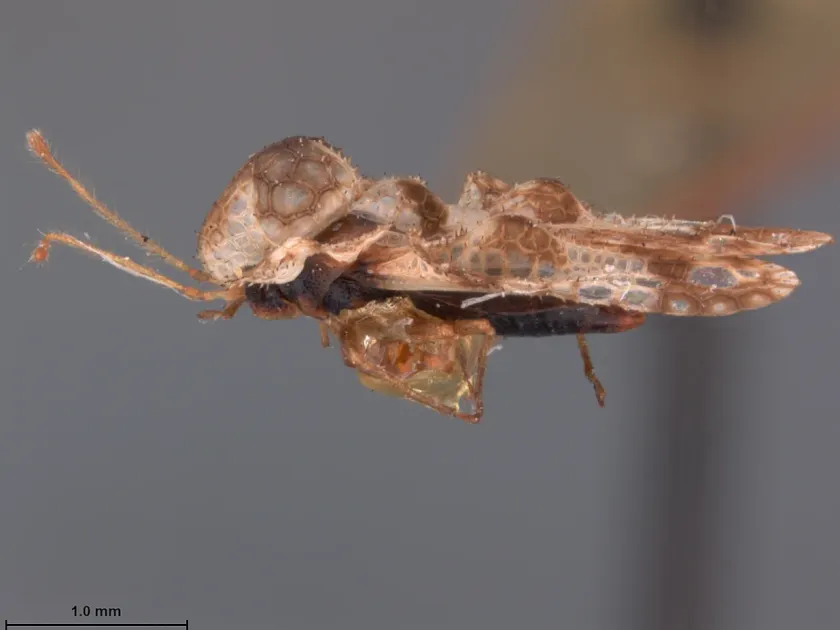
Description
How to identify
The Hackberry lace bug (Corythucha celtidis) belongs to the lace bug family (Tingidae). It is named for the intricate, net-like appearance of its wing covers and pronotum, which resemble delicate lace under magnification.
Adult bugs are small, typically measuring 3 to 4 millimeters in length. Their bodies are light-colored with dark, patterned markings that provide excellent camouflage against the foliage of host trees.
Nymphs, or immature stages, are wingless and characterized by a spiny appearance. They go through several developmental instars, becoming larger and more structured with each molt.
Eggs are typically laid in small clusters on the undersides of leaves. Females often cover them with dark frass to protect the brood from potential predators and parasites.
Diagnostic features include specific spines and hood shapes on the head and thorax, which help specialists differentiate this species from other common members of the Corythucha genus.
What it damages
The primary hosts for this insect are trees in the Celtis genus, commonly known as hackberry trees. The bug is considered a significant pest in urban landscapes and park settings.
Lace bugs feed by inserting their needle-like mouthparts into the leaf tissue and extracting sap. This feeding process destroys the chlorophyll-containing cells, leading to a loss of photosynthetic efficiency.
Heavy infestations can cause significant aesthetic damage, making the trees appear chlorotic and unhealthy. If left untreated, the cumulative stress can weaken the tree's overall vigor.
Premature leaf drop is a common consequence of severe feeding. When trees lose their foliage early, they may suffer from reduced carbohydrate storage, impacting their winter survival and spring growth.
The feeding sites create physical openings in the leaf, which can serve as entry points for secondary pathogens like fungi or bacteria, further damaging the tree's health.
When it appears
Adult lace bugs overwinter in protected areas, such as bark crevices, leaf litter, or other sheltered spots near the host tree. They emerge in early spring as temperatures rise.
Throughout the growing season, multiple generations can occur. The lifecycle duration depends heavily on ambient temperature, with warmer conditions leading to faster development cycles.
Population levels usually peak during mid-summer. It is common to see all stages of the lifecycle, including eggs, nymphs, and adults, existing simultaneously on the same leaf.
As autumn approaches and temperatures decline, adults begin to migrate away from the foliage to seek out secure overwintering sites for the cold season.
In regions with long, warm summers, the number of generations may increase, placing significant, sustained pressure on the host trees throughout the entire vegetative period.
Signs of infestation
The first sign of infestation is the appearance of mottled, yellow, or white stippling on the upper surface of the leaves, resulting from the bug's sap-sucking activity.
A telltale sign of a lace bug presence is the accumulation of dark, varnish-like fecal spots on the underside of the leaves, which makes the foliage appear dirty.
Visible decline in the crown's overall color is common. Affected trees often look washed-out or grayish-green instead of having a vibrant, healthy green canopy.
Upon close inspection of the leaf undersides, one can find colonies of nymphs clustered together near the leaf veins, which is their preferred area for feeding.
- Mottled or speckled leaf appearance.
- Sticky black spots on leaf undersides.
- Premature yellowing of foliage.
- Early leaf abscission in severe cases.
Control measures
Managing the Hackberry lace bug involves an integrated pest management approach. Preventive measures and timely intervention are key to protecting the trees.
Systemic insecticides are the most effective control method. These products are taken up by the tree, providing long-lasting protection against feeding nymphs and adults.
Timing is crucial for successful control. Applications should be made shortly after the first nymphs are observed in spring to prevent the population from reaching damaging levels.
Sanitation practices, such as removing and disposing of fallen leaves in autumn, can reduce the number of overwintering adults that emerge the following year.
Biological controls, including predatory insects or microbial insecticides, offer a safer alternative to synthetic chemicals and can be used to suppress populations in sensitive urban environments.
Taxonomy
- Latin name
- Corythucha celtidis
- Order
- Hemiptera (bugs, aphids, leafhoppers)
- Family
- Tingidae
- EPPO code
- CRTHCE
Discussion
No discussions yet — be the first.