
Oak lace bug
Corythucha arcuata
Description
How to identify
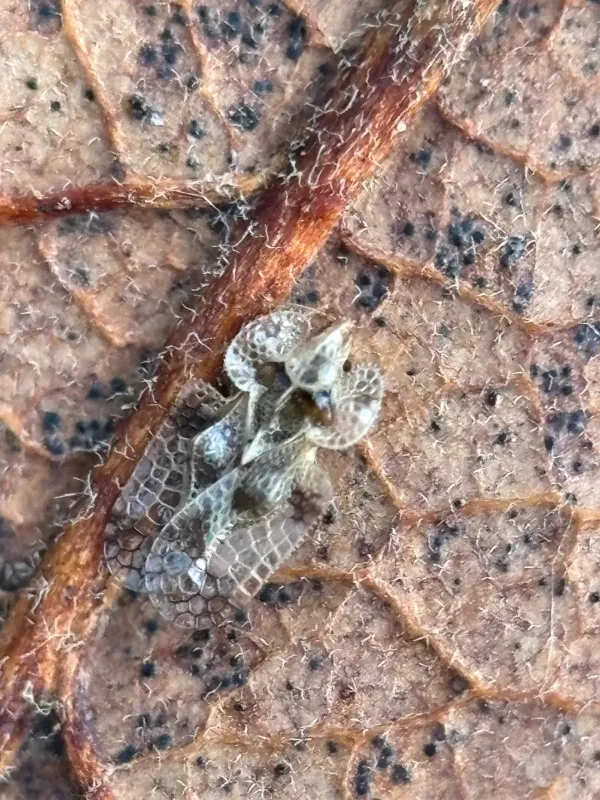
The Oak lace bug (Corythucha arcuata) belongs to the order Hemiptera and the family Tingidae. It is a small, invasive insect known for its intricate, lace-like wing structure which provides excellent camouflage against bark.
Adult bugs are approximately 3–4 mm long, typically exhibiting a pale, translucent coloration with dark markings on the wings. They possess a broad, net-like pronotum that extends over the head.
Eggs are deposited in small clusters on the underside of leaves and are dark brown to black in color. Larvae develop through five instars, appearing as spiny, dark-colored nymphs that gradually shift in appearance as they mature.
Native to North America, this species has successfully invaded European oak forests. Its rapid reproductive rate is facilitated by a lack of specialized local predators and favorable environmental conditions.
Identification often requires careful inspection of the foliage, particularly the lower canopy, where the bugs establish their primary feeding colonies.
What it damages
While the Oak lace bug primarily infests various species of oak, it can also feed on beech, hornbeam, lime, and other deciduous trees when host populations are dense.
Both adults and nymphs feed by piercing the leaf epidermis and sucking out cell contents. This results in the destruction of chlorophyll-rich tissue, severely impairing the tree's ability to photosynthesize.
Repeated infestations lead to significant physiological stress. Symptoms include chlorosis, leaf necrosis, and premature defoliation, which exhausts the tree's energy reserves before winter dormancy.
In forest ecosystems, severe and repeated attacks lead to reduced wood increment and crown dieback. Young trees are particularly vulnerable and may face mortality after successive years of heavy infestation.
Economic damage is twofold: it includes the direct loss of timber quality and the high cost of monitoring and implementing control measures across extensive forest areas.
When it appears
Adult lace bugs overwinter in bark crevices, under forest litter, or in other protected refuges. Emergence begins in spring as temperatures rise, usually aligning with the flushing of oak leaves.
The first generation starts oviposition in late spring. Development is highly temperature-dependent, and the species can complete multiple generations per season in warm climates.
Population density typically peaks in mid-to-late summer, around July and August, when conditions are most favorable for nymphal development and successive breeding cycles.
By autumn, as temperatures begin to drop, adults prepare for diapause. They seek suitable hibernation sites to survive the winter, ending their feeding activities on the foliage.
Extended periods of hot, dry weather during the growing season significantly accelerate the lifecycle, allowing for higher population spikes and more intense damage.
Signs of infestation
The first signs of infestation are small, pale yellow spots (stippling) on the upper surface of leaves, created by localized cell death at the feeding sites.
The underside of affected leaves will show clusters of bugs, cast-off larval skins, and dark, sticky fecal spots, which serve as a clear diagnostic feature for the pest.
As damage progresses, the entire leaf takes on a bronzed or dirty gray appearance. In cases of severe infestation, the leaves may curl, wither, and drop from the tree well before autumn.
A heavily infested forest stand appears unhealthy and prematurely discolored, with the lower branches often showing the most intense signs of damage compared to the top of the canopy.
Early leaf drop is a major indicator of an ongoing infestation, signaling that the tree has been under significant feeding pressure for several weeks.
Control measures
Biological control strategies include the conservation of generalist predators such as lacewings, lady beetles, and predatory hemipterans that naturally predate on lace bug eggs and nymphs.
Chemical control involves the application of systemic insecticides, which are absorbed by the tree and prove most effective when applied during the early nymphal stages of the first generation.
Trunk injections represent a precise and environmentally friendly method for managing infestations in urban trees or sensitive areas, preventing drift and off-target impacts.
Silvicultural practices, such as clearing fallen leaf litter, can reduce the number of overwintering sites, though this is often difficult to implement on a large forest scale.
Regular forest health monitoring and the promotion of tree vigor through appropriate site management are essential for increasing the natural resistance of oak stands against lace bug outbreaks.
Taxonomy
- Latin name
- Corythucha arcuata
- Order
- Hemiptera (bugs, aphids, leafhoppers)
- Family
- Tingidae
- EPPO code
- CRTHAR
Discussion
No discussions yet — be the first.