
Horse chestnut lace bug
Corythucha aesculi
Description
How to identify
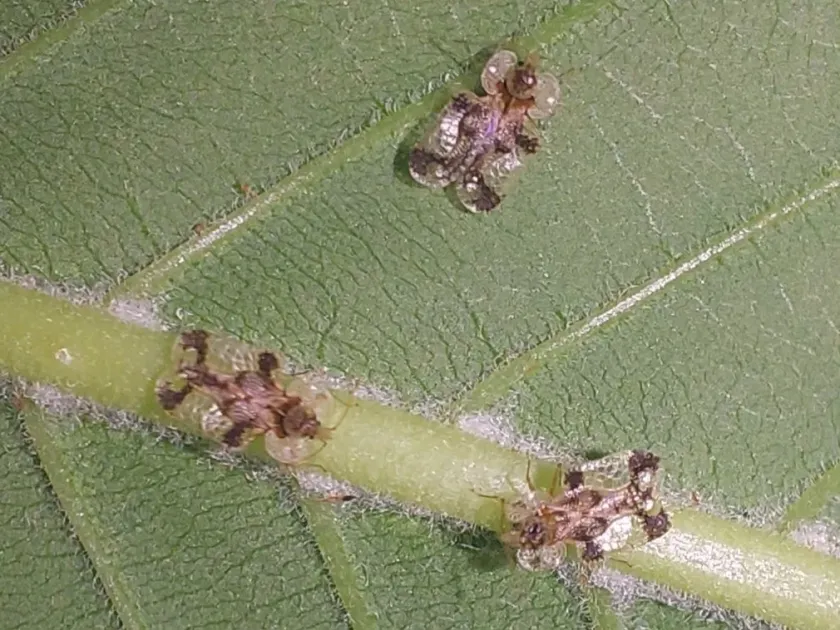
The horse chestnut lace bug, scientifically known as Corythucha aesculi, is a member of the Tingidae family. It is easily recognized by its distinctive, intricate, lace-like wing pattern that gives this group of insects their common name.
Adults are very small, typically measuring between 3 to 4 millimeters. Their coloration is generally pale, ranging from cream to light brown, which provides excellent camouflage against the foliage of host trees, making them difficult to spot during early stages of infestation.
The life cycle includes multiple nymphal stages. These nymphs are wingless and often feature small spines or tubercles on their bodies, which serve as a defense mechanism against potential predators within the dense foliage.
These insects prefer to congregate on the undersides of leaves, forming dense colonies. This behavior helps them maintain a stable microclimate and protects them from direct environmental stressors and some types of mechanical disturbances.
The lace bug is highly specialized in its habitat choice, favoring the foliage of horse chestnut trees. Due to their hidden lifestyle, infestations often go unnoticed until visible damage becomes widespread across the tree canopy.
What it damages
The primary host for this species is the common horse chestnut tree. Damage occurs when both nymphs and adults use their piercing-sucking mouthparts to feed on the leaf tissues, extracting plant sap and essential fluids.
As the insects feed, they inject enzymes that damage the photosynthetic cells of the leaf. This results in localized chlorosis, which manifests as pale, stippled spots across the leaf surface, significantly reducing the tree's overall vigor.
Heavy infestations can lead to massive leaf yellowing, browning, and premature leaf drop. When a tree loses its foliage prematurely in mid-summer, its ability to store energy for the next growing season is severely compromised.
Stressed trees, weakened by continuous feeding, become more susceptible to opportunistic pathogens and environmental factors like drought or fungal infections. This decline in vitality is particularly noticeable in urban environments.
While a single tree may survive minor infestations, sustained pressure over several years can result in branch dieback and a significant reduction in the tree's ornamental and ecological value.
When it appears
Activity begins in the spring, triggered by rising temperatures and the initiation of leaf development on the host trees. Overwintering adults emerge from their dormant sites to begin feeding and egg-laying.
The insect is capable of producing several generations per year, depending on the length of the growing season and regional climate. Warm, dry summers significantly accelerate their development, leading to peak populations in late July and August.
As autumn approaches, adult bugs begin seeking suitable overwintering sites. They often settle in the bark crevices of the host tree, within the layer of leaf litter, or in protected areas of nearby structures.
The population density is highly climate-dependent. Unusually hot summers often result in population explosions, while periods of heavy rain may slightly dampen the growth rate of nymphs but rarely eliminate an established colony.
Monitoring should be most intensive from early June through August to detect early signs of colony formation before the damage becomes severe enough to cause premature leaf senescence.
Signs of infestation
The earliest symptom is the appearance of tiny yellow or whitish spots on the upper leaf surface. These dots represent the specific sites where the lace bugs have punctured the leaf and extracted chlorophyll-rich sap.
On the underside of the leaves, one can observe clusters of insects, including adults, nymphs, and shed skins. Also, small dark spots of excrement are often present, indicating active feeding colonies.
As damage progresses, the leaves take on a mottled or marble-like appearance. In cases of extreme infestation, the entire leaf turns brown and crisp, eventually falling from the tree long before the natural autumn abscission.
The presence of sooty mold on the foliage or nearby branches can also be an indirect sign of a high population, as the sugary residues from feeding may attract other organisms or encourage fungal growth.
- Stippled, pale spotting on leaves.
- Clusters of nymphs on leaf undersides.
- Small, dark fecal spots on foliage.
- Premature yellowing and leaf loss.
- Reduced overall canopy density.
Control measures
Sanitation is a critical management practice. Removing and properly disposing of fallen leaves in the autumn is essential to eliminate the primary overwintering sites for adult lace bugs.
Chemical control often involves the use of systemic insecticides. These are applied to the soil or trunk and translocated into the leaf tissue, ensuring that the insects ingest the toxin while feeding on the sap.
Applications are most effective when timed with the appearance of the first generation of nymphs. Ensuring the coverage reaches the undersides of the leaves is vital for immediate suppression of the population.
Maintaining tree health through proper irrigation and mulching helps the horse chestnut withstand the stress caused by the insects. A well-watered tree is more resilient and less prone to severe damage than a drought-stressed one.
Promoting a healthy garden ecosystem by protecting natural predators, such as lady beetles, green lacewings, and predatory bugs, provides a sustainable way to keep lace bug numbers in check over the long term.
Taxonomy
- Latin name
- Corythucha aesculi
- Order
- Hemiptera (bugs, aphids, leafhoppers)
- Family
- Tingidae
- EPPO code
- CRTHAE
Discussion
No discussions yet — be the first.