
Jasmine lace bug
Corythauma ayyari
Description
How to identify
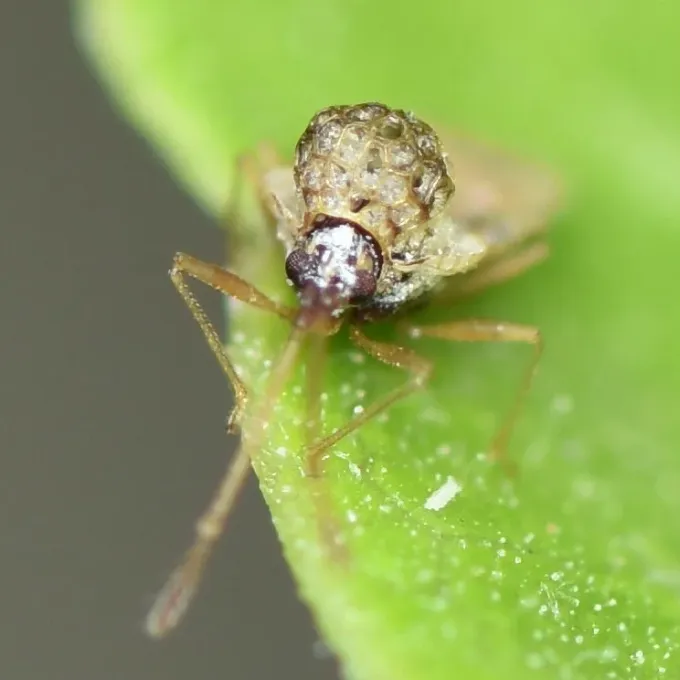
The jasmine lace bug, scientifically known as Corythauma ayyari, is a member of the Tingidae family, commonly referred to as lace bugs due to the intricate, lacy texture of their wings.
These insects are very small, typically measuring between 2 and 3 millimeters in length, making them easy to overlook on the foliage until significant damage occurs.
Adults possess a delicate, semi-transparent appearance with a characteristic reticulate pattern on their pronotum and wings that resembles fine embroidery or lace.
Nymphs are generally darker and often feature spines on their bodies; they tend to remain stationary on the undersides of leaves, living in colonies alongside adults.
Their life cycle is relatively rapid, allowing several overlapping generations to occur during the growing season, which leads to exponential population growth under favorable conditions.
What it damages
The primary hosts for Corythauma ayyari are plants within the Jasminum genus, although they may occasionally infest related ornamental plants in the Oleaceae family.
Feeding occurs through piercing-sucking mouthparts, which extract cell sap directly from the leaf tissue, leading to the disruption of essential metabolic processes.
The most visible result of this feeding is the appearance of chlorotic stippling or bleaching on the upper surface of the leaves, eventually leading to senescence.
In addition to direct damage, the excrement of the lace bugs often promotes the growth of sooty mold, which can further block light and impede photosynthesis.
Severely infested plants often exhibit stunted growth, leaf yellowing, and may lose their foliage prematurely, significantly reducing their ornamental and aesthetic value.
When it appears
Jasmine lace bugs are most active during warm and dry periods, as high temperatures significantly accelerate their metabolism and shorten their reproductive cycle.
During the peak of summer, a generation can complete its development in as little as two to four weeks, causing rapid infestation flare-ups in gardens and greenhouses.
In regions with distinct seasons, overwintering occurs in the adult or late-nymph stage, typically hiding in protected areas like plant debris or bark crevices.
In indoor environments or tropical climates, these insects can persist and reproduce throughout the year, provided the host plant remains healthy.
Monitoring is crucial from early spring to late autumn to prevent initial small populations from becoming uncontrollable infestations by the end of the season.
Signs of infestation
The initial signs of an infestation include the appearance of tiny yellow or whitish spots on the upper leaf surface, which correspond to the feeding sites on the underside.
Turning the leaves over usually reveals colonies of lace bugs, dark fecal spots, and cast-off exuviae (shed skins) from nymph development.
- Stippled or mottled leaf appearance (chlorosis).
- Development of sticky or black sooty mold on leaves.
- Leaf curling, drying, and premature wilting.
- Presence of delicate, lace-like insects on the lower leaf surface.
As the infestation progresses, the foliage loses its green color, becomes brittle, and eventually drops off, causing the plant to appear ragged and sickly.
Control measures
Effective management of Corythauma ayyari requires an integrated approach, focusing on early detection and consistent intervention.
Physical control measures include the removal and disposal of heavily infested leaves or branches, which can significantly reduce the local population density.
Systemic insecticides are generally the most effective chemical control, as they are absorbed by the plant and provide protection against the sap-sucking habits of the pests.
When applying any control product, it is vital to ensure thorough coverage of the underside of the leaves, where the colony stages primarily reside.
Maintaining plant health through proper watering and fertilization can help the jasmine plant withstand minor damage and recover more quickly following control efforts.
Taxonomy
- Latin name
- Corythauma ayyari
- Order
- Hemiptera (bugs, aphids, leafhoppers)
- Family
- Tingidae
- EPPO code
- COTMAY
Discussion
No discussions yet — be the first.