
Blue wildebeest
Connochaetes taurinus
Description
How to identify
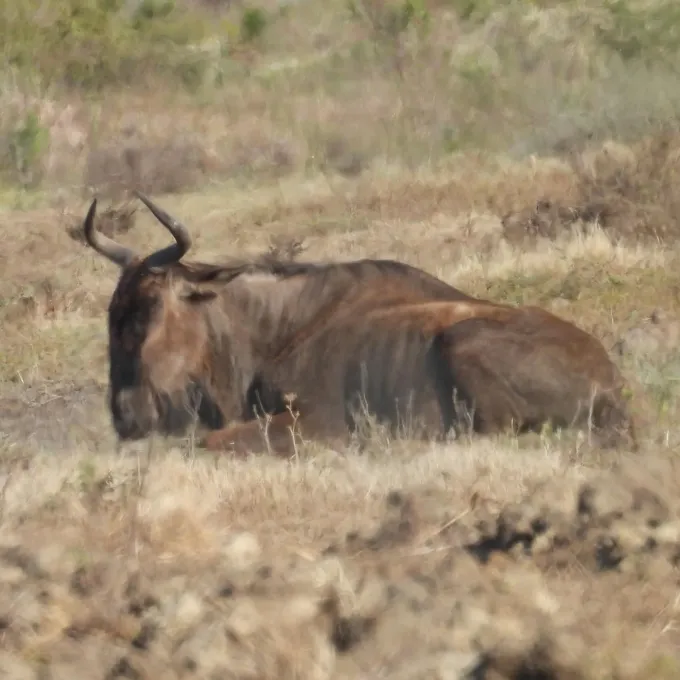
The blue wildebeest (Connochaetes taurinus) is a large herbivore belonging to the Artiodactyla order and the Bovidae family. These animals are characterized by a sturdy build, broad muzzle, and horns curved outwards and then inwards.
Adult males and females can weigh up to 270 kg. Their coat color is typically grey to blue-grey, marked with a dark mane and a beard, which gives them a distinctive look in the savannah environment.
Socially, they live in large herds. In the context of agriculture, this gregarious behavior makes them a significant threat, as a single passing herd can contain thousands of individuals.
These animals are native to the African savannas, but as land is increasingly converted into farmland, the interaction between wildebeest and agricultural crops has led to them being classified as major pests.
Biologically, they are grazers that require large amounts of forage daily, making high-yield grain fields highly attractive destinations for their feeding migrations.
What it damages
Blue wildebeest damage various crops, including maize, sorghum, and wheat. The damage is twofold: direct consumption of plants and extensive physical damage caused by trampling.
When a herd grazes on a field, they can defoliate entire hectares in a matter of hours, often eating the plants down to the root, which prevents any potential for crop regeneration.
Trampling leads to soil compaction, which is detrimental to root health and water infiltration. Even if a crop is not entirely consumed, it often fails to thrive due to these physical soil disruptions.
Beyond the crops themselves, wildebeest frequently destroy agricultural infrastructure. They break irrigation pipes, knock down fencing, and damage soil conservation structures like bunds and trenches.
In regions where agriculture borders wildlands, the competition for grazing space between wildebeest and livestock can result in the overgrazing of shared rangelands, reducing overall agricultural productivity.
When it appears
The risk of wildebeest damage peaks during the rainy season when the animals follow the availability of lush, green vegetation for their breeding and migration cycles.
During the dry season, wildebeest often concentrate around permanent water sources, which frequently overlap with farmland. In these periods, they graze intensively on any available vegetation, including crops.
The migration cycle is highly predictable, meaning farmers in specific regions can often anticipate the arrival of herds based on historical patterns and seasonal climate data.
During calving season, herds become highly mobile, which increases the frequency of field incursions as they search for nutrient-rich grass to sustain lactation.
While they are usually migratory, local droughts can force wildebeest to stay in farmed areas for longer durations, prolonging the window of vulnerability for agricultural crops.
Signs of infestation
A primary sign of wildebeest presence is the sudden and total disappearance of young crops from large sections of a field, often with nothing left but remnants of stems.
Deep, widespread hoof prints across the fields are a clear indicator of a herd's movement. These prints are often accompanied by soil churning and displacement.
Significant amounts of dung found on cultivated land signal that the herd has spent a prolonged period grazing in the area, increasing the risk of pathogen spread.
Damaged fencing, bent metal support structures for irrigation, and crushed access paths are characteristic indicators of a large group of wildebeest passing through a farm.
Observation of high-intensity grazing patterns, where grass or crop cover is removed evenly across a specific patch, is typical for this species' feeding behavior.
Control measures
Physical exclusion is the most reliable method of protection. High-tensile wire fencing or fortified, robust boundaries are necessary to prevent large wildebeest from entering crop zones.
Electric fencing, particularly multi-strand systems with high voltage, is effective at deterring wildebeest, provided the system is well-maintained and cleared of vegetation.
Using motion-activated scaring devices, such as high-intensity strobe lights or sonic sirens, can temporarily disperse herds before they reach critical stages of crop growth.
Buffer zones are recommended. Planting non-palatable or low-value crops at the perimeter of the farm can discourage herds from pushing deeper into the main production areas.
Integrating GPS tracking of local wild populations into farm management systems allows for proactive patrolling and the deployment of deterrent measures precisely when herds are approaching.
Taxonomy
- Latin name
- Connochaetes taurinus
- Family
- Bovidae
- EPPO code
- CONNTA
Discussion
No discussions yet — be the first.