
Mottled Umber
Colotois
Description
How to identify
The Mottled Umber (Colotois pennaria) is a moth belonging to the family Geometridae. Adult moths typically have a wingspan ranging from 40 to 50 mm, with coloration varying from yellowish-brown to reddish-brown.
The forewings are characterized by two dark transverse bands, with a noticeable pale spot often visible between them. The hindwings are generally paler, featuring a distinct dark line across the surface.
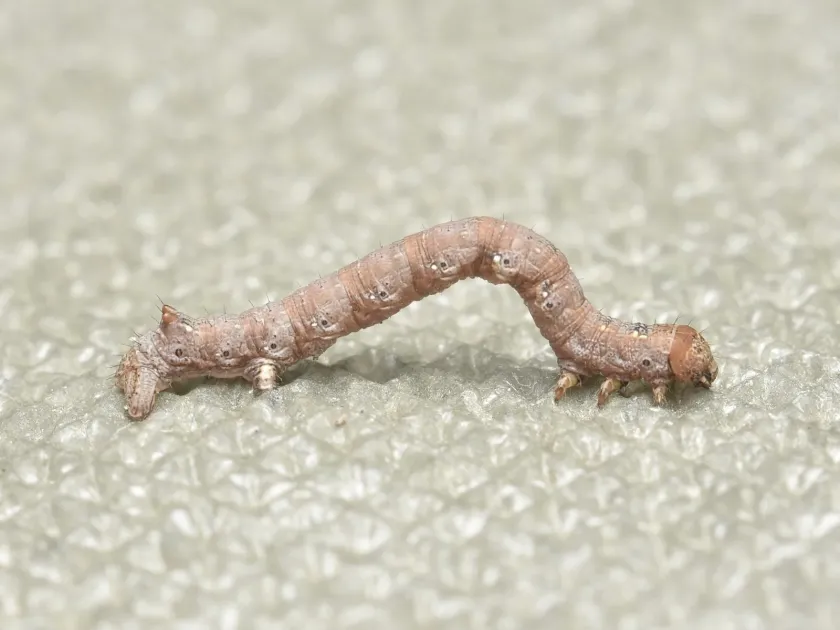
Larvae, or caterpillars, reach lengths of up to 50 mm. They are typically gray, brown, or greenish, often decorated with faint light patterns that provide excellent camouflage against tree bark.
As members of the Geometridae family, the larvae move in a unique looping fashion, pulling their posterior segments forward to meet their thoracic legs, which gives them the common name 'inchworms'.
The pupae are dark brown and spend the winter within firm cocoons buried in the soil or beneath leaf litter, protecting them from harsh winter temperatures and predation.
What it damages
This pest is a polyphagous insect, meaning it targets a wide variety of deciduous trees. Its primary hosts include apple, pear, plum, cherry, and apricot trees, making it a significant orchard threat.
Beyond fruit trees, the Mottled Umber larvae frequently feed on forest trees such as oak, birch, lime, and beech, often leading to localized outbreaks in woodlands near orchards.
The primary damage is caused by mature larvae that exhibit voracious feeding habits. They consume foliage, flower buds, and young fruitlets, often resulting in severe defoliation of the canopy.
Severe infestations can lead to significant stress for the tree, weakening its overall health and reducing its ability to form flower buds for the following season's harvest.
Infested trees show reduced photosynthetic capacity, which directly translates into lower yield quality and quantity, necessitating intervention to prevent long-term damage to orchard productivity.
When it appears
Adult moths emerge during the autumn months, typically from September to October. During this period, they mate and lay eggs on the branches of suitable host trees.
Eggs overwinter on the twigs of the host plant, usually in small clusters near buds or in branch bifurcations, remaining dormant throughout the cold winter months.
Caterpillars hatch in early spring, coinciding with the budburst of host trees. This timing ensures that larvae have immediate access to the most nutritious young plant tissues.
The active feeding phase lasts from spring until early June. Once the larvae have completed their development, they drop to the ground to pupate in the soil until the next autumn.
Monitoring the flight activity of adult moths using light traps or pheromone traps can help growers identify potential infestation risks and plan necessary preventive measures.
Signs of infestation
Early signs of infestation include damaged or hollowed-out buds that fail to develop properly. This is often observed just as the tree begins its spring growth phase.
Skeletonized leaves with ragged edges are a classic symptom of caterpillar feeding. In severe cases, the foliage is consumed entirely, leaving only the primary leaf veins intact.
The presence of larval frass (droppings) on the leaves or the ground beneath the tree canopy is a clear indicator of active feeding by a large population of caterpillars.
Egg clusters can sometimes be identified during winter pruning. They appear as small, firm bumps on the wood, often hidden near buds or in the rough texture of the tree bark.
Caterpillars themselves are difficult to spot because they remain immobile during the day, mimicking small twigs or bark growths, which is their primary defense mechanism against birds.
Control measures
Mechanical control, such as collecting and destroying egg clusters during winter pruning, is one of the most effective ways to reduce the population without the use of chemicals.
Biological control methods, including the application of Bacillus thuringiensis based products, are highly effective against young larvae while sparing beneficial insects and pollinators.
If population levels are high, targeted applications of insecticides during the green-tip or bud-burst stage can effectively protect the developing foliage from early damage.
Cultivating the soil beneath the trees in late autumn can expose overwintering pupae to the elements and predators, significantly reducing the survival rate for the next generation.
Encouraging natural bird populations in the orchard is a sustainable practice, as many species of birds actively feed on the caterpillars throughout the spring season.
Taxonomy
- Latin name
- Colotois
- Order
- Lepidoptera (butterflies)
- Family
- Geometridae
- EPPO code
- COOTSP
Discussion
No discussions yet — be the first.