
Two-spotted collops
Collops bipunctatus
Description
How to identify
The two-spotted collops (Collops bipunctatus) is a beetle belonging to the family Melyridae, within the order Coleoptera. It is recognized as a significant pest in various agricultural regions due to its feeding habits.
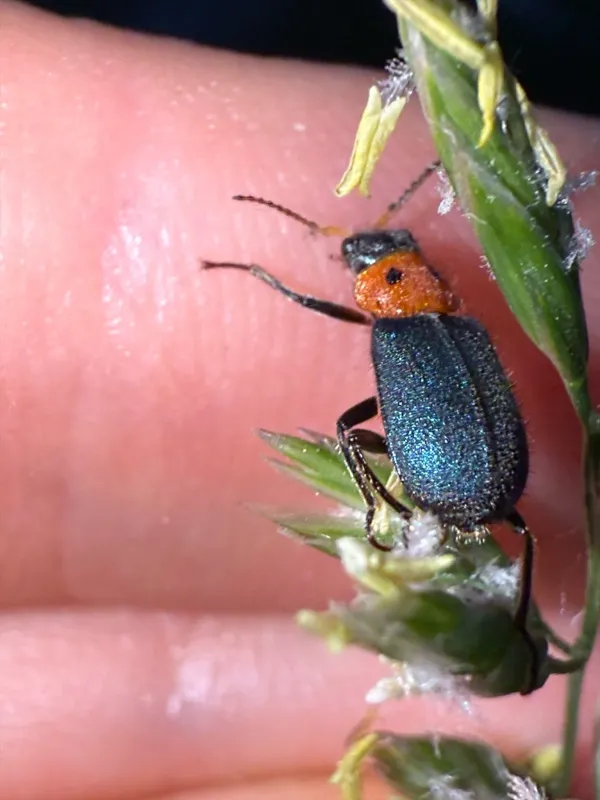
Adult beetles have an oval body shape, typically measuring 5–6 mm in length. Their elytra (wing covers) are distinctly reddish-orange and feature two prominent dark spots, which are diagnostic for this species.
The head and pronotum are generally dark with a metallic sheen. These beetles are highly mobile and possess strong legs, allowing them to move rapidly across plant surfaces during daylight hours.
Larvae often reside in soil or plant debris, leading a relatively concealed life. They are known to exhibit both predatory and herbivorous feeding behaviors, depending on environmental factors.
The species is well-adapted to arid environments, and its life cycle is heavily influenced by temperature and moisture availability in the crop field.
What it damages
The two-spotted collops is a generalist feeder that impacts various crops, including cereals, legumes, and several vegetable varieties.
Adults cause the most significant damage by feeding on foliage, tender shoots, and floral structures, effectively reducing the photosynthetic capacity of the plants.
By consuming flower petals and developing ovules, these beetles can severely hinder the pollination process, directly leading to reduced seed set and yield loss.
The feeding lesions created by the beetles serve as entry points for various phytopathogens, potentially triggering secondary fungal or bacterial infections.
During outbreak years, the economic impact can be substantial, especially when the insect population density peaks during the critical reproductive phases of the crops.
When it appears
The emergence of adult beetles typically coincides with the warming of soil temperatures in late spring, marking the transition from overwintering sites to host plants.
Peak activity and feeding intensity are observed during mid-summer, often correlated with the flowering stage of agricultural crops.
The life cycle involves complete metamorphosis, with the duration of each life stage highly dependent on accumulated heat units throughout the growing season.
As autumn approaches and temperatures drop, adults search for overwintering sites, such as soil crevices or dense plant residue, to survive the winter.
The number of generations per year depends on the local climate, with multiple generations possible in warmer, southern geographic areas.
Signs of infestation
Key indicators of infestation include irregular "window-pane" holes and ragged edges on leaves caused by the beetle's mouthparts during feeding.
Visual identification involves observing the brightly colored adults on leaves or within blossoms, often accompanied by flower drop or wilting of damaged plant parts.
Localized patches of yellowing or stunted growth in a field often indicate areas of high beetle density, where they have intensively grazed on host tissues.
The beetles are easily spotted due to their vivid coloration and active, skittish behavior when foliage is disturbed.
Severe infestations often result in reduced canopy development, which can be observed across parts of the field following a rapid migration of the pest.
Control measures
Integrated pest management strategies begin with crop rotation, which helps disrupt the lifecycle and reduces the accumulation of the pest in specific fields.
Effective soil management, such as post-harvest tilling, can disturb larvae and adults in their overwintering habitats, significantly suppressing the local population.
Chemical control measures, including the application of approved insecticides, should be implemented when scouting reveals populations exceeding economic thresholds.
- Regular field scouting to monitor beetle abundance and distribution.
- Removal of host weeds that provide early-season refuge for the beetles.
- Integration of biological controls to suppress populations naturally.
For maximum efficacy, insecticide applications are recommended during early morning or late evening when beetles are actively foraging and fully exposed on the foliage.
Taxonomy
- Latin name
- Collops bipunctatus
- Order
- Coleoptera (beetles)
- Family
- Melyridae
- EPPO code
- CLLPBI
Discussion
No discussions yet — be the first.