
Collops
Collops
Description
How to identify
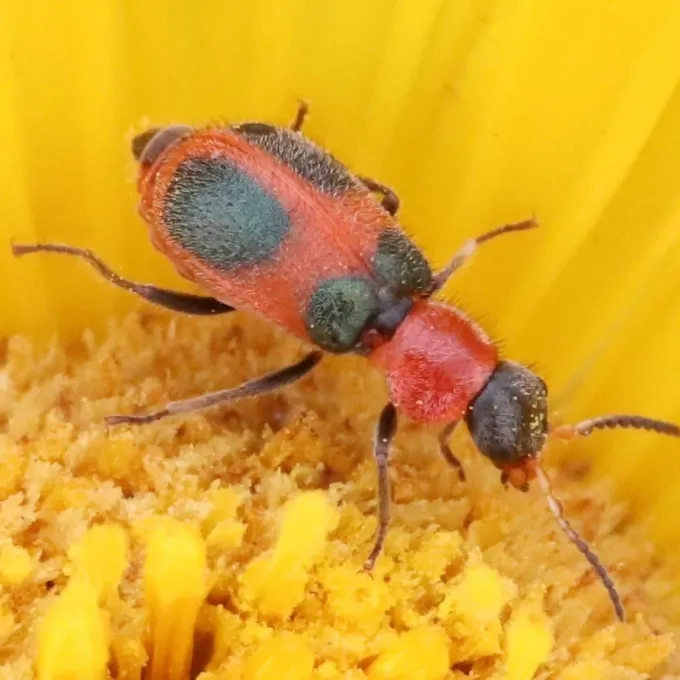
The genus Collops belongs to the family Melyridae, commonly known as soft-winged flower beetles. These insects are easily recognized by their vivid coloration, usually featuring bright orange or red patterns on black, which serves as an aposematic signal.
Adult beetles are relatively small, typically measuring 3 to 6 millimeters in length. Their bodies have a characteristic soft texture and an elongated shape that distinguishes them from more rigid beetle families.
A key identifying feature is the structure of their antennae, which are often serrate or pectinate. The head is noticeably extended, and the pronotum often carries specific markings that help in precise taxonomic identification.
The larvae are typically secretive, inhabiting the soil or plant debris. They possess a slender, active body with well-developed legs, which allows them to navigate efficiently through the root zone.
In field observation, it is important to note that while adults are often seen on flowers, their presence can be dual-natured; they act as both potential plant feeders and predatory insects.
What it damages
Economic damage caused by Collops beetles is primarily observed when large populations gather on flowering crops. They feed on pollen, petals, and other reproductive structures of the plant.
Commonly affected crops include alfalfa, soybean, sunflower, and various small grains. Damage to these parts can significantly impair pollination, leading to a reduction in seed or fruit set.
Despite the damage caused by adults, the larvae are often beneficial predators. They feed on the eggs of other pests, such as lepidopteran larvae, which helps in balancing the agricultural ecosystem.
Signs of infestation include ragged edges on flower petals and hollowed-out anthers. This feeding behavior can reduce the overall health and yield potential of the crop during critical growth phases.
Farmers should assess the population density before taking action, as the balance between predatory activity and crop feeding is highly variable depending on the specific species and crop environment.
When it appears
The activity period for Collops begins in late spring, following the first consistent warm temperatures. Their appearance often correlates with the onset of the flowering season for host crops.
These beetles overwinter in the larval or pupal stages, residing in the soil or protected leaf litter. This survival strategy ensures they are ready to emerge as the season warms.
As spring progresses, development accelerates, and adults emerge to feed and reproduce. The duration of their lifecycle is heavily influenced by regional climate conditions and moisture levels.
In many regions, multiple generations can occur within a single growing season, allowing for population spikes in mid-to-late summer when food sources are most abundant.
As temperatures drop in the autumn, adult activity wanes. The insects gradually move towards overwintering sites, entering a state of diapause until the following year.
Control measures
Effective management begins with regular monitoring using sweep nets or visual inspection during peak bloom. Control measures should only be implemented if the population exceeds economic thresholds.
Cultural practices, such as proper soil cultivation, can disrupt the lifecycle of overwintering larvae and pupae. Rotating crops is also a effective strategy to reduce local pest pressure.
If chemical intervention is necessary, select insecticides that have low toxicity to pollinators. Applying treatments during late evening, when bees are not foraging, is standard practice.
Biological control, by encouraging beneficial predatory insects and avian species, can naturally suppress the population without the need for synthetic chemical applications.
Integrated Pest Management (IPM) plans should emphasize the beneficial role of the larvae to ensure that any control strategy does not cause more harm than the beetle itself.
Taxonomy
- Latin name
- Collops
- Order
- Coleoptera (beetles)
- Family
- Melyridae
- EPPO code
- CLLPSP
Discussion
No discussions yet — be the first.