
Oak casebearer
Coleophora lutipennella
Description
How to identify
The oak casebearer (Coleophora lutipennella) is a moth belonging to the family Coleophoridae. The adult moth is small, with a wingspan of about 10–12 mm, featuring narrow, ochreous-brown wings that help it blend into the bark of its host trees.
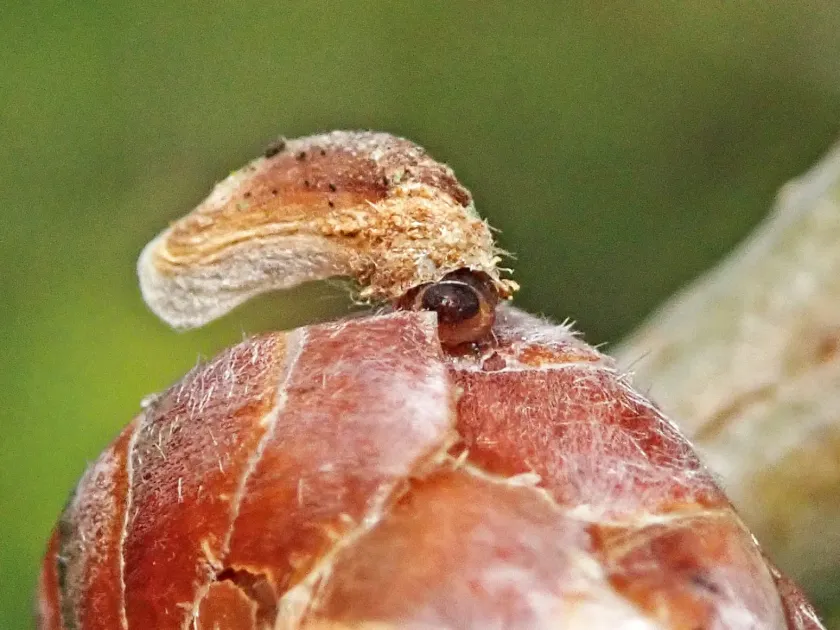
The larva is the most distinctive stage, characterized by the construction of a portable case. This case, typically curved or cylindrical, is crafted from bits of leaf tissue and silk, which provides excellent camouflage against the foliage and twigs.
Eggs are minute and yellowish-orange, usually deposited singly on the underside of leaves or near the veins. This placement hides them from the view of many potential predators and mimics the color of the developing buds.
Pupation occurs within the same larval case. Before transforming, the caterpillar secures its case to a twig or bark, choosing a location that offers physical protection and matches the texture of the host tree's surface.
As nocturnal creatures, the adults are rarely seen during the day. They remain inactive on tree trunks, where their cryptic coloration makes them almost impossible to spot, ensuring survival throughout their short adult life.
What it damages
The oak casebearer primarily targets various species of the Quercus genus, with a strong preference for the pedunculate oak. In outbreak conditions, it may also spread to other hardwood species located in the immediate vicinity.
The caterpillars are leaf miners in their early stages. They create small holes by consuming the internal tissue of the leaf, which eventually leads to the tissue drying out and falling away, leaving characteristic small holes.
Heavy infestations lead to significant defoliation of the canopy. This reduces the tree's photosynthetic capacity, causing long-term stress and increasing the tree's vulnerability to secondary pests, such as wood-boring beetles or fungal pathogens.
Continuous damage over multiple growing seasons can severely stunt the growth of young trees. The loss of foliage disrupts the tree's ability to store necessary carbohydrates in the roots, impacting winter survival.
In forest nurseries and urban plantings, the damage is particularly concerning as it can lead to aesthetic degradation and significantly weakened saplings that may fail to reach maturity if left untreated.
When it appears
Adult moths typically emerge in early summer, generally during June. This is the peak time for mating and oviposition, as the females search for fresh foliage on which to lay their eggs.
Larvae are active throughout the summer months, feeding on the leaves. During this time, they gradually enlarge their cases to accommodate their growing body size, moving across the foliage as they feed.
The larvae overwinter in their cases, firmly attached to twigs or tree bark. This strategy allows them to remain in a state of diapause through the winter months and resume feeding as soon as the buds begin to burst in spring.
The most intense feeding period occurs in early spring, as the caterpillars emerge from their dormant state to consume the succulent, newly formed oak buds and leaves, causing the most visible damage.
The insect follows a univoltine cycle (one generation per year). This cycle is strictly synchronized with the phenology of the oak tree, which is a major factor in the population stability of the casebearer.
Signs of infestation
The first signs of infestation are tiny, light-colored translucent spots on leaves where the larvae have initiated mining. These spots later dry up and drop out, resulting in a "shot-hole" appearance on the foliage.
The presence of small, moving "debris" on the underside of leaves or twigs is a definitive indicator. These are not debris, but the protective cases of the larvae, which can be seen shifting position as the insect feeds.
Premature leaf drop and a sparse, thinning canopy are common signs in mid-summer. If the trees appear prematurely ragged or damaged, a close inspection of the leaves is warranted.
Fine silk threads used by the caterpillars to move between leaves or secure their cases to branches may also be visible, signaling a heavy presence of the pest within the canopy.
- Characteristic "shot-hole" damage on oak leaves.
- Small, mobile cases attached to leaves and twigs.
- Premature yellowing and shedding of leaves.
- Reduced annual growth and tree vigor.
- Visible silk strands on twigs and leaf undersides.
Control measures
Mechanical control involves the removal and destruction of fallen leaves and debris around the base of trees in autumn, which helps eliminate a significant portion of the overwintering population.
Biological control, using specialized bacteria like Bacillus thuringiensis, is the preferred method for managing infestations in sensitive areas such as public parks and forest nurseries.
Chemical intervention should be reserved for severe outbreak years. Spraying should be timed carefully with the bud-burst stage to maximize the impact on the caterpillars before they can cause extensive foliage damage.
Enhancing habitat for natural predators, such as insectivorous birds, is highly effective. Many bird species feed on the larvae during the spring, keeping the population levels naturally balanced.
Monitoring is crucial throughout the spring and early summer. Early detection of larval cases allows for localized management, preventing the need for broad-spectrum insecticide applications later in the season.
Taxonomy
- Latin name
- Coleophora lutipennella
- Order
- Lepidoptera (butterflies)
- Family
- Coleophoridae
- EPPO code
- COLELU
Discussion
No discussions yet — be the first.