
Larch casebearer
Coleophora laricella
Description
How to identify
The larch casebearer (Coleophora laricella) is a small moth belonging to the family Coleophoridae, known for its distinct larval case-making behavior.
The adult moth has a wingspan of approximately 10 mm, characterized by narrow, fringed wings with a brownish or grayish coloration.
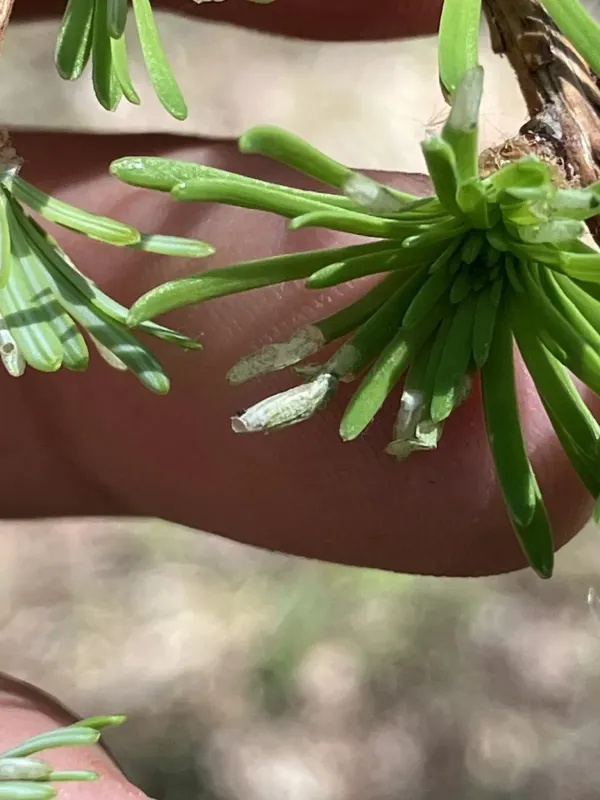
Larvae are the damaging stage, recognizable by the small, cigar-shaped cases they construct from hollowed-out needle segments.
The larvae live, feed, and pupate within these protective cases, which they attach to twigs or needles during hibernation and development.
This species is specifically adapted to feed on larch trees (Larix spp.), making it a significant pest in both natural forests and plantations.
What it damages
Damage is caused by larvae mining the needles of larch trees, which results in the needles becoming hollowed out, white, or straw-colored.
Heavy infestations lead to widespread defoliation, giving the trees a scorched appearance, which significantly weakens their overall health.
Reduced photosynthetic capacity from needle loss affects the tree's growth rate and may lead to branch dieback in severe cases.
Repeated defoliation cycles can make the trees highly susceptible to secondary pests like bark beetles, leading to tree mortality.
In ornamental or nursery settings, the aesthetic value of the trees is severely compromised, rendering them unsuitable for landscaping purposes.
When it appears
Adult moths typically emerge in early summer, from late May to June, to mate and lay eggs on the surface of the larch needles.
Larvae hatch in mid-to-late summer, mine the needles to create their cases, and feed until autumn before seeking hibernation sites.
Overwintering occurs as larvae in their protective cases, securely attached to the twigs or near the bud scales of the host tree.
In spring, as larch buds begin to swell, the larvae resume feeding, creating characteristic needle mining damage that is most visible during this period.
Pupation takes place within the cases in late spring, marking the final stage before the adult moths emerge to restart the cycle.
Signs of infestation
The most prominent sign is the presence of pale, hollowed-out needles that stick out from the foliage, indicating larval mining activity.
Small, curved, brownish cases, about 3-5 mm in length, attached to needles or twigs, confirm the presence of the larch casebearer.
A widespread yellowish or rusty-brown discoloration of the larch foliage in late spring is a clear indicator of a severe infestation level.
Frass (larval waste) appearing as tiny, dark granules on the ground or understory beneath the canopy is a sign of high larval density.
Defoliation occurring earlier than the tree's normal needle drop cycle suggests significant stress from the moth population.
Control measures
Systemic insecticides applied during the early spring, as larvae resume feeding, are the most effective chemical method of control.
Biological control, including the release of specific parasitoid wasps that target the larvae, can significantly suppress population growth.
Maintaining tree vigor through proper irrigation and soil management helps the larch to better withstand the stress of defoliation.
In small landscapes, hand-picking and destroying infested branches during the dormant season can help manage localized populations.
- Spring application of systemic insecticides.
- Use of natural parasitoids and predators.
- Monitoring with pheromone traps.
Taxonomy
- Latin name
- Coleophora laricella
- Order
- Lepidoptera (butterflies)
- Family
- Coleophoridae
- EPPO code
- COLELA
Discussion
No discussions yet — be the first.