
Oak casebearer
Coleophora kuehnella
Description
How to identify
The oak casebearer (Coleophora kuehnella) belongs to the order Lepidoptera, family Coleophoridae. It is a small moth known for the unique larval behavior of constructing a portable case.
Adult moths are small with narrow wings fringed with long scales. Their wingspan ranges from 10 to 12 mm, with a coloration that is typically shades of greyish-brown or ochre.
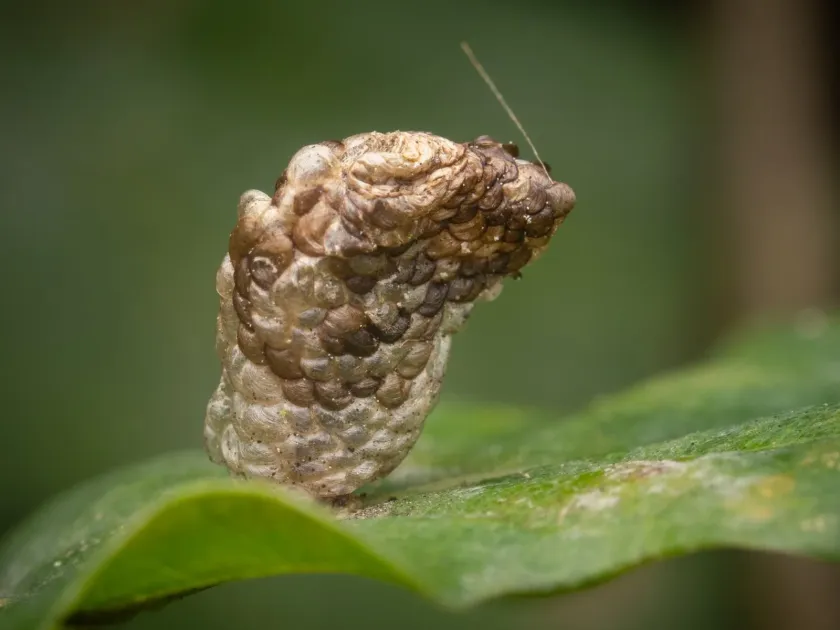
The most distinctive feature of this species is the larval case. The larva constructs a curved, tube-like protective structure that it carries throughout its larval stage, feeding from within it.
The life cycle involves complete metamorphosis, typically with one generation per year. Development is closely synchronized with the phenology of host trees, primarily oaks.
Larvae overwinter in their cases, firmly attached to twigs or bark crevices. This overwintering strategy allows the species to survive harsh winter conditions until spring growth begins.
What it damages
The primary host plants for the oak casebearer are various oak species, including the common oak. In cases of outbreaks, they may infest other deciduous trees nearby.
Larvae cause damage by feeding on young buds and expanding leaves. They graze on the leaf parenchyma, leaving the epidermis and veins intact, which creates characteristic holes.
The primary damage results in leaf loss and reduced photosynthetic capacity of the tree. Chronic infestation leads to decreased tree vigor and can weaken the tree significantly.
Heavily infested trees become susceptible to secondary pests, such as wood-boring insects, and various pathogens that can cause further deterioration of the timber quality.
In forestry and landscape management, this moth is viewed as a biotic stressor that, if left uncontrolled, can compromise the long-term health of oak ecosystems.
When it appears
Adult moths are typically active during late spring and early summer. This is when mating and egg-laying occur, marking the start of the new generation's life cycle.
Larval activity begins in early spring, coinciding with bud burst. This is the period of intense feeding and rapid development for the young caterpillars.
Pupation occurs inside the protective case, which is firmly secured to a leaf or twig, typically taking place in late spring or early summer.
The life cycle is tightly regulated by seasonal temperature changes, which trigger the transition between developmental stages for the next generation.
As summer draws to a close, young larvae move to the woody parts of the tree to prepare for overwintering, finding sheltered spots to withstand the cold.
Signs of infestation
Small, neat holes in the leaf surface are the primary symptom of damage. These holes look like small windows because the larvae consume only internal tissue.
The presence of small, curved, brown or grey cases on the undersides of leaves or on twigs is the most reliable way to confirm an infestation.
Affected foliage may appear discolored, with yellowing or browning occurring around the areas where the larvae have fed, leading to premature leaf fall.
A heavy infestation is often indicated by an unusual amount of leaf drop in the spring, which is disproportionate to other environmental stress factors.
Traces of attachment on the bark, appearing as tiny, hardened spots where cases were previously anchored, can indicate previous years of activity.
Control measures
Monitoring using pheromone traps is highly effective for detecting the presence of adults and determining the timing of control actions to prevent outbreaks.
Chemical control involving systemic or contact insecticides is recommended during the bud burst stage, when larvae are most vulnerable to treatment.
Biological control methods, including the use of bacterial-based insecticides, provide a targeted and environmentally friendly approach to reducing pest populations.
Promoting a healthy environment for natural predators, such as insectivorous birds and parasitic wasps, can help keep the casebearer population under natural control.
Sanitary management, including the removal of heavily infested branches during the dormant season, can significantly reduce the overwintering population of the pest.
Taxonomy
- Latin name
- Coleophora kuehnella
- Order
- Lepidoptera (butterflies)
- Family
- Coleophoridae
- EPPO code
- COLEKU
Discussion
No discussions yet — be the first.