
Clover casebearer
Coleophora frischella
Description
How to identify
The clover casebearer (Coleophora frischella) is a small moth belonging to the Coleophoridae family. It is a specialized pest primarily affecting various species of clover grown for seed production.
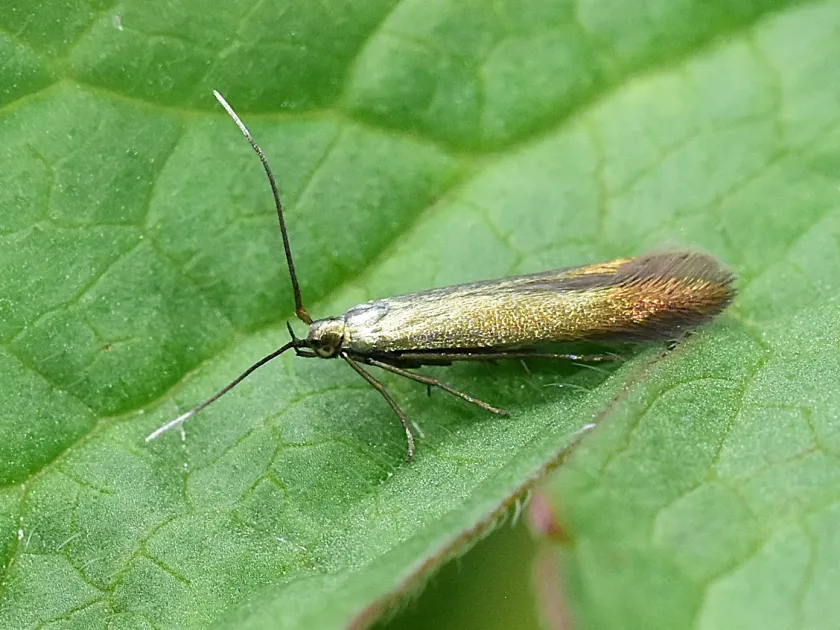
Adult moths are small, with a wingspan of approximately 10–12 mm, featuring narrow, bronze-brown wings. The common name comes from the characteristic cases that the larvae construct.
The life cycle involves complete metamorphosis. Larvae typically overwinter in their protective cases on plant debris or in the upper soil layers, resuming activity in early spring.
After pupation, adult moths emerge, usually during the clover flowering season. They lay eggs directly on the host plant, allowing larvae to access food sources immediately upon hatching.
These pests are cryptic in nature. The larvae spend most of their existence hidden within cases that mimic plant parts, making visual detection in the field quite challenging for farmers.
What it damages
The damage is caused by larvae feeding on the developing ovaries and seeds inside the clover flower heads. This feeding behavior directly reduces the yield of seed crops.
By consuming the reproductive organs, the larvae prevent seed set. In heavy infestations, a significant percentage of the clover seed crop can be entirely destroyed.
Secondary damage occurs as the wounded flower heads become prone to mold and bacterial rot, which further compromises the quality and viability of the harvested seeds.
The economic impact is particularly severe on fields dedicated to clover seed production, where even a moderate population density can result in significant financial losses.
Because the larvae feed inside the flower heads, they are shielded from environmental exposure and many generalist predators, allowing them to cause sustained damage.
Signs of infestation
The most reliable sign of an infestation is the presence of small, elongated larval cases attached to the clover flower heads, often oriented vertically along the florets.
Visual inspection may reveal deformed or prematurely wilting flower heads. Inside the florets, one may find larval frass (excrement) and tunnels indicating where the larvae have fed.
Affected clover heads may show scattered holes where the larvae bored through the petals to reach the developing seeds, causing individual florets to fail to produce pods.
During the peak of the season, adult moth activity can be observed in the evenings. The moths fly low over the crop, which is a key indicator to begin intensive scouting.
A uneven appearance in the clover canopy, with localized patches of discolored or underdeveloped flowers, often points to a concentration of larvae in those specific areas.
Control measures
Spatial isolation is the primary preventive measure. Maintaining a sufficient distance between new seed crops and older, infested fields significantly reduces the migration of the pest.
Early mowing of the clover crop for hay is an effective cultural control method, as it disrupts the larval development cycle before they can complete their feeding and pupation.
Chemical control must be timed precisely. Applications are most effective during the early larval stage or the moth flight period, before the larvae construct their protective cases.
Biological control options, such as using Bacillus thuringiensis, offer a targeted approach that protects natural enemies and pollinators while suppressing the pest population.
Regular monitoring using pheromone traps is essential for informed decision-making. This practice helps determine the exact timing for intervention, reducing the need for broad-spectrum insecticide use.
Taxonomy
- Latin name
- Coleophora frischella
- Order
- Lepidoptera (butterflies)
- Family
- Coleophoridae
- EPPO code
- COLEAL
Discussion
No discussions yet — be the first.