
White Italian snail
Cochlicella acuta
Description
How to identify
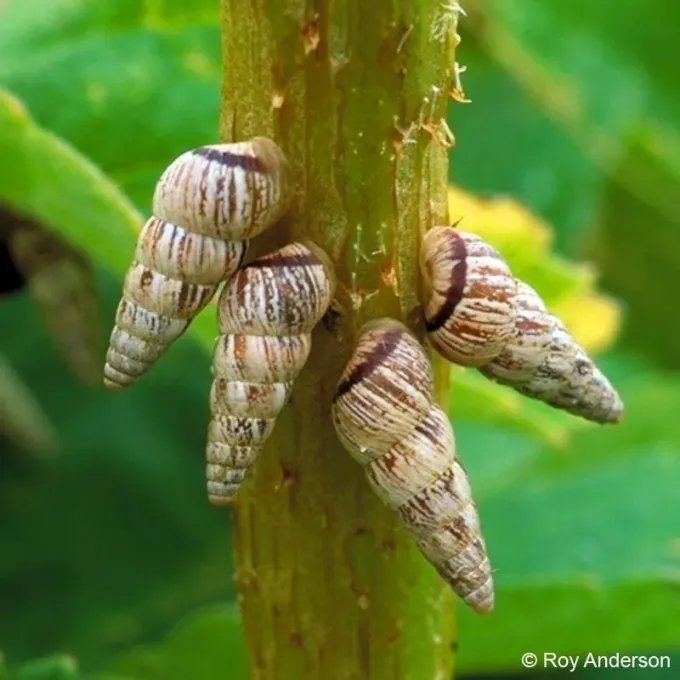
The White Italian snail (Cochlicella acuta) is a terrestrial gastropod mollusk belonging to the family Geomitridae, recognized by its tall, conical shell.
The shell features a pointed apex and is typically pale in color, often marked with distinct brown spiral bands or spots that provide camouflage.
Adult specimens generally reach a height of 8 to 16 mm, with a body that ranges from light gray to tan, blending well with desiccated vegetation.
This species is highly adaptable, favoring open landscapes, coastal areas, and regions with sandy soils where it can easily move and hide.
As a member of the order Stylommatophora, it shares common biological characteristics with other land snails that are known to invade and damage crops.
What it damages
The White Italian snail is a significant polyphagous pest, causing damage to cereals, legumes, pastures, and various horticultural crops.
The most severe economic impact occurs during harvest, as snails climb onto plants, leading to contamination of the harvested grain with mucus and shell fragments.
In terms of crop health, they feed on young leaves and succulent shoots, which stunts plant growth and reduces the overall yield potential of the crop.
High population densities can lead to significant seedling loss, causing patchy or thin stands in fields that were otherwise healthy and well-sown.
Feeding activity often causes superficial damage that makes the plant more susceptible to secondary fungal infections and environmental stress.
When it appears
Their activity is strictly seasonal, peaking during cool, moist months when they emerge from aestivation to feed and reproduce.
Breeding typically takes place in autumn and winter, with eggs deposited in moist soil, sheltered by plant debris or beneath the surface of the ground.
During the dry summer months, they enter a state of dormancy (aestivation) to prevent water loss, often clustering in large numbers on upright structures.
Spring growth is a critical period for snail activity, as young snails begin feeding aggressively to accumulate mass for their upcoming development.
Survival and reproduction are highly dependent on rainfall, making years with high spring or autumn precipitation particularly risky for crop damage.
Signs of infestation
Visual identification is often straightforward due to their tendency to aggregate on stalks, fence posts, and other elevated points during the day.
Irregular feeding marks on the foliage and the presence of dried, silvery mucus trails on leaves are clear indicators of a snail infestation.
A high number of conical shells found at the base of plants or on the soil surface in the morning is a definitive sign of an active snail population.
Contamination observed during harvesting operations confirms that the pest population has reached a level requiring immediate agricultural intervention.
Observations of predators, such as birds or beetles foraging on the ground, can sometimes point to high concentrations of snails in specific field areas.
Control measures
Deep tillage is a primary control method, as it disrupts egg-laying sites and buries snails, causing high mortality rates through mechanical disturbance.
Vegetation management along field margins and fences is crucial to remove summer refuges where snails aestivate and wait for cooler weather.
Molluscicides, particularly those formulated with iron phosphate, offer an effective and more environmentally sustainable way to reduce high populations.
Strategic crop rotation and the timing of sowing can help reduce the overlap between the most vulnerable plant stages and peak snail activity.
Encouraging biological control through the protection of natural predators, such as carabid beetles and certain bird species, can significantly mitigate outbreaks.
Taxonomy
- Latin name
- Cochlicella acuta
- Order
- Molluscs
- Family
- Hygromiidae
- EPPO code
- COCEAC
Discussion
No discussions yet — be the first.