
Clytoleptus albofasciatus
Clytoleptus albofasciatus
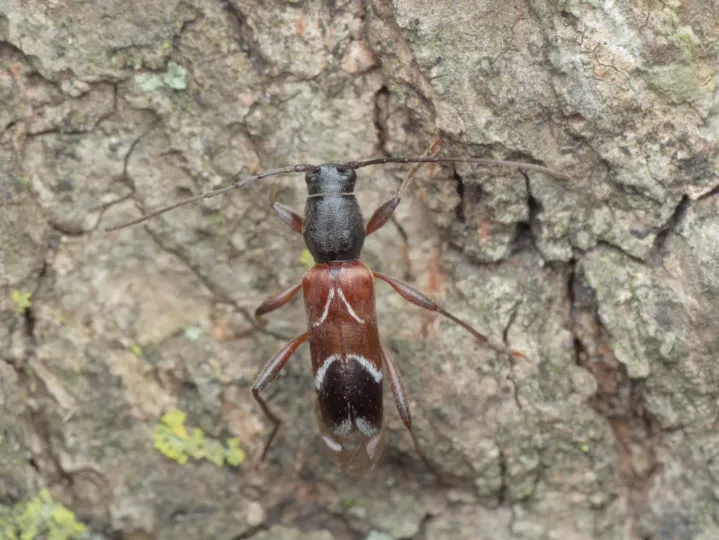
Description
How to identify
Clytoleptus albofasciatus is a species of longhorn beetle within the Cerambycidae family, typically recognized by its small body size ranging from 7 to 12 millimeters.
The beetle features a dark brown to black coloration with distinct light-colored transverse bands across its elytra, providing camouflage against bark.
Like other members of the Cerambycinae subfamily, this insect possesses relatively long, agile antennae that are essential for environmental navigation.
The larvae are legless, ivory-colored, and equipped with strong, specialized mandibles that allow them to tunnel through dense wood tissues efficiently.
Adult beetles are most active during daylight hours, commonly seen moving across the surface of host plants in search of suitable egg-laying sites.
What it damages
The primary damage is inflicted by the larvae, which burrow into the wood of weakened, diseased, or recently felled plant tissues to feed.
Grapevines are particularly susceptible, as the larvae mine into the canes and woody parts, disrupting the flow of water and essential nutrients.
In addition to vines, this pest can inhabit various deciduous trees, leading to structural weaknesses and promoting the entry of secondary fungal pathogens.
The tunneling activity creates extensive galleries that compromise the integrity of the plant, often resulting in premature dieback of branches or entire limbs.
While healthy plants are rarely severely impacted, stressed or neglected vegetation often suffers significant physiological decline due to larval feeding.
When it appears
The adult flight period for Clytoleptus albofasciatus generally occurs during the late spring and summer months when ambient temperatures facilitate breeding.
Females search for cracks, wounds, or rough patches on the bark to deposit their eggs, ensuring the larvae have immediate access to the internal wood.
The life cycle is largely dependent on the host plant's condition, with larvae spending the majority of their development protected inside the woody tissue.
Overwintering occurs at the larval stage within the wood galleries, which provides a thermal buffer against harsh environmental conditions during the dormant season.
Pupation takes place inside the wood, and upon emergence, the adults chew small, precise exit holes to move to the surface for reproduction.
Signs of infestation
A definitive sign of an infestation is the presence of small, circular exit holes on the bark of infected branches or trunks, indicating recent emergence.
Accumulated frass, or fine wood shavings, visible near the base of the plant or around crevices, indicates active larval feeding deep within the structure.
Sudden wilting or chlorosis of foliage on specific branches often points to internal damage that has blocked the vascular system of the grapevine or tree.
When the bark is carefully peeled away in affected areas, complex and winding galleries become visible, confirming the presence of the wood-boring pests.
Increased fragility of the woody plant parts, which may snap easily under slight mechanical pressure, is a clear indicator of long-term structural damage.
Control measures
Effective management begins with maintaining high vigor in the vineyard or orchard through proper fertilization, irrigation, and corrective pruning techniques.
Strict sanitation protocols must be followed: all infested, dead, or dying wood must be removed and destroyed by burning to prevent adult beetle spread.
It is crucial to eliminate brush piles near growing sites, as these act as breeding reservoirs that can significantly boost local populations of the beetle.
While biological and chemical controls exist, they are best utilized as part of an integrated program focusing primarily on early detection and prevention.
- Rigorous sanitation by removing infested wood.
- Monitoring for adult beetle activity in spring.
- Maintaining optimal tree and vine health.
- Prompt removal of storm-damaged or dead limbs.
Taxonomy
- Latin name
- Clytoleptus albofasciatus
- Order
- Coleoptera (beetles)
- Family
- Cerambycidae
- EPPO code
- CLYTAL
Discussion
No discussions yet — be the first.