
Two-winged mayfly
Cloeon dipterum
Description
How to identify
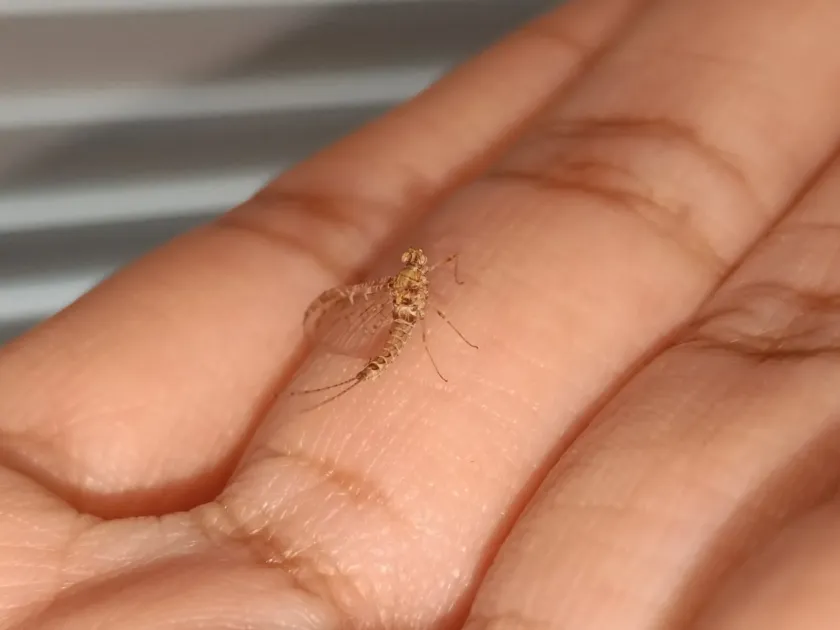
The two-winged mayfly (Cloeon dipterum) is a species of mayfly belonging to the family Baetidae. It is uniquely characterized by the presence of only two wings in the adult stage, unlike other mayflies that possess four.
The adults are delicate insects with translucent wings, distinct veining, and long, slender tail filaments. They typically exhibit a protective coloration that helps them blend into their natural riparian habitats.
The nymphs (larvae) are strictly aquatic and possess elongated bodies with lateral gills for efficient underwater respiration. They are highly active swimmers, moving through the water using their caudal filaments.
This species is well-known for its viviparous nature, where females release already hatched nymphs into the water. This adaptation allows the species to survive in temporary ponds that might otherwise dry up too quickly.
They are widely distributed across Europe and parts of Asia, frequently found in ponds, lakes, and slowly moving streams where aquatic vegetation is abundant.
What it damages
The two-winged mayfly is not an agricultural pest. Adult mayflies do not feed because they lack functional mouthparts, meaning they cause zero damage to crops, vegetables, or ornamental plants.
The nymphs feed primarily on algae, detritus, and decaying organic matter found in the water. They have no interest in plant tissues or agricultural produce and do not damage terrestrial crops.
There is no economic impact associated with Cloeon dipterum in farming or gardening. Their presence is generally a sign of a healthy aquatic ecosystem rather than a biological threat.
Farmers should not view this insect as an adversary. It plays a neutral role in the vicinity of agricultural land, contributing to the aquatic food web without causing any agricultural losses.
Categorizing this species as a pest is scientifically inaccurate. It remains a harmless and fascinating part of the local biodiversity, posing no risk to crop production.
When it appears
The active flight season for adults typically spans from late spring through early autumn. Depending on the climate, multiple generations can emerge during a single growing season.
Larval growth is highly dependent on water temperature. In warmer months, nymphs develop quickly, leading to large emergence events during the summer season.
As autumn approaches, the development cycle slows down. Many larvae will spend the winter months in the sediment at the bottom of ponds, emerging when temperatures rise again in the spring.
Adult swarming usually occurs during the evening hours. During these times, large numbers of mayflies can be seen dancing above the water surface to facilitate mating.
The adult lifespan is extremely short, lasting only a few days at most. After mating and reproduction, the adults perish, completing their life cycle within a very tight timeframe.
Control measures
No control measures are needed for the two-winged mayfly, as it does not interfere with crop development or agricultural productivity in any way.
The application of chemical pesticides near water bodies is discouraged as it poses a significant risk to the environment and non-target organisms, including beneficial insects.
If adult mayflies become a nuisance near farm buildings during the night, the most effective management tool is to reduce or shield artificial lighting, which attracts these insects.
Maintaining a balanced aquatic environment is the best practice. By preserving natural pond ecosystems, you support the natural predators and balance that keeps insect populations in check.
Overall, Cloeon dipterum should be respected as a harmless component of the ecosystem, requiring no intervention or management by the agricultural community.
Taxonomy
- Latin name
- Cloeon dipterum
- Family
- Baetidae
- EPPO code
- CLOEDI
Discussion
No discussions yet — be the first.