
Mayfly
Baetis
Description
How to identify
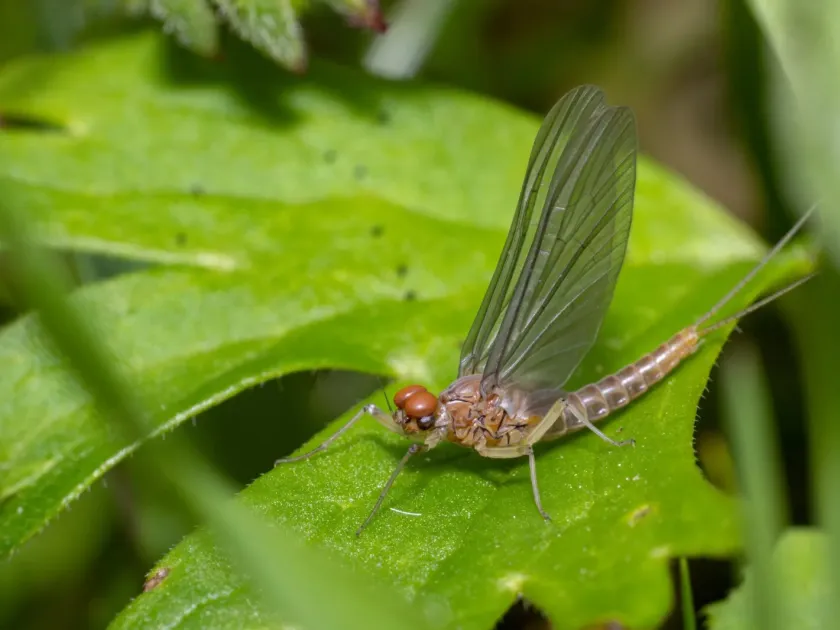
Mayflies of the genus Baetis belong to the order Ephemeroptera and the family Baetidae. They are small, delicate insects easily recognized by their upright, translucent wings.
A distinctive anatomical feature is the presence of two or three long, thread-like caudal filaments (cerci) extending from the end of the abdomen.
The larval stage, known as a naiad, lives underwater and possesses elongated bodies with external gills, allowing them to extract oxygen efficiently from stream water.
Adults do not feed as their mouthparts are non-functional, a strategy that directs all energy toward rapid reproduction within their very short lifespan.
Visually, they can be distinguished from other aquatic insects by their characteristic rhythmic, bobbing flight patterns during mating swarms.
What it damages
It is vital to clarify that Baetis mayflies are not pests of agricultural crops. They cause absolutely no damage to leaves, roots, or stems.
Their life cycle is strictly tied to freshwater environments, and they lack the physiological capacity to feed on terrestrial plant tissues.
On the contrary, they serve as a critical food source for fish and other aquatic wildlife, contributing to the biodiversity of the local ecosystem.
Since they do not impact crop health, they are not categorized as organisms of concern for farmers, agronomists, or orchard managers.
Their presence near fields should be viewed as a sign of environmental health rather than a cause for agricultural intervention.
When it appears
The swarming of adult mayflies typically occurs during the spring and summer months, often triggered by optimal temperature ranges and humidity.
The larval stage is aquatic and perennial, meaning they inhabit streams throughout the year, but the emergence as winged adults is seasonal.
Large swarms are common in late afternoon or early evening, which is when they are most frequently observed by farm workers near irrigation sources.
The specific timing of emergence is highly dependent on water quality, dissolved oxygen levels, and the overall stability of the aquatic environment.
Because their adult lifespan is fleeting—often lasting only a few hours to a couple of days—their visual impact is concentrated within short time windows.
Signs of infestation
The primary sign of their presence is the observation of large, synchronized swarms hovering over water bodies or damp soil near fields.
Finding discarded exoskeletons (exuviae) near irrigation ditches or rocky riverbeds is a natural sign of their metamorphosis from larvae to adults.
Unlike true pests, there are no characteristic bite marks, necrotic tissue, or wilting patterns on crops associated with mayfly activity.
If insects are observed in high numbers, they are attracted to the water, not the crops, and will dissipate once their brief mating cycle is complete.
The absence of crop damage despite the presence of many insects is the ultimate diagnostic feature confirming that Baetis is not a pest.
Control measures
No control measures are necessary for Baetis mayflies, as they pose no economic threat to agriculture and perform important ecological functions.
The use of insecticides is highly discouraged, as it would destroy beneficial aquatic fauna and potentially contaminate vital irrigation water.
Management should focus on maintaining the health of water resources, which naturally supports mayfly populations that keep aquatic systems balanced.
No agricultural practices or chemical regimes need adjustment in response to their presence, as they coexist peacefully with crop production.
Monitoring mayfly populations is recommended only as a biological indicator for environmental quality, rather than for pest management purposes.
Taxonomy
- Latin name
- Baetis
- Family
- Baetidae
- EPPO code
- BAETSP
Discussion
No discussions yet — be the first.