
Chain spotted carpet
Cingilia catenaria
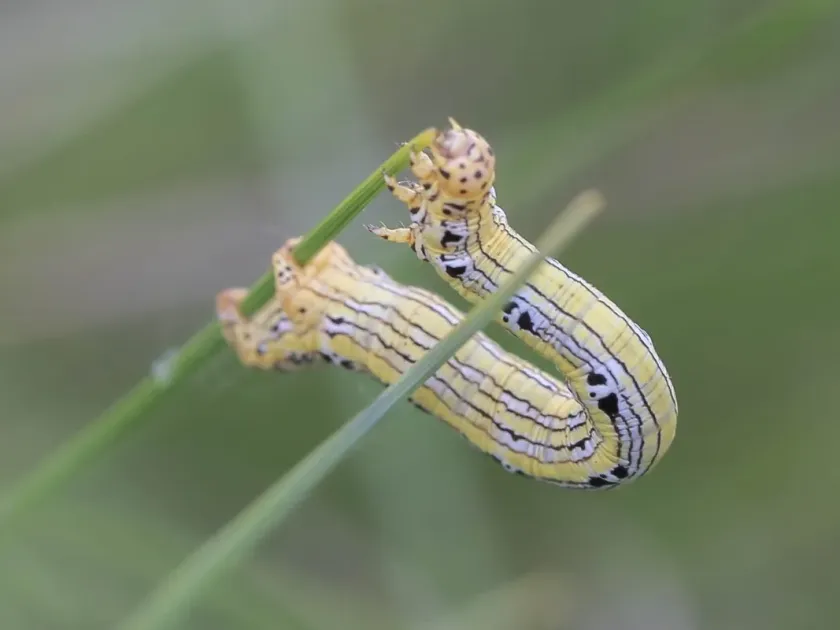
Description
How to identify
The Chain spotted carpet (Cingilia catenaria) belongs to the Geometridae family, order Lepidoptera. This moth species is recognized by its delicate appearance and specific wing patterns that mimic the environment.
Adult moths typically exhibit a wingspan of 30 to 40 mm. Their wings are off-white or yellowish with distinct dark brown or black dots forming curved, chain-like lines, which gives the species its common name.
The larvae, or caterpillars, have the typical looping movement of geometrids. Their coloration varies from pale yellow to brownish, providing excellent camouflage against twigs and foliage.
Pupation occurs within a loose, net-like cocoon. These cocoons are usually suspended among leaves or hidden in debris near the base of the host plant to provide protection during metamorphosis.
As a moth native to temperate regions, the species is well-adapted to fluctuating seasonal temperatures, which allows its population to persist across varied habitats from forests to cultivated orchards.
What it damages
Cingilia catenaria is a generalist herbivore, meaning it feeds on a wide range of plants. It is known to impact both wild forest vegetation and various cultivated ornamental and fruit-bearing shrubs.
Key host plants include members of the Rosaceae and Ericaceae families. In agricultural settings, it is particularly noted for causing damage to blueberry, cranberry, raspberry, and huckleberry bushes.
Beyond berry crops, the larvae are capable of feeding on the foliage of broad-leaved trees like willows and birches. High concentrations of caterpillars can cause significant defoliation, stressing the plants.
Larval feeding primarily targets the leaf tissue, leaving behind ragged edges or large holes. When populations reach outbreak levels, the structural integrity and growth potential of the shrubs can be severely compromised.
Young plants are particularly vulnerable, as repeated defoliation by these caterpillars hinders their ability to produce energy through photosynthesis, leading to reduced overall yield and vigor.
When it appears
This species is univoltine, meaning it completes only one life cycle per year. Adults are typically active during late summer, specifically appearing in August and September for mating.
The overwintering stage is the egg. These eggs are laid on the branches or leaves of host plants and remain in diapause throughout the winter, demonstrating high cold hardiness.
Larvae hatch in the spring, coinciding with the initial flush of new foliage. This timing ensures that the caterpillars have immediate access to the high-nutrient food source they need for rapid growth.
The feeding period spans from spring to early summer. During this time, the larvae progress through several instars, significantly increasing their body mass and feeding intensity as they grow.
By mid-summer, the larvae reach maturity and begin the process of pupation. This transition marks the conclusion of the active feeding phase before the emergence of the next generation of moths.
Signs of infestation
Early signs of infestation include the appearance of irregular, chewed areas on leaves, often concentrated in the upper canopy where young larvae first begin to feed.
Caterpillars can often be found by carefully inspecting the undersides of leaves or along stems, where they remain stationary and stretched out to mimic small twigs, making them difficult to spot.
The presence of fine silk webbing is a strong indicator of the larvae's presence. They use these threads to anchor themselves or to travel between foliage without falling.
Accumulation of frass (larval droppings) on the leaves or on the ground beneath the plant is a reliable sign that a significant colony of larvae is actively consuming the host plant.
Severe infestations manifest as visible thinning of the canopy and, in extreme cases, partial browning of the foliage followed by premature leaf drop due to the stress exerted by the pest.
Control measures
Cultural control involves maintaining healthy plant stands through proper pruning, which removes dead or infested wood and disrupts the habitat preferred by the larvae.
Biological control using microbial insecticides, such as products containing Bacillus thuringiensis, is highly effective against young larvae while preserving beneficial predatory insects.
For smaller garden areas, manual collection of caterpillars in the morning or evening hours provides a non-toxic way to reduce population pressure on sensitive ornamental plants.
Chemical intervention should be reserved as a last resort, using targeted, low-persistence insecticides that are specifically approved for use against Lepidopteran pests on fruit crops.
- Regular monitoring of fields using light traps to detect adult moth activity.
- Encouraging the presence of insectivorous birds that feed on larvae.
- Removing alternative host weeds from the vicinity of the main crop.
Taxonomy
- Latin name
- Cingilia catenaria
- Order
- Lepidoptera (butterflies)
- Family
- Geometridae
- EPPO code
- CINGCA
Discussion
No discussions yet — be the first.