
Barred Carpet
Cidaria fulvata
Description
How to identify
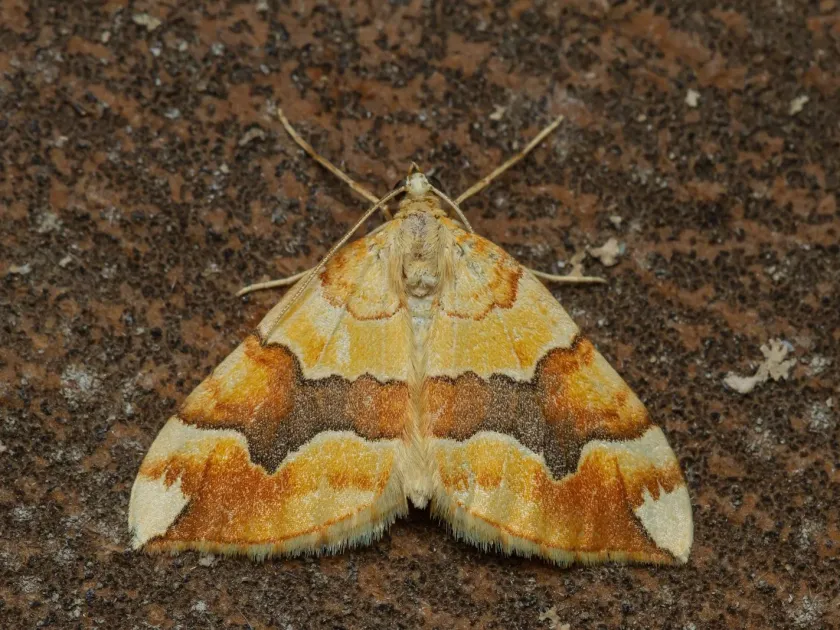
The Barred Carpet (Cidaria fulvata) is a moth of the Geometridae family. Adult moths have a wingspan of approximately 25–30 mm, displaying a distinct yellowish-brown coloration with a prominent dark central band.
The larvae, or caterpillars, are pale green with subtle yellowish lateral stripes. This coloration provides excellent camouflage against the foliage of their primary host plants, wild and domestic roses.
Pupation typically occurs within a loose cocoon made of spun leaves or debris. The pupa itself is dark brown, smooth, and measures about 10–12 mm, hidden securely on the host plant.
Eggs are minute, oval, and pale in color. They are laid singly or in small clusters on twigs or near buds, ensuring they are positioned perfectly for when the larvae hatch in spring.
As a nocturnal moth, the adult is rarely seen during the day, while the larvae are also masters of concealment, often feeding on the undersides of leaves or inside spun leaf shelters.
What it damages
The primary food source for the Barred Carpet larvae is the genus Rosa, including wild briar (dog rose) and many garden rose cultivars, making it a specialized pest.
Larvae consume the leaf blades, often leaving only the main veins behind. In cases of high infestation, this can lead to severe defoliation of the entire bush.
Beyond the leaves, caterpillars frequently bore into flower buds. By consuming the internal parts of the bud, they prevent the flower from opening, causing irreversible damage to the season's bloom.
Young nursery stock is particularly vulnerable. Extensive feeding on new shoots can stunt the plant's growth, leading to weak, malformed stems that struggle to develop properly.
Overall plant vigor is compromised, leaving the roses more susceptible to secondary issues, including fungal infections like rust or powdery mildew that capitalize on the stressed plant.
When it appears
The Barred Carpet typically completes one generation per year. The species overwinters in the egg stage, attached firmly to the bark of host plants, dormant throughout the cold winter months.
Larval emergence is perfectly synchronized with the budburst of roses in spring. This ensures that the caterpillars have immediate access to the most tender, nutrient-rich plant tissues.
The active feeding period for the larvae spans from May to June. As the weather warms, they grow rapidly, progressing through several instars before reaching maturity.
Pupation occurs in early summer, once the larvae have completed their development. The adult moths then emerge to fly, mate, and lay eggs during the mid-summer months.
The cycle concludes with the eggs remaining on the host plant until the following spring, demonstrating a highly effective strategy for surviving seasonal climate fluctuations.
Signs of infestation
Early signs of infestation include small, irregular holes in the developing spring leaves. As the larvae grow, these holes become larger, eventually consuming entire leaf sections.
Webbing between leaves is a classic indicator. The caterpillars spin silken threads to tie leaves together, creating a protected micro-environment where they feed undisturbed.
Frass (caterpillar droppings) visible on leaves or on the ground beneath the plant is a reliable signal of active feeding and a significant population density.
Flower buds that fail to open or appear twisted and hollowed out are tell-tale signs that larvae have moved on to consume the reproductive parts of the plant.
A sickly or sparse appearance of the rose bush, with noticeable skeletonized leaves, highlights a severe infestation that requires immediate horticultural attention.
Control measures
Manual removal of caterpillars is highly effective for small gardens. Simply check for leaf clusters tied together with webbing and remove them by hand to stop the infestation.
Horticultural hygiene is paramount; removing fallen leaves and pruning away heavily infested twigs in the fall can destroy overwintering eggs and pupae.
Biological control using Bacillus thuringiensis (Bt) sprays is an environmentally friendly option that specifically targets caterpillars while sparing beneficial insects and pollinators.
When necessary, chemical insecticides should be applied during the larval stage. Always choose products that are compatible with integrated pest management (IPM) practices to protect the garden ecosystem.
- Monitor rose bushes for larvae starting in late spring.
- Encourage local bird populations as natural predators.
- Apply seaweed extract or fertilizers to strengthen plant resistance.
Taxonomy
- Latin name
- Cidaria fulvata
- Order
- Lepidoptera (butterflies)
- Family
- Geometridae
- EPPO code
- CIDAFU
Discussion
No discussions yet — be the first.