
Steppe cicada
Cicadetta musiva
Description
How to identify
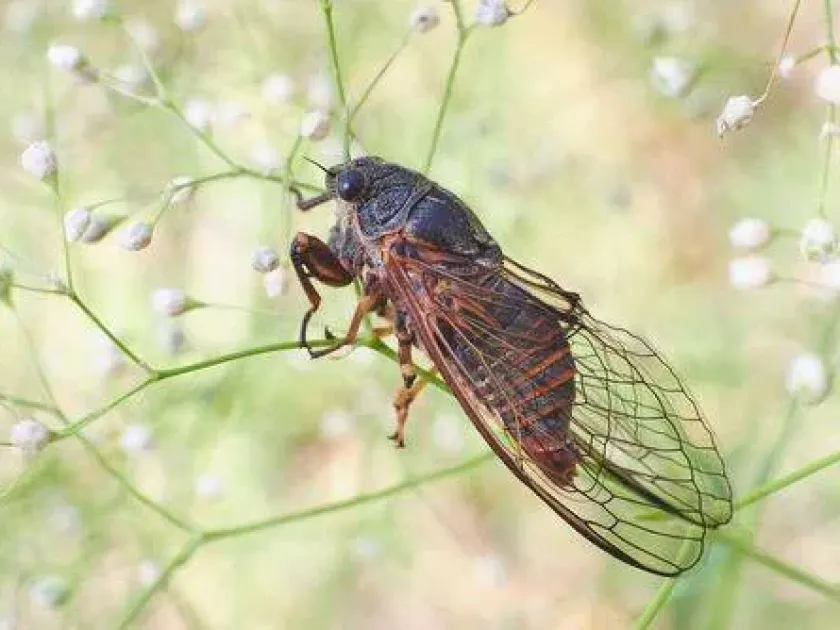
The Steppe cicada (Cicadetta musiva) belongs to the order Hemiptera and the family Cicadidae. Adult specimens have a robust body ranging from 18 to 25 mm in length, typically displaying a dark coloration often marked with yellowish or brownish spots.
The wings are transparent with a complex network of veins, which is a primary diagnostic feature for identifying the species. The head is large with prominent compound eyes and three simple ocelli located in the center.
Sexual dimorphism is evident in the abdomen structure: males possess a specialized sound-producing organ known as tymbals, allowing them to emit loud buzzing calls during the mating season.
Nymphs live a hidden, subterranean lifestyle, which makes their detection difficult. They possess powerful forelegs adapted for digging through dense soil and feeding on the sap of root systems.
The lifecycle of this species is multi-year, often taking several years to complete, which results in sporadic appearances of the pest in agricultural systems across different seasons.
What it damages
Both adults and nymphs cause damage, although the nature of the injury differs significantly depending on the stage of the lifecycle.
Adults damage the above-ground parts of herbaceous plants and young shrub shoots by piercing stems and leaves with their piercing-sucking mouthparts to feed on plant sap.
During outbreaks, cicadas can significantly weaken forage crops, including wheat, barley, and various cereals, as well as several perennial grass species.
Nymphs, which inhabit the soil, feed on root sap, leading to stunted growth, leaf yellowing, and in cases of high population density, the total collapse of the root system.
Beyond direct mechanical injury, the puncture wounds serve as entry points for phytopathogenic fungi and bacteria, leading to rot and viral diseases in the crops.
When it appears
Adult activity peaks during the summer months, specifically June and July, when stable, warm, and dry weather conditions are present.
Peak activity occurs during daylight hours when males actively attract females with loud buzzing sounds in steppe areas and fields with tall vegetation.
Oviposition occurs in the second half of summer, after which the adults die. Eggs hatch into nymphs that descend into the soil for feeding and further development.
Within the soil, nymphs undergo several molts, spending a significant portion of their lives underground, rendering their activity nearly invisible to agronomists during the growing season.
Adult emergence following the final molt typically happens in early to mid-summer, coinciding with the active growth phases of cereal crops.
Signs of infestation
One of the first signs of presence is the characteristic loud buzzing of males, which can be heard from dozens of meters away on hot days.
Upon close inspection of cereal plant stems, one can identify small puncture marks, often arranged in rows, indicating where the sap was extracted.
During mass infestations, the general state of the crops shows patchy yellowing and wilting that cannot be easily explained by water stress or nutrient deficiency.
Excavating the soil near damaged plants often reveals whitish or yellowish nymphs and discarded exuviae (cast-off skins) left behind after adult emergence.
Gradual thinning of the crop stand and the appearance of bare spots in the field are common indicators of underlying root system damage caused by the nymphs.
Control measures
Management strategies for this pest include a range of agrotechnical measures designed to create unfavorable conditions for nymph development in the soil.
Deep autumn plowing is an effective method that disrupts nymph tunnels, leading to mortality through mechanical damage and increased exposure to entomopathogens.
Implementing crop rotation, by excluding the most vulnerable crops for several years, helps reduce the available food supply for the nymphs and lowers the overall population.
The use of insecticides is only recommended during the periods of mass adult emergence; however, due to the subterranean nature of the nymphs, soil chemical treatments are often ineffective and economically costly.
- Maintain spatial isolation of fields from reservoir areas (unplowed steppe lands).
- Control weed growth along field margins where adults often congregate.
- Planting resilient crop varieties capable of rapid root system regeneration.
Taxonomy
- Latin name
- Cicadetta musiva
- Order
- Hemiptera (bugs, aphids, leafhoppers)
- Family
- Cicadidae
- EPPO code
- CCDTMU
Discussion
No discussions yet — be the first.