
Mountain cicada
Cicadetta montana
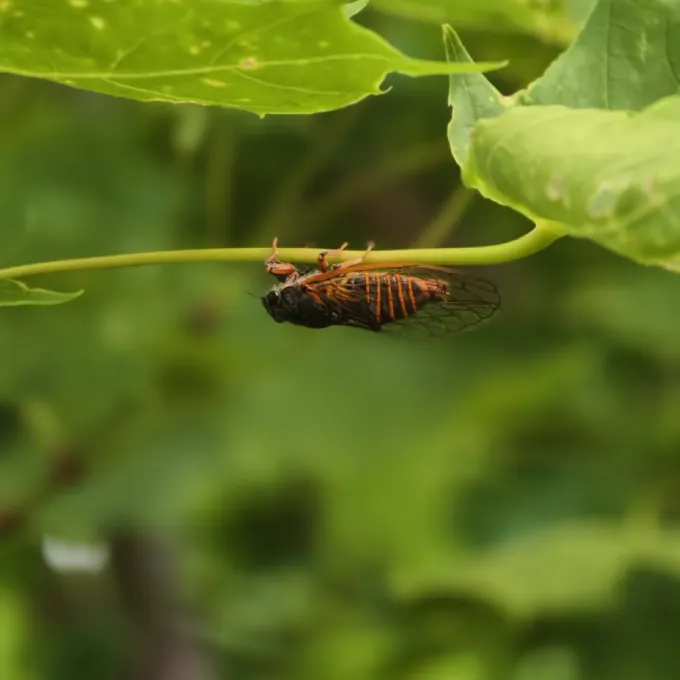
Description
How to identify
The mountain cicada (Cicadetta montana) is a small to medium-sized insect belonging to the family Cicadidae. It is characterized by its dark body, which typically measures around 20–25 mm in length, and its translucent wings with noticeable dark veins and patterns.
Unlike many other cicada species, this insect is well-adapted to cooler climates and is the only species of the family found in parts of Northern and Central Europe. Males are known for their distinct high-pitched song, produced by specialized organs called tymbals.
The lifecycle of the mountain cicada is notably long, often spanning several years. Most of this time is spent underground as a nymph, where the insect lives in the root zone, feeding on xylem sap from various host plants.
Adults emerge from the soil during late spring and early summer. Once they undergo their final molt, they spend their short adult life cycle focused on mating and egg-laying, which typically lasts only a few weeks.
They are strong fliers and are most active during warm, sunny days. Identifying them is usually done by their loud acoustic signaling or by finding their exuviae (cast-off skins) attached to the bark of trees after emergence.
What it damages
The primary damage is caused by the females during the egg-laying process. Using a sharp, saw-like ovipositor, the female slits the bark of young, succulent twigs to deposit her eggs, often weakening the branch significantly.
These wounds create structural weaknesses in the wood. Affected branches may wither, turn yellow, and eventually snap under the pressure of wind or fruit weight, resulting in direct yield loss for fruit growers.
Common hosts include fruit trees such as apple, pear, cherry, and plum, as well as various ornamental trees and shrubs. Young orchards are particularly susceptible to damage due to the smaller diameter of their branches.
The punctures in the bark serve as entry points for secondary infections, including fungal pathogens and bacteria. These infections can lead to localized cankers, which may cause long-term decline in the health and vitality of the tree.
While the nymphs feed underground on roots, they generally do not cause catastrophic damage unless the population density is extremely high, which can stress the tree and make it less resilient to other environmental factors.
When it appears
Adult mountain cicadas typically emerge from late May through July. Their appearance is highly dependent on temperature, as they require sufficient warmth to reach maturity and successfully reproduce.
The egg-laying period coincides with the most active growth phase of the trees, making the new growth particularly vulnerable. This creates a narrow but critical window for potential infestation in the orchard.
Nymphs hatch from the eggs within a few weeks and drop to the ground, where they immediately burrow into the soil. They will spend the next several years developing underground, moving through different nymphal stages.
By late summer, the activity of the adults ceases. The damage inflicted on the twigs often becomes clearly visible in late summer or autumn as the leaves on the affected branches wilt and turn brown.
Monitoring should be most intensive during June and early July. Identifying the specific acoustic signatures of the males is the most efficient way to confirm the presence of a population within a specific garden area.
Control measures
Managing the mountain cicada relies on a combination of cultural practices and targeted chemical interventions. Early detection is crucial to preventing long-term damage to fruit tree scaffolds.
- Pruning and removing infested branches to destroy eggs before nymphs emerge.
- Maintaining healthy soil conditions and potentially using soil cultivation to disrupt nymph development.
- Applying registered insecticides during the adult emergence phase to limit successful mating and oviposition.
- Using protective netting on young, vulnerable saplings to physically prevent access by females.
- Promoting a biodiverse garden environment to encourage natural predators, including birds and parasitic wasps.
For high-value crops, systemic insecticides may provide effective control against the subterranean nymph stage, though this should be managed carefully to avoid negative impacts on soil health.
Because the development cycle is multi-year, control measures must be applied consistently over several seasons. A single year of management is rarely sufficient to eliminate a well-established local population.
The most effective strategy involves integrating mechanical removal of damaged wood with chemical protection of the canopy during the peak flight season to minimize the next generation's success.
Taxonomy
- Latin name
- Cicadetta montana
- Order
- Hemiptera (bugs, aphids, leafhoppers)
- Family
- Cicadidae
- EPPO code
- CCDTMO
Discussion
No discussions yet — be the first.