
Chlosyne
Chlosyne
Description
How to identify
The genus Chlosyne belongs to the family Nymphalidae within the order Lepidoptera. Adult butterflies are characterized by their medium size and wings featuring an orange-brown pattern with intricate black lines and light spots.
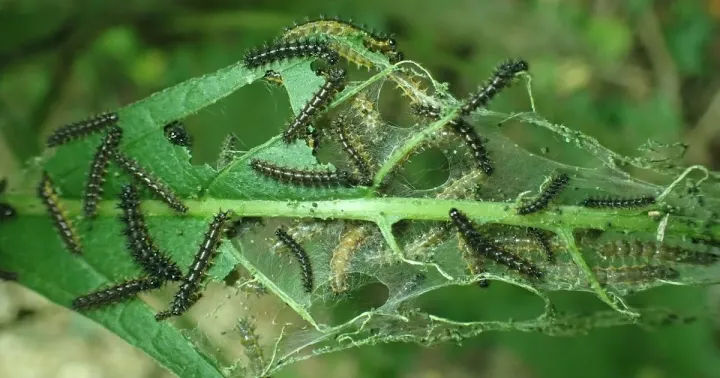
Larvae of these butterflies possess a distinct appearance, often covered in spikes or stiff bristles that serve as a defense mechanism against predators. Their coloration is usually dark, with contrasting stripes or spots, making them clearly visible on foliage.
Chlosyne undergoes a complete metamorphosis, including egg, larval, pupal, and adult stages. Females lay their eggs in clusters on the undersides of host plant leaves, ensuring the larvae have immediate access to food upon hatching.
Pupation typically occurs in protected sites, such as among plant debris, which allows the species to survive adverse environmental conditions. These butterflies are active during daylight hours, preferring sunlit areas of fields.
While the genus comprises numerous species, Chlosyne lacinia is recognized as a significant pest in specific regions where its host plants, particularly Asteraceae, are cultivated extensively.
What it damages
The primary crops affected by Chlosyne larvae are members of the Asteraceae family. Sunflowers are of particular interest to this pest, as they provide an ideal environment for rapid population growth.
The damage is caused primarily by the larvae, which are voracious eaters. Early instar larvae feed in groups, skeletonizing leaves, while later instars spread across the plant, consuming the leaf tissue entirely.
Mass infestations lead to significant defoliation of the crop. The loss of leaf surface area reduces photosynthetic capacity, which directly negatively impacts head development and seed filling in sunflowers.
In addition to sunflowers, various weed species such as ragweed (Ambrosia) often serve as primary reservoirs for the pest population within an agricultural ecosystem.
The severity of the damage depends on the crop growth stage. Infestations during the budding and early flowering phases are the most critical, as the plant requires maximum energy resources for high-quality yield formation.
Signs of infestation
The first sign of Chlosyne activity is the appearance of characteristic "windows" on the leaves left by young caterpillars. Leaves may appear lace-like because the larvae consume the soft tissue while leaving the veins intact.
The presence of frass (larval excrement) on the leaf surface and beneath the plants is a clear indicator of active larvae. This waste often accumulates in leaf axils, potentially promoting secondary infections.
In later stages, the pest may completely strip stems, leaving only skeletal leaf remnants. This leads to rapid wilting and drying of the plant, especially under drought conditions or high temperatures.
During the pupal phase, pupae can be found attached to stems or hidden within folded leaves. This serves as a warning that the current generation is completing development and a new flight of adults is imminent.
- Defoliation down to the central leaf veins.
- Loss of turgor pressure in damaged plants.
- Stunted growth and impaired sunflower head development.
- Mass grouping of larvae on the undersides of leaves.
Control measures
Agrotechnical control measures include rigorous weed management around field margins. Removing ragweed and other Asteraceae weeds deprives the pest of alternative food sources before the main crop emerges.
Biological control for Chlosyne involves the utilization of natural enemies, such as parasitic wasps and tachinid flies, which can effectively keep larval populations in check within natural environments.
Insecticide applications are recommended only when the economic injury threshold is exceeded. Products with stomach and contact activity are generally most effective when applied against early instar larvae.
Monitoring fields with pheromone traps allows for the timely detection of adult flight, enabling farmers to forecast larval emergence and plan precise control applications.
Crop rotation and optimized planting dates help reduce the risk of infestation, as more robust and well-developed plants are better able to withstand leaf damage without significant yield loss.
Taxonomy
- Latin name
- Chlosyne
- Order
- Lepidoptera (butterflies)
- Family
- Nymphalidae
- EPPO code
- CHLYSP
Discussion
No discussions yet — be the first.