
Chlorostrymon simaethis
Chlorostrymon simaethis
Description
How to identify
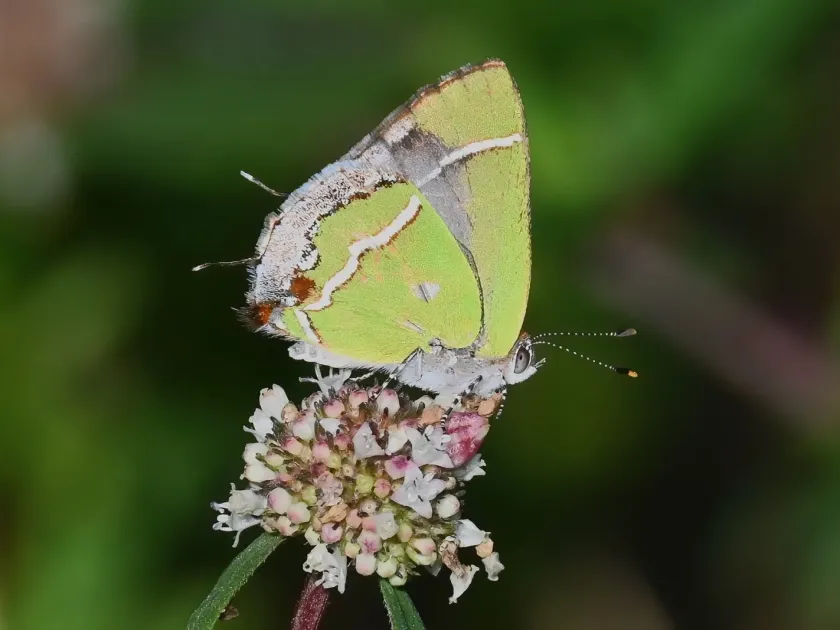
Chlorostrymon simaethis, commonly known as the silver-banded hairstreak, belongs to the order Lepidoptera and the family Lycaenidae. This butterfly is characterized by its distinct greenish-silver underwing patterns, which provide excellent camouflage.
Adults typically have a wingspan of approximately 20–25 mm. The upper side of the wings varies from dark brown to a deep violet-blue, often with a metallic sheen. They are primarily day-active insects that frequent areas with abundant floral resources.
The larvae are small, ranging in color from light green to brownish as they mature. This coloration allows them to blend in perfectly with the flower buds and pods of their host plants, making them difficult to detect during field inspections.
Pupation usually occurs on the plant itself or in nearby debris, secured by silk pads. The pupal stage is crucial for surviving environmental fluctuations, serving as a dormant state during unfavorable weather conditions.
The species exhibits high plasticity in its life cycle. Depending on the geographical region and ambient temperatures, it can produce multiple generations within a single growing season, leading to potential outbreaks.
What it damages
The primary damage is caused by the larval stage, which feeds exclusively on the reproductive structures of legume plants, such as beans (Phaseolus) and peas. They target buds, flowers, and developing pods.
Larvae bore into the interior of the pods, consuming the developing seeds. This feeding behavior causes significant deformation, reduced seed quality, and, in severe cases, the complete loss of the reproductive output of the plant.
Beyond cultivated legumes, the species utilizes various wild legumes as alternative hosts. This makes it challenging to eliminate the pest from agricultural landscapes, as it continuously re-infests nearby fields.
Feeding holes created by the caterpillars provide entry points for secondary pathogens, including fungi and bacteria. This often results in rot, further degrading the harvest and affecting the storage potential of the crop.
In high-density populations, the economic damage can be substantial. Producers may face significant yield reductions if the timing of the pest emergence coincides with the critical flowering and pod-setting stages of the crop.
When it appears
The seasonal activity of Chlorostrymon simaethis is highly correlated with the presence of floral resources and temperature. Adults emerge as temperatures rise, signaling the start of the primary infestation period.
Peak egg-laying activity coincides with the budding and flowering phase of the host plants. Females select high-quality sites on the plant to ensure that larvae have immediate access to nutrients upon hatching.
The duration of the life cycle from egg to adult is temperature-dependent. Under optimal tropical or subtropical conditions, development is rapid, allowing for the rapid expansion of the population throughout the growing season.
Wintering usually occurs in the pupal stage, nestled in soil or plant residues. This allows the species to persist through colder periods, ensuring its survival and readiness for the next spring season.
Farmers should monitor for adult butterflies starting shortly before the onset of flowering. Early detection is vital for implementing non-chemical or preventative measures before larvae begin to bore into pods.
Signs of infestation
Signs of infestation include visible entry holes on flower buds and immature pods. These are often accompanied by frass (larval excrement) clustered near the damaged sites.
Premature wilting and abscission of buds or flowers are strong indicators of internal feeding. If a flower bud appears to be "hollowed out" or distorted, it is highly likely that a caterpillar is feeding inside.
Fine silk webbing may be present, used by the larvae to secure floral parts or leaves together, creating a protected micro-environment. Detecting these structures is a reliable way to identify active infestations.
The presence of adult butterflies, particularly those with the characteristic silver-green wing undersides, is an immediate warning sign that oviposition (egg-laying) is likely occurring on the crop.
In advanced cases, patchy development and the discoloration of pods indicate established feeding. Observing these symptoms requires immediate field inspection to determine the current larval growth stage.
Control measures
Integrated pest management strategies should focus on cultural practices, such as crop rotation and the destruction of wild legume hosts surrounding the production site to minimize local population reservoirs.
Biological control, specifically the use of formulations containing Bacillus thuringiensis, is highly effective against young larvae while posing minimal risk to non-target pollinators and beneficial insects.
Chemical intervention is most effective when timed precisely with the period of larval emergence. Once the larvae have penetrated the pod tissue, they become protected from most contact insecticides.
Monitoring populations using pheromone or light traps allows for precise timing of interventions, reducing the frequency of chemical applications and promoting sustainable farming practices.
- Deep plowing to destroy pupal overwintering sites.
- Removal of weeds that serve as alternative hosts.
- Targeted use of biopesticides.
- Strategic timing of contact insecticide applications.
- Cleaning of harvest equipment to prevent spread.
Taxonomy
- Latin name
- Chlorostrymon simaethis
- Order
- Lepidoptera (butterflies)
- Family
- Lycaenidae
- EPPO code
- CHSTSI
Discussion
No discussions yet — be the first.