
Bruce spanworm
Cheimatobia bruceata
Description
How to identify
The Bruce spanworm (Operophtera bruceata) belongs to the Geometridae family, known for the unique movement of its larvae. This moth species exhibits extreme sexual dimorphism, which is a critical feature for identification.
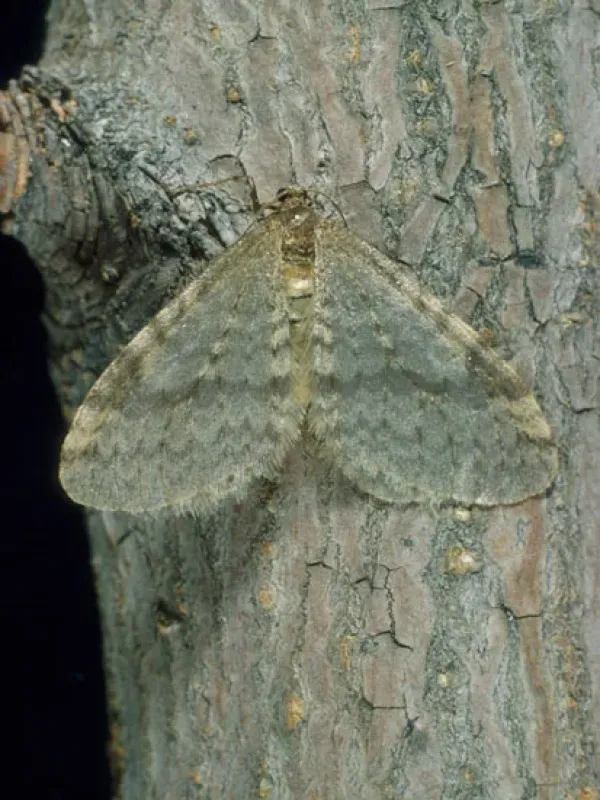
Male moths have fully developed wings with a span of 30-35 mm, displaying light brown or grayish patterns. In contrast, females are flightless, possessing only vestigial wing pads, which limits their mobility to crawling up the tree trunk.
The larvae, or caterpillars, are typically lime-green with longitudinal white stripes. They move with a looping motion, characteristic of all spanworms, due to the reduced number of prolegs on their abdomen.
This species is well-adapted to cold climates. Eggs serve as the overwintering stage, laid securely on the bark or near buds, which allows the species to survive harsh winter conditions.
Adult moths emerge in late autumn, often when temperatures are near freezing. This late-season activity is a hallmark of the species, distinguishing it from many other common defoliators.
What it damages
Bruce spanworms feed on a wide variety of deciduous trees, with a strong preference for Rosaceae family members, including apple, pear, cherry, and plum trees, as well as oaks and maples.
The primary damage occurs in early spring when larvae emerge from eggs. They immediately begin feeding on swelling buds, often destroying them before they can even break, which directly impacts the fruit-bearing potential.
As the leaves develop, caterpillars continue to feed, skeletonizing the leaf blades. In cases of high infestation, they can consume the entire leaf, leaving only the primary veins behind.
Heavy defoliation significantly weakens the tree, reducing its ability to photosynthesize. This stress often leads to a decrease in fruit quality and can affect the plant's health over several growing seasons.
Young trees are particularly susceptible to severe damage, as early spring defoliation can stunt their growth and make them more vulnerable to secondary pests and various diseases.
When it appears
The Bruce spanworm follows an univoltine life cycle. Adults emerge in late autumn, typically after the first significant frosts, to mate and deposit eggs on the host trees.
These eggs undergo a long diapause during the winter months. They are located on the branches, waiting for the physiological signals of spring to begin their development.
Hatching occurs early in the spring, perfectly synchronized with the bud-break phase of host trees. This ensures that larvae have immediate access to high-quality food sources.
Larval development typically lasts about 4 to 6 weeks. Once mature, caterpillars drop to the ground and burrow into the soil to create a silk cocoon for pupation.
The pupal stage lasts through the summer and early autumn. The insect remains inactive in the soil until the cooling temperatures of autumn trigger the emergence of the next generation of adults.
Signs of infestation
Early spring signs include the presence of silk webbing on terminal shoots. Caterpillars use this silk to tie leaves together, creating protective tents against predators and environmental stress.
Bud damage is a primary indicator. If you observe buds that fail to open or show signs of being hollowed out, this is a sign of caterpillar activity, which should be verified by closer inspection.
The accumulation of frass (caterpillar excrement) on leaves beneath the canopy is a strong indicator of an active population feeding in the upper branches.
During late autumn, observing wingless females crawling up trunks in the evening is a clear signal of the upcoming spring infestation risk.
Damaged, withered, or malformed leaves that appear as if they have been chewed are common symptoms of localized feeding by late-instar larvae.
Control measures
Using sticky barrier bands around the trunks of trees in autumn is an effective non-chemical control method. It prevents wingless females from reaching the canopy to lay eggs.
Chemical control is most effective during the early spring when caterpillars are small. Targeted applications of insecticides during the green-tip stage can minimize damage to the fruit buds.
Biological control using Bacillus thuringiensis (Bt) is highly recommended, as it targets larvae specifically while remaining harmless to beneficial predatory insects and pollinators.
Cultivating the soil beneath the canopy in late autumn or early spring can disrupt the pupal cells, exposing them to predators and freezing temperatures.
- Monitor adult flight using pheromone traps in the fall.
- Encourage insectivorous birds in the orchard area.
- Prune and remove heavily infested branches during the dormant season.
Taxonomy
- Latin name
- Cheimatobia bruceata
- Order
- Lepidoptera (butterflies)
- Family
- Geometridae
- EPPO code
- CHEIBC
Discussion
No discussions yet — be the first.