
Willow leaf aphid
Chaitophorus vitellinae
Description
How to identify
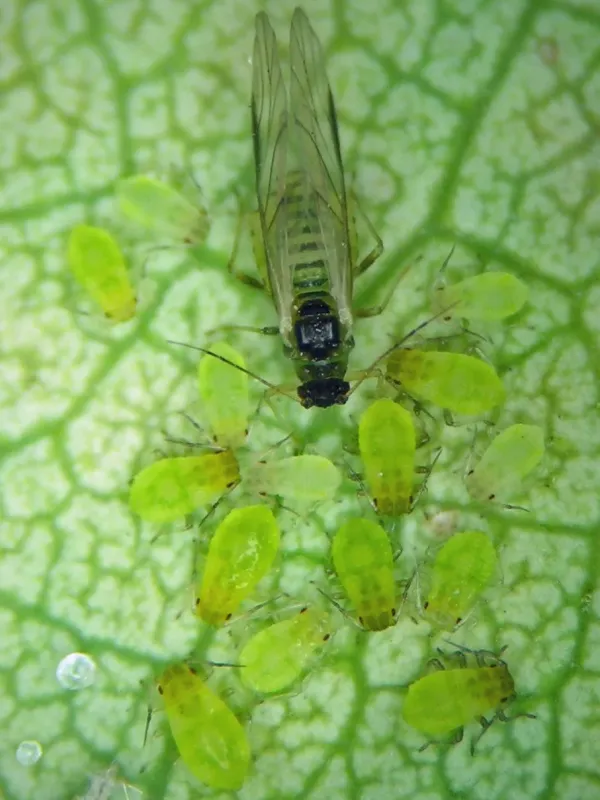
The willow leaf aphid (Chaitophorus vitellinae) is a small sap-sucking insect belonging to the family Aphididae. It is characterized by a yellowish-green body, which allows it to blend in with the leaves of its host plant.
Adults exhibit dimorphism, with both wingless and winged forms present. The wingless forms typically feature dark spots, while winged individuals are adapted for dispersal to other branches or neighboring trees.
A distinctive feature of the Chaitophorus genus is the presence of fine hairs covering their bodies. They are relatively small, usually measuring between 2 to 3 millimeters in length, making them difficult to spot without close inspection.
Their life cycle begins in spring with the emergence of fundatrices (stem mothers) from overwintered eggs deposited on the bark near the buds.
The reproduction rate of this aphid is rapid, allowing the population to reach high densities within a short timeframe during the active growing season.
What it damages
This pest specifically targets members of the Salicaceae family, primarily willows (Salix) and occasionally poplars (Populus). They feed on the tender tissues of young leaves and shoots.
By constantly extracting cell sap, the aphids weaken the plant significantly. This process disrupts the plant's metabolic pathways and leads to stunted growth.
Leaves affected by aphid feeding often show signs of curling, yellowing, and premature senescence. Such damage reduces the aesthetic appeal, particularly in ornamental willow cultivars.
The excretion of honeydew is a significant secondary issue. This sticky substance covers the foliage and serves as a primary substrate for the growth of sooty mold, which appears as a black, powdery layer.
Severe infestations can lead to decreased photosynthetic activity, making the tree less capable of storing energy for the winter, ultimately leading to reduced winter hardiness.
When it appears
Activity starts in early spring, synchronized with the budding of the host trees. The overwintered eggs hatch, initiating the first generation of the season.
The peak of population density typically occurs throughout late spring and early summer, when environmental conditions are optimal for aphid proliferation.
As summer progresses, winged forms emerge to facilitate the colonization of new parts of the tree or adjacent plants, effectively spreading the infestation.
By autumn, the aphids produce sexual forms that mate and lay overwintering eggs. These eggs are hardy and designed to survive harsh winter conditions.
The number of generations per year is substantial, often exceeding ten in favorable climates, which necessitates consistent monitoring throughout the growth period.
Signs of infestation
The most reliable sign of an infestation is the curling of the tips of young shoots and leaves. Careful inspection of the underside of these curled leaves usually reveals the aphid colony.
The presence of sticky honeydew on the leaves or branches is a clear indicator of aphid activity. This stickiness often attracts ants, which farm the aphids and protect them from predators.
The development of a black, sooty mold on leaves and twigs is a secondary sign. This fungus thrives on the honeydew produced by the aphids and can cover large sections of the canopy.
Distorted growth or twisted shoots are symptoms of chronic feeding stress. In young saplings, this can result in the loss of apical dominance and irregular branch development.
An increased presence of ladybirds, lacewings, or hoverfly larvae in the canopy suggests that a population of aphids is likely supporting these natural predators.
Control measures
Management of the willow leaf aphid should be based on an integrated pest management (IPM) strategy to minimize environmental impact:
- Promoting canopy airflow through regular pruning to discourage aphid colonization.
- Encouraging natural predators such as ladybugs and lacewings by avoiding broad-spectrum insecticides.
- Using horticultural soaps or oils to physically disrupt the aphids on the leaf surface.
- Applying systemic insecticides if the population levels threaten the health of the tree.
- Regular inspection of the trees during the early season to identify and treat hotspots before they spread.
Systemic insecticides are particularly effective as they are absorbed by the tree and provide long-term protection against sap-sucking pests.
Treatment timing is critical; applications should be timed to hit the early generations to prevent the establishment of massive colonies later in the season.
Always rotate different classes of insecticides to prevent the development of pesticide resistance in aphid populations, ensuring long-term control effectiveness.
Taxonomy
- Latin name
- Chaitophorus vitellinae
- Order
- Hemiptera (bugs, aphids, leafhoppers)
- Family
- Chaitophoridae
- EPPO code
- PSEMVI
Discussion
No discussions yet — be the first.