
Cerambyx welensii
Cerambyx welensii
Description
How to identify
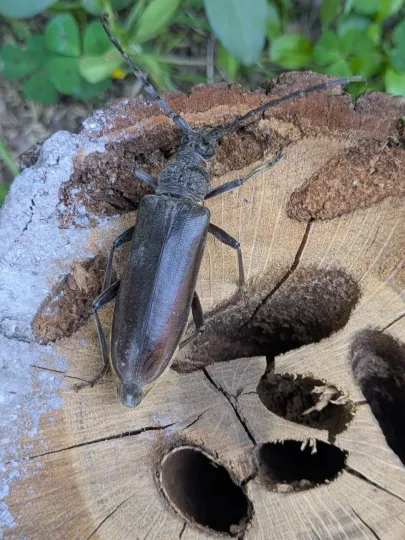
Cerambyx welensii is a large longhorn beetle species belonging to the Cerambycidae family. The adults are impressive insects with a length ranging from 25 to 55 millimeters, typically displaying a black or dark brownish body with a distinct metallic sheen.
The most recognizable feature of this beetle is its long antennae, which can be significantly longer than the insect's own body in males. The pronotum exhibits deep transverse ridges and lateral spines, serving as a key diagnostic character for identifying this specific species.
Larvae are cream-colored, robust, and equipped with powerful mandibles capable of mining deep into the heartwood of the host tree. They develop within the wood over a period of several years, creating complex gallery systems that sustain them until pupation.
Adult females deposit their eggs into the deep crevices of the bark on aging or stressed trees. The selection of the host tree is crucial, as the larvae require specific environmental conditions found under the bark to successfully initiate their tunneling process.
The adults are nocturnal, making them difficult to observe during the day. They usually spend daylight hours hidden within tree crevices or high in the canopy, emerging at dusk to feed and seek mates, which often leads to them being overlooked by casual observers.
##damage##The primary hosts for Cerambyx welensii are oak species, although other broad-leaved trees may occasionally be affected. The larvae act as primary pests by consuming the inner bark and the underlying xylem, which disrupts the tree's nutrient transport system.
In forest environments, the cumulative effect of these borers can lead to severe crown dieback and the eventual death of affected trees. This is particularly problematic in old-growth forests where the loss of mature oaks disrupts the local ecological balance.
The larval galleries significantly weaken the structural integrity of the tree, making it vulnerable to windthrow. Furthermore, these tunnels serve as entry points for various wood-decay fungi, which further degrade the quality of the timber and accelerate the tree's decline.
For managed landscapes and parks, the presence of this pest necessitates strict management. The loss of large, mature oak trees is not only an aesthetic concern but also represents a loss of critical habitat for many other species within the ecosystem.
The economic impact of this species is measured by the degradation of timber quality and the management costs associated with removing dead or hazardous trees that pose a safety risk to park visitors or infrastructure.
Signs of infestation
One of the most visible indicators of Cerambyx welensii presence is the emergence hole, which typically appears as a distinct oval opening on the bark surface. These holes are formed when the adult beetle tunnels its way out of the wood after completing its cycle.
The accumulation of frass, a mixture of wood shavings and insect waste, at the base of the trunk or caught in bark crevices is a clear sign of active larval infestation inside the tree. This debris acts as a primary indicator for pest scouts.
During the examination of the trunk, one may notice deep, elongated fissures in the bark. These are often the sites where females have laid eggs, and in some cases, sap flux might be visible, indicating the tree's response to the initial injury.
A progressive thinning of the canopy and the premature yellowing or drying of branches are classic signs of structural damage to the vascular system. Such symptoms usually indicate a well-established larval population within the main trunk.
Audible evidence is also possible; during quiet periods, the sound of larvae feeding and boring through the wood can sometimes be heard near the trunk, providing a secondary confirmation of the internal activity occurring within the heartwood.
Control measures
Sanitation felling is the most effective management strategy for controlling Cerambyx welensii. By removing infested trees before the adult beetles emerge, forest managers can effectively prevent the further spread of the population to neighboring healthy trees.
Proper silvicultural practices, such as maintaining optimal soil moisture and preventing mechanical damage to trunks, are essential for bolstering tree resilience. Healthy trees are significantly more capable of resisting initial colonization attempts.
The use of pheromone-based traps has proven successful in monitoring the presence of adult beetles and, in some cases, reducing their numbers during the peak flight season by disrupting mating cycles and attracting males away from host trees.
For high-value ornamental trees, localized insecticide treatments or professional trunk injections can be considered, though these methods are intensive and must be performed under expert guidance to ensure both efficacy and environmental safety.
- Regular monitoring of mature oak stands for signs of frass.
- Prompt removal and disposal of heavily infested timber.
- Use of pheromone lures for population density assessment.
- Maintenance of overall forest health through selective pruning.
Taxonomy
- Latin name
- Cerambyx welensii
- Order
- Coleoptera (beetles)
- Family
- Cerambycidae
- EPPO code
- CERBVE
Discussion
No discussions yet — be the first.