
Scopoli's longhorn beetle
Cerambyx scopolii
Description
How to identify
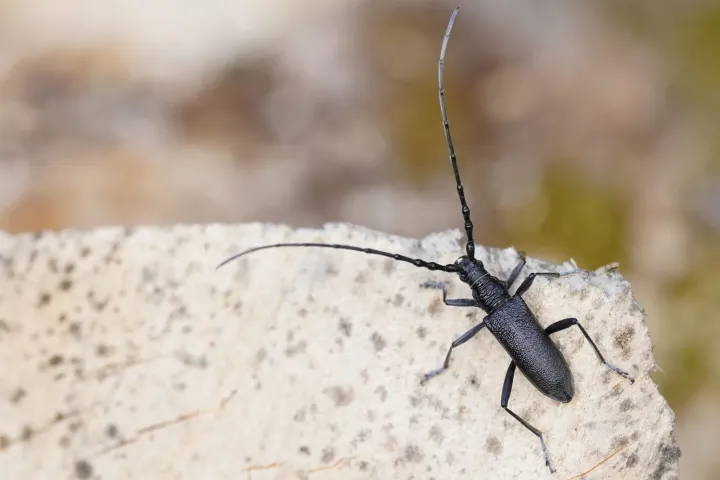
Scopoli's longhorn beetle (Cerambyx scopolii) is a member of the Cerambycidae family, commonly known for their characteristic long antennae that distinguish them from other beetles.
The adult beetle typically measures between 17 and 28 millimeters in length and has a matte black coloration with a rough, wrinkled surface on its elytra.
The larvae are cylindrical, cream-colored, and can reach up to 40 millimeters, equipped with powerful mandibles designed for boring through wood tissue.
This species is widely distributed across Europe and parts of Western Asia, frequently inhabiting deciduous forests and old fruit orchards.
As wood-boring insects, their entire larval development occurs within the host tree, making them difficult to detect until significant damage has occurred.
What it damages
Larvae primarily infest weakened or dying trees, showing a strong preference for deciduous species including plum, cherry, apple, apricot, and peach trees.
By boring deep galleries into the sapwood and heartwood, the larvae disrupt the tree's vascular system, hindering the transport of water and nutrients.
This internal damage weakens the tree structure, leading to reduced vitality, premature yellowing of leaves, and dieback of branches and twigs.
In mature trees, a heavy infestation can cause structural failure or the eventual death of the tree after several years of persistent larval activity.
The pest often attacks trees already suffering from environmental stress, pathogens, or other mechanical injuries, exacerbating the decline of the orchard.
When it appears
The flight period for adult beetles usually takes place during late spring and throughout the summer, specifically from May through July.
During the day, these beetles are active and can often be spotted on the bark of host trees, especially near sites where sap is flowing from wounds.
Females lay their eggs in bark crevices or existing damage on the trunk, ensuring the larvae have immediate access to wood once they hatch.
The life cycle is long, with the larval stage lasting 2 to 3 years within the host plant before the insect enters the pupal phase in the spring.
Once the transformation is complete, the adult beetle bores an exit hole to emerge, which is often the first visible sign of the infestation cycle.
Signs of infestation
The most reliable sign of an infestation is the presence of distinct, oval-shaped exit holes on the tree trunk or thick branches.
Accumulations of frass, which looks like fine sawdust or wood shavings, around the base of the tree or in branch forks indicate active larval boring.
For stone fruit trees, excessive gumming (gummosis) on the bark is a common defensive response to the internal damage caused by the developing larvae.
Visually, infected trees show signs of canopy decline, including sparse foliage, yellowing leaves, and significant dieback of the crown.
Peeling away loose bark may reveal extensive galleries packed with excrement, confirming that the tree has been colonized by the wood-boring larvae.
Control measures
Maintaining good orchard hygiene is essential, which includes the regular pruning of dead or diseased branches to prevent suitable breeding sites.
Avoid stacking old firewood near healthy fruit trees, as these piles are prime targets for egg-laying and can harbor the pest for multiple seasons.
Chemical control can be attempted by applying systemic insecticides or injecting specialized compounds into the holes during the active flight season.
Promoting a healthy environment for birds, such as woodpeckers, helps keep the beetle population under control by providing natural predators.
If a tree is heavily infested and beyond recovery, it should be removed and destroyed to prevent the beetles from spreading to neighboring healthy trees.
Taxonomy
- Latin name
- Cerambyx scopolii
- Order
- Coleoptera (beetles)
- Family
- Cerambycidae
- EPPO code
- CERBSC
Discussion
No discussions yet — be the first.