
Arizona bark scorpion
Centruroides sculpturatus
Description
How to identify
The Arizona bark scorpion (Centruroides sculpturatus) is a prominent member of the Buthidae family, widely recognized for its clinical significance.
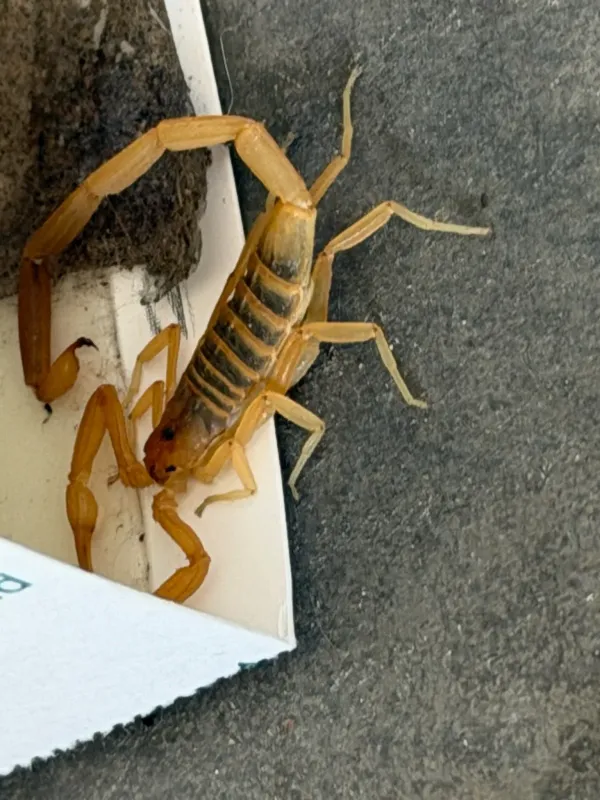
Adult specimens typically reach 5–7 cm in length and feature a slender, yellowish-brown body that provides effective camouflage in wood-rich environments.
Unlike many other scorpion species, this organism is highly adapted for climbing, frequently occupying vertical surfaces and trees.
The species exhibits a distinct biological strategy involving live birth and prolonged maternal care, which contributes to its high population stability.
Its physiological design, particularly its narrow pincers and thin tail, allows it to squeeze into extremely tight crevices, making it a challenging pest to track.
What it damages
While Centruroides sculpturatus is not a herbivore, it impacts agricultural productivity by creating hazardous conditions for human labor.
These scorpions are attracted to moisture, frequently residing near irrigation systems and the root zones of orchards, hindering routine maintenance.
In nursery environments, they infest containers and substrates, creating constant safety risks for staff handling plants and planting media.
Their burrowing activities in the soil near the base of young trees can disrupt root systems, potentially leading to plant stress in vulnerable crops.
The presence of this pest necessitates stricter safety protocols and often slows down harvesting and thinning operations in infested areas.
When it appears
Seasonal activity is highly correlated with temperature and humidity levels, peaking during the warm months of spring and summer.
Arizona bark scorpions are nocturnal predators, being most active at night when temperatures allow for optimal movement and hunting.
During the intense heat of the day, they remain dormant in protected, humid refuges, such as under tree bark, mulch, or stone walls.
As autumn approaches and temperatures drop, they seek warmer, stable environments, which often leads to migration into buildings or equipment sheds.
Their life cycle is highly resilient, allowing them to withstand extreme desert climates while remaining a constant concern for rural property management.
Signs of infestation
The most common indicator of an infestation is the occurrence of stings among farmworkers engaged in manual field tasks.
Discarded exoskeletons found around the base of trees are clear evidence of a maturing population and frequent molting activity.
Nighttime visual surveys using UV flashlights are the gold standard for detecting and mapping the extent of a scorpion infestation.
The scorpions' bodies fluoresce under ultraviolet light, appearing as bright, glowing figures against the dark agricultural background.
Frequent sightings in irrigation valves or beneath piles of wood debris indicate active nesting sites that require immediate attention.
Control measures
Management strategies focus on habitat modification to make the environment less hospitable to this predator.
Eliminating debris, wood piles, and leaf litter around the perimeter of orchards is crucial for reducing hiding spots.
Sealing gaps in agricultural structures and keeping vegetation trimmed away from buildings prevents internal infestations.
Chemical control can be utilized as a secondary measure, focusing on target areas where the scorpions congregate rather than broad-spectrum application.
- Remove wood and debris piles.
- Seal structural cracks in buildings.
- Use protective gloves during fieldwork.
- Keep irrigation areas clear of dense growth.
Taxonomy
- Latin name
- Centruroides sculpturatus
- Family
- Buthidae
- EPPO code
- CENUSC
Discussion
No discussions yet — be the first.