
Holly Blue
Celastrina argiolus
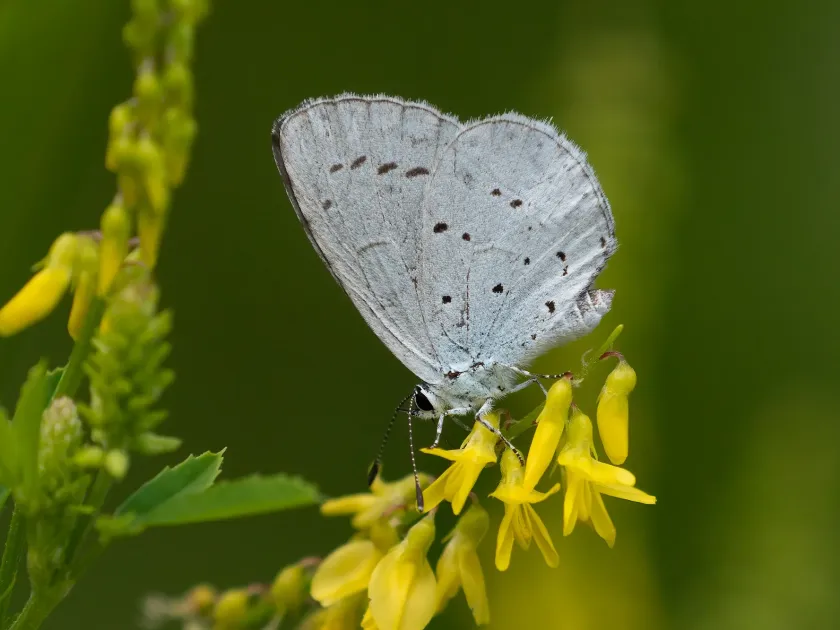
Description
How to identify
The Holly Blue, scientifically known as Celastrina argiolus, is a small butterfly belonging to the Lycaenidae family. It is widely distributed across the temperate regions.
Adults typically have a wingspan of 26–30 mm. The males are characterized by a bright blue upper surface with narrow dark margins, while females have much wider, darker borders.
The underside of the wings is pale silvery-blue or grey with a delicate pattern of tiny black spots. The body is covered with fine hairs, which is typical for this species.
The larvae (caterpillars) are short and stout, often appearing green or pinkish-brown, which provides excellent camouflage among the flower buds and young foliage.
As a butterfly, it undergoes complete metamorphosis, including the egg, larva, pupa, and adult stages, ensuring its survival across different seasonal conditions.
What it damages
The Holly Blue is a polyphagous pest that affects a variety of woody shrubs and trees. In home gardens, it poses a specific threat to berry crops.
It is commonly found on holly, ivy, dogwood, blueberry, and blackberry bushes. The caterpillars consume flower buds, blossoms, and developing fruitlets.
During years of high population density, the pest can significantly reduce crop yields by hollowing out the buds before they even have a chance to bloom.
Beyond berry production, the caterpillars may damage the foliage of ornamental shrubs, detracting from the plant's aesthetic value and overall health.
Most of the damage occurs during the larval stage, when the caterpillars feed voraciously on the reproductive parts of the host plants throughout the spring and summer.
When it appears
The first generation of adults typically emerges in early spring, usually between April and May, depending on the local climate and temperature trends.
A second generation appears during mid-summer, specifically in July and August, and is often more numerous, leading to increased damage in the garden.
The species overwinters in the pupal stage, typically resting in leaf litter or near the surface of the soil beneath host plants, protected by organic debris.
Adults are most active during sunny days, spending their time nectaring on flowers and searching for suitable sites to deposit their eggs.
Monitoring the flight periods is essential for effective pest management, as climatic variations can influence the timing of each generation's lifecycle.
Signs of infestation
The most common sign of infestation is the presence of small, clean-cut holes in flower buds, which often lead to premature bud abortion and dropping.
Tiny black frass (excrement) pellets found on leaves or at the base of the bushes are a reliable indicator of active caterpillar feeding.
Visible distortion of flower spikes or developing fruit clusters often points to internal tissue damage caused by caterpillars hiding inside the buds.
General wilting or stunted growth of young shoots can indicate that the plant is under stress due to the feeding activity of the larvae.
Careful inspection during the early morning hours can reveal the presence of caterpillars, as they are often more stationary before the heat of the day.
Control measures
Autumn maintenance, including deep cultivation or clearing leaf litter under host plants, helps disrupt the life cycle by destroying overwintering pupae.
For chemical-free management, applying biological control agents like Bacillus thuringiensis during the early larval stage is highly effective.
Pheromone traps and visual monitoring of adult flights allow for precise timing of interventions, reducing the need for broad-spectrum insecticide sprays.
Maintaining garden hygiene by removing debris and weeds helps eliminate alternative food sources that could support the pest population.
- Hand-picking and disposing of infested buds and damaged flower clusters.
- Encouraging predatory insects such as parasitic wasps to colonize the garden.
- Using fine netting over valuable plants during the egg-laying season to prevent damage.
Taxonomy
- Latin name
- Celastrina argiolus
- Order
- Lepidoptera (butterflies)
- Family
- Lycaenidae
- EPPO code
- CELSAR
Discussion
No discussions yet — be the first.