
Iberian ibex
Capra pyrenaica
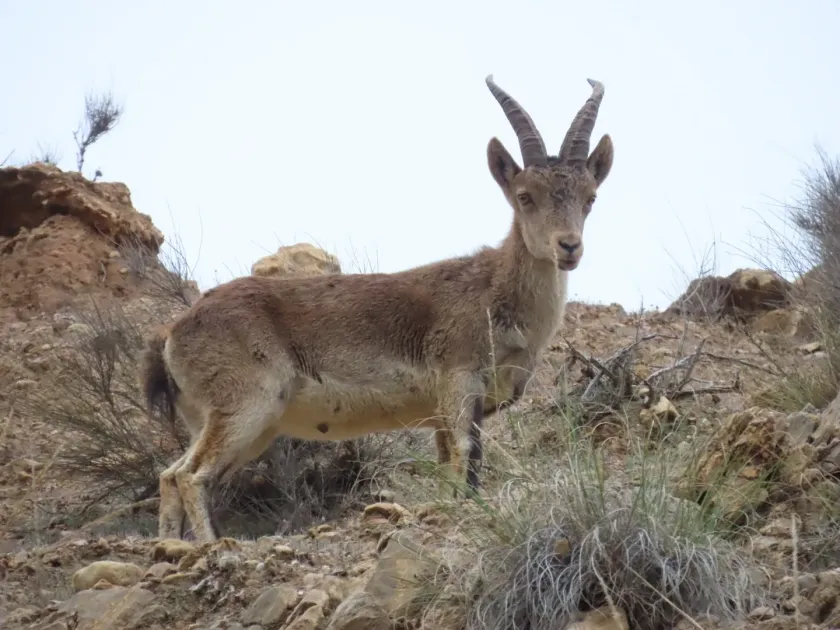
Description
How to identify
The Iberian ibex (Capra pyrenaica) is a species of wild goat that belongs to the Bovidae family, native to the Iberian Peninsula.
Adult males are distinguished by their large, ridged, back-curving horns, which are significantly more developed than those of the females.
These animals are exceptionally agile and are perfectly adapted to the rugged, steep mountainous terrain of their natural habitat.
They live in social groups and demonstrate a high level of environmental plasticity, allowing them to expand their range toward human-modified landscapes.
Their body size and strength make them a persistent challenge for land managers and farmers operating in areas adjacent to their territory.
What it damages
The primary impact of the Iberian ibex on agriculture involves overgrazing of pastures, which drastically reduces fodder availability for livestock.
They cause significant economic loss by stripping the bark from fruit trees and ornamental shrubs, often leading to the death of young saplings.
In vineyards and orchards, they feed on tender shoots, buds, and leaves, which disrupts the development of the crop and reduces harvest yields.
Large herds can trample significant portions of grain fields, compacting the soil and destroying the seedlings in their path.
Additionally, they may consume vegetables and other horticultural products, leaving crops unusable and failing to meet market standards.
When it appears
The risk of crop damage increases significantly during the winter months when high-altitude forage becomes scarce due to snow cover.
During these lean periods, ibex herds migrate to lower altitudes, entering cultivated valleys in search of accessible and nutrient-rich food.
The spring growth period also draws the animals toward orchards and nurseries, as young shoots are highly attractive and easy to digest.
Drought conditions during the summer months can further incentivize these animals to move toward irrigated agricultural lands to find food and moisture.
Farmers must remain particularly vigilant during these transitional seasons when the animals' natural food sources are most unstable.
Signs of infestation
Visual identification of their presence includes distinct hoof prints found in soft, damp soil or along the edges of fields.
Characteristic damage patterns, such as frayed branches and bark stripped to the bare wood, indicate feeding activity by these caprids.
Pellet-like droppings scattered around the feeding area serve as a clear indicator of a recent visit by a herd.
Tufts of fur left on fences, thorns, or tree trunks are common signs that the animals are frequenting the property.
- Striped bark on trunks at a height accessible to goats.
- Well-worn paths through crops or vegetation.
- Destruction of protective netting or low-height perimeter fencing.
Control measures
Robust perimeter fencing is the most effective preventative measure to exclude Iberian ibex from sensitive agricultural areas.
Integrating acoustic deterrents and motion-activated lights can help keep the animals away by creating an unpredictable and unpleasant environment.
Applying specialized botanical or chemical repellents on the trunks of fruit trees can deter the animals from feeding on the bark.
Landowners can implement strategic planting, using species that are less palatable to wild goats to create natural boundaries.
Collaborative management with local wildlife agencies is essential for developing long-term population control strategies that respect regional conservation laws.
Taxonomy
- Latin name
- Capra pyrenaica
- Family
- Bovidae
- EPPO code
- CAPAPY
Discussion
No discussions yet — be the first.