
Bezoar ibex
Capra aegagrus
Description
How to identify
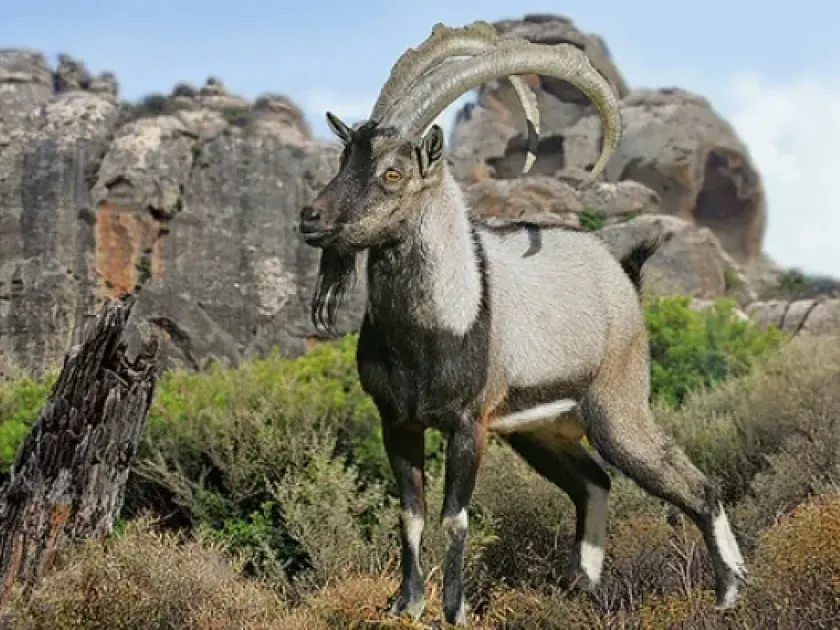
The Bezoar ibex (Capra aegagrus) is a large bovid species characterized by its impressive physique and agility. Adult males are particularly notable for their long, scimitar-shaped horns that curve backward, serving as a distinct identification mark.
These animals are typically found in mountainous regions, navigating steep terrain with ease. Their coat color changes from reddish-grey in summer to a duller, more muted brown in winter, which helps them blend into rocky environments.
They are gregarious animals, living in herds that vary in size. Their high mobility and social structure allow them to explore and exploit new food sources, including agricultural land situated near their natural habitat.
Physically, they are robust, with males often weighing significantly more than females. Their strength allows them to overcome minor physical barriers that might otherwise deter smaller pests.
Despite their shy nature, when driven by hunger, they become bold intruders into human-cultivated areas, posing a significant challenge for local agricultural productivity.
What it damages
Bezoar ibex cause extensive damage to cereal crops, especially during the seedling stage. They can graze on wheat and barley, leaving large, barren patches in the middle of healthy fields.
Orchards are highly susceptible to their feeding habits. The animals graze on the buds, succulent shoots, and bark of young fruit trees, which can stunt tree growth or lead to mortality.
Vineyards face similar risks, as the ibex are known to prune or destroy tender grapevines, impacting both the immediate harvest and the long-term structural health of the vines.
Apart from direct biomass consumption, the soil compaction caused by their hooves is a major concern, as it alters soil porosity and inhibits root development in planted crops.
The damage to fences and irrigation systems is also frequent, as they can break through or trample over infrastructure while moving in herds toward desired grazing patches.
When it appears
The risk of damage is highest during the spring when fresh, succulent greens emerge on fields, attracting herds from the barren upper mountain slopes to the fertile plains below.
Summer grazing continues to be problematic, especially in irrigated or watered zones where crops remain green and palatable despite high temperatures or external drought conditions.
Autumn brings an increase in activity as the ibex prioritize high-energy crops, such as ripening grains, to build up fat reserves in preparation for the harsh winter season.
Winter presents a danger for nurseries and young plantations. When ground vegetation is covered by snow, these ungulates shift their diet to bark and twigs, severely damaging woody plants.
Because they are most active during crepuscular hours (dawn and dusk), farmers often find damage in the morning without ever seeing the herd responsible for the destruction.
Signs of infestation
The most reliable sign of presence is the discovery of hoof prints, which are distinct in shape and larger than those of small domestic goats, often appearing in soft soil near crop edges.
Evidence of clean browsing at a specific height—usually corresponding to the shoulder height of the animal—is a tell-tale sign of ungulate feeding versus the gnawing typical of rodents.
Pellet-like droppings scattered along trails or at the field periphery confirm recent activity and indicate the size and recent movement of the herd.
Scratched bark on tree trunks or missing lateral branches in orchards and shrubberies provide clear proof of browsing activity during periods of low natural food supply.
Well-worn paths leading from high-altitude rocky zones down into the agricultural plots are indicative of established patterns of movement and repeat visits by the herd.
Control measures
Erecting tall, high-tensile wire fencing is the most effective way to protect agricultural assets. These fences should be securely anchored to the ground to prevent tunneling.
Using sensory deterrents, including motion-activated acoustic alarms or strobe lights, can startle the animals and discourage them from entering sensitive cropping zones.
Chemical repellents that mimic predator scents or provide unpleasant tastes can be applied to the foliage of vulnerable fruit trees to discourage browsing.
Collaborating with local wildlife management authorities is essential for regulating populations if the herds become a chronic and significant nuisance to agricultural activities.
Implementing non-attractive crop buffers, such as planting species they find unpalatable around the perimeter, can serve as a passive deterrent to further encroachment.
Taxonomy
- Latin name
- Capra aegagrus
- Family
- Bovidae
- EPPO code
- CAPAAE
Discussion
No discussions yet — be the first.