
Common soldier beetle
Cantharis rustica
Description
How to identify
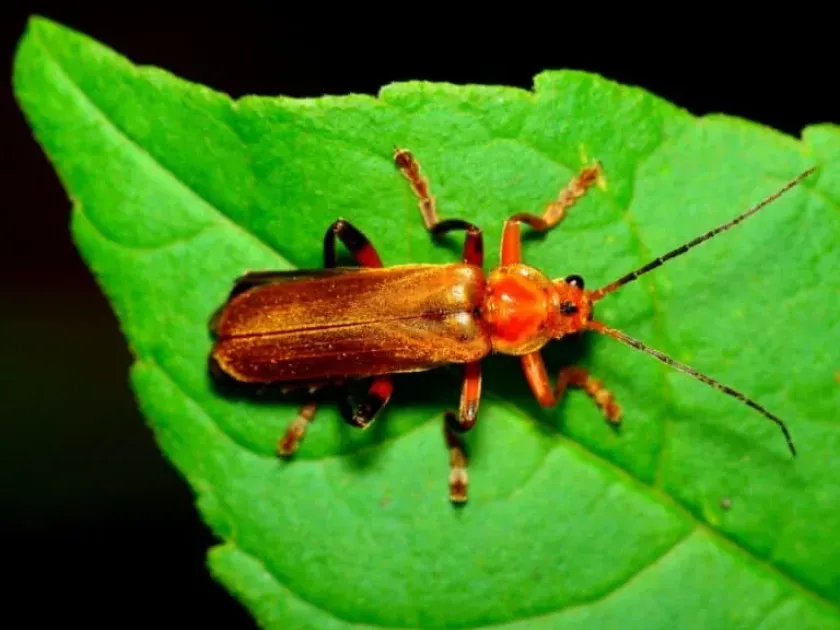
The common soldier beetle belongs to the family Cantharidae within the order Coleoptera. Adult beetles are elongated, measuring about 10–15 mm in length, with soft elytra (wing covers) that do not fit tightly against the abdomen, hence their name.
The coloration of the beetle is typically black with distinct orange or reddish markings on the pronotum and often at the base of the elytra. The legs are well-developed, allowing the beetle to navigate effectively across plant stems and leaves.
Larvae are characterized by a velvety appearance due to dense hair covering. They are highly active predators with strong mandibles, designed to capture and consume prey within the soil or leaf litter.
The life cycle involves complete metamorphosis: egg, larva, pupa, and imago. Overwintering occurs primarily as late-stage larvae, which remain tucked away in the soil or under organic debris, surviving even in cold conditions.
It is important to correctly identify these beetles. They are facultative predators, meaning they primarily hunt other insects but can sometimes feed on plant parts if their usual food sources are scarce or during high population spikes.
What it damages
The common soldier beetle is not a specialized pest that targets a single crop. Adults may occasionally damage the reproductive parts of plants, such as flower petals, buds, and young ovaries of various fruit and vegetable crops.
During the blooming season of fruit trees like apple, pear, or cherry, beetles may feed on petals, stamens, and pistils. This can interfere with pollination efficiency and potentially lead to a slight reduction in total fruit yield.
In some cases, they may affect grain or legume fields, feeding on the tender tips of young shoots. The damage is usually sporadic and depends heavily on the population density observed during the season.
Crucially, the larvae are considered beneficial, as they prey on slugs, caterpillars, and eggs of various harmful insects. The damage caused by adults is often balanced by the predatory activity of their offspring.
Economic damage is rare and generally only occurs in years with highly favorable conditions for the beetle's reproduction, where the sheer number of beetles puts pressure on flowering plants.
When it appears
The activity period for adult common soldier beetles occurs in late spring and early summer, aligning perfectly with the peak flowering period of most cultivated plants.
The highest population density of adults is typically observed in May and June. During this time, they are actively moving across plants in search of food and mates.
The larval stage spans throughout the autumn and spring. Overwintering occurs in the upper layers of the soil or deep within organic matter, protecting them from extreme frost.
After the soil warms up in spring, larvae pupate in small earthen cells. After a few weeks, the new generation of adults emerges to begin the cycle again.
Ambient temperature has a direct effect on development rates. A cold, prolonged spring may delay the emergence of adults, shifting the potential period of interaction with flowering crops.
Signs of infestation
The first indicator of soldier beetles in the garden is the visual presence of adults on flowers. They are easily recognizable by their contrasting orange-black appearance.
On flowers, one might notice petals with ragged or bitten edges. In cases of very high infestation, some flowers may drop prematurely without forming fruits.
Larvae can be spotted when working the soil in the garden. They are usually found searching for prey and will quickly move out of sight if disturbed, as they are essentially ground-dwellers.
A decline in fruit yield in the absence of other obvious pests can serve as a secondary signal of intense soldier beetle activity during the blossoming stage.
A high density of beetles on wild weeds adjacent to crop fields serves as an early warning sign, suggesting that migration to the cultivated plants may soon follow.
Control measures
Management of the common soldier beetle is rarely necessary, as they are not major agricultural pests. An integrated approach focusing on balance is recommended.
Cultural methods, such as keeping the garden clear of excessive weeds, help remove host habitats for adults. Deep soil cultivation in autumn helps disrupt larval overwintering sites.
Insecticide use is generally discouraged as it often harms beneficial insects and natural predators that help regulate the beetle population.
If population numbers reach extreme levels, choose selective biological treatments rather than broad-spectrum chemicals. Avoid all treatments during peak flowering to protect essential pollinators like bees.
- Monitor insect populations regularly.
- Implement proper soil management practices.
- Encourage natural predators by providing diverse habitats.
- Use biological controls only if strictly necessary.
Taxonomy
- Latin name
- Cantharis rustica
- Order
- Coleoptera (beetles)
- Family
- Cantharidae
- EPPO code
- CANTRS
Discussion
No discussions yet — be the first.