
Common Red Soldier Beetle
Cantharis rufa
Description
How to identify
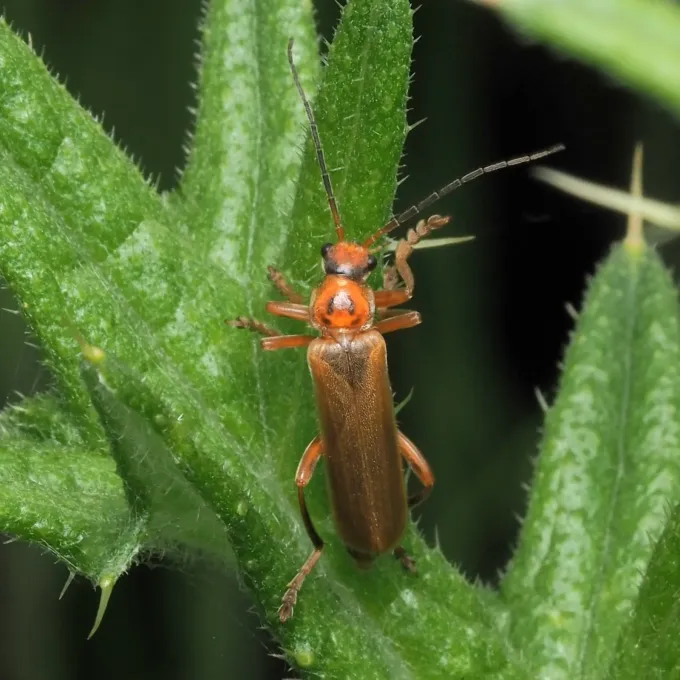
The Common Red Soldier Beetle (Cantharis rufa) is a member of the Cantharidae family within the order Coleoptera. Adult beetles typically measure between 10 and 15 mm in length and possess soft, flexible elytra that distinguish them from harder-shelled beetles.
The species is identifiable by its predominantly reddish or orange-brown coloration, often featuring a distinct dark spot on the pronotum. Their elongated body shape and well-developed antennae facilitate their hunting behavior as they navigate through vegetation.
What it damages
In agricultural practice, the Common Red Soldier Beetle is widely considered a beneficial insect. Both adult beetles and their larvae act as predators, feeding on aphids, mites, small caterpillars, and various other garden pests that threaten crop health.
While the larvae reside primarily in the soil or leaf litter, their predatory nature helps suppress populations of soil-dwelling pests. Significant damage to commercial crops is rarely recorded, making them valuable allies in integrated pest management (IPM) strategies.
When it appears
Adults are typically active from late spring to early summer, with peak observations occurring throughout May and June. During this window, they congregate on flowers to feed on nectar and prey upon smaller insects found on the foliage.
The life cycle involves overwintering as larvae in the soil or under debris. As temperatures rise in spring, they complete their development, pupate, and emerge as adults to begin the next generation, showing high dependence on local environmental conditions.
Signs of infestation
Observation of these beetles is common in gardens and field margins, especially on Apiaceae and other flowering plants. Their distinct orange color makes them easy to spot as they forage actively for small insect prey.
Larval activity may be observed during soil cultivation or compost maintenance. Distinguishing these beneficial predators from true pests is crucial for farmers to prevent unnecessary chemical interventions that could harm natural biological control agents.
Control measures
Specific chemical control is not recommended for this species, as its presence is highly beneficial to the ecosystem. Integrated management focuses on protecting the beetle population rather than eradicating it.
- Avoid broad-spectrum insecticide applications during flowering periods.
- Maintain hedgerows and wildflower borders to provide refuge.
- Limit soil disturbance to preserve larval development habitats.
- Promote biological diversity to ensure a natural balance of predators.
- Utilize selective pest control measures only when target pest levels exceed thresholds.
Taxonomy
- Latin name
- Cantharis rufa
- Order
- Coleoptera (beetles)
- Family
- Cantharidae
- EPPO code
- CANTRF
Discussion
No discussions yet — be the first.