
Canonura princeps moth
Canonura princeps
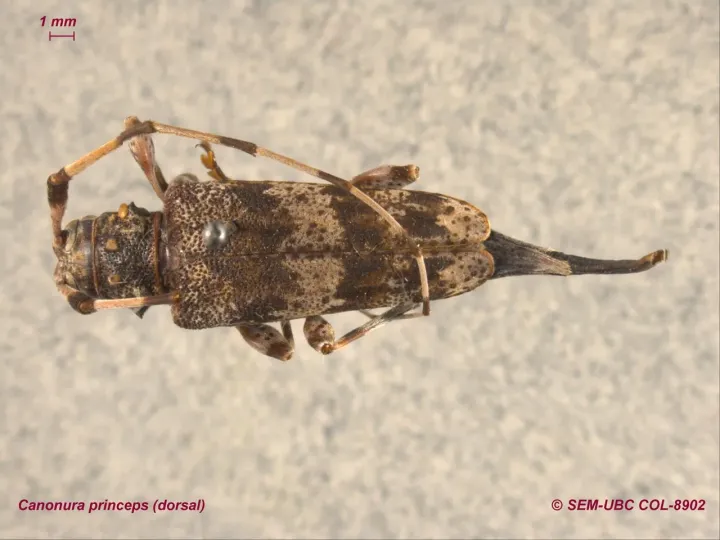
Description
How to identify
Canonura princeps belongs to the order Lepidoptera, family Noctuidae (Owlet moths). This is a nocturnal insect species whose adults possess camouflage coloring typical for the family, allowing them to effectively hide on tree bark or dry vegetation during the day.
The adult moth is characterized by a medium-sized body with dense pubescence. The forewings feature a complex pattern of dark and gray spots, making them nearly invisible against a natural background and difficult to identify for non-specialists.
The insect undergoes complete metamorphosis, including egg, larva (caterpillar), pupa, and adult stages. Caterpillar coloration varies depending on the development stage and the specific host plant, providing additional protection from predators.
Larvae are the most damaging stage of this insect's life cycle. They possess well-developed chewing mouthparts that allow them to rapidly consume significant amounts of plant biomass.
The systematic position of this species necessitates careful monitoring in specific steppe and forest-steppe zones, where population density can reach thresholds dangerous for agro-ecosystems.
What it damages
This pest primarily damages various herbaceous plants, including members of the Asteraceae family and other species found in the wild and along field margins.
In agricultural settings, caterpillars can damage the vegetative parts of crops by gnawing the edges of leaves and creating holes, which reduces the total photosynthetic area of the plant.
During mass outbreaks, the pest transitions to reproductive organs, damaging buds and inflorescences, which leads to a direct reduction in yields and a decrease in the quality of marketable produce.
Damaged plant tissues create entry points for secondary fungal and bacterial infections, which significantly complicates the condition of crops and requires a comprehensive treatment approach.
The level of damage directly depends on the phenological phase of the crop: damage during periods of active growth and flowering is particularly critical, as plants are most vulnerable to nutrient deficits at these stages.
When it appears
Adult activity of Canonura princeps usually occurs during the spring and summer. During this time, adults search for suitable egg-laying sites on host plants.
The hatching of caterpillars is synchronized with the growth period of primary host species. The speed of larval development is highly dependent on ambient temperature, with cycles accelerating during warmer periods.
Depending on the climatic zone, the species may produce one or two generations per year. Understanding this cyclicity is crucial for establishing optimal timing for pest management interventions.
In the autumn, pupation occurs, with pupae often overwintering in the soil or plant debris, which is a key survival strategy for the species in unfavorable cold seasons.
Monitoring the appearance of initial individuals is performed using pheromone or light traps, which allow agronomists to respond in a timely manner to the beginning of the moth's flight.
Signs of infestation
The primary external sign of field infestation is the presence of coarse foliage edges being eaten, which becomes noticeable during night or twilight hours when caterpillars are most active.
On the soil surface beneath affected plants or on the leaves themselves, one may find caterpillar frass, which serves as an indicator of their presence and the intensity of infestation.
During daylight inspection, caterpillars can often be found in curled leaves or at the base of the stem, where they hide from direct sunlight and natural predators.
Stunted growth, chlorosis, or stem deformation, when no other obvious causes are present, can also indicate hidden damage caused by cutworm-like moth larvae.
- Irregularly shaped holes in leaves
- Remnants of chewed inflorescences
- Evidence of activity (frass)
- Presence of caterpillars in shelters
Control measures
Agronomic methods include deep autumn plowing, which destroys pupal overwintering sites, significantly reducing survival rates and population density in the following season.
Adherence to crop rotation is an mandatory practice, as it prevents the buildup of the pest in specific fields and interrupts the feeding cycle of specialized caterpillars.
Biological control includes the use of entomophages and bacteria-based biopesticides that effectively suppress caterpillar populations without harming the environment.
Chemical control is applied when economic thresholds are exceeded. Insecticides with systemic or contact-stomach action that are approved for use on specific crops are employed.
A vital protection element is weed control, as weeds serve as reservoirs for the pest before larvae migrate to cultivated crops, thereby reducing the risks of mass infestation.
Taxonomy
- Latin name
- Canonura princeps
- Order
- Coleoptera (beetles)
- Family
- Cerambycidae
- EPPO code
- CANOPR
Discussion
No discussions yet — be the first.