
Scalloped Hazel
Calocalpe undulata
Description
How to identify
The Scalloped Hazel moth (Calocalpe undulata) belongs to the Geometridae family, known for the distinctive movement pattern of its larvae, often called loopers or inchworms.
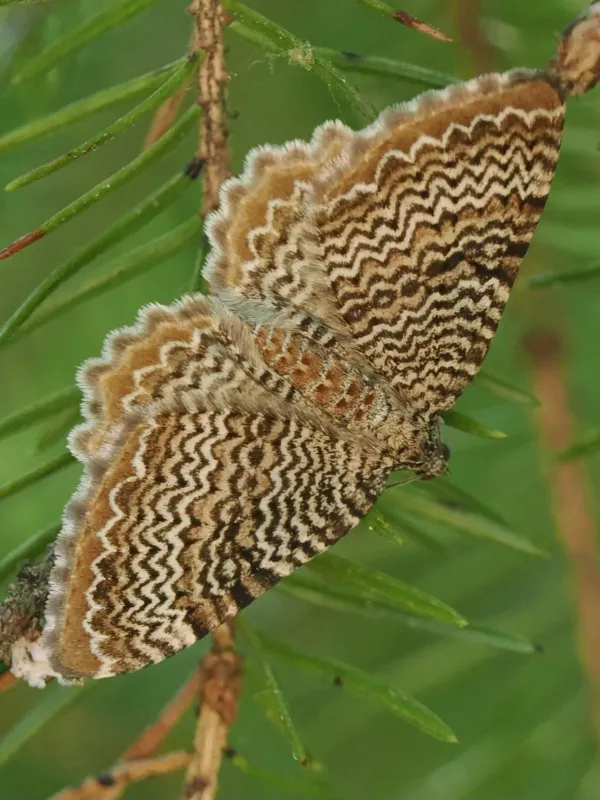
The adult moth has a wingspan of approximately 30–40 mm, with wings featuring brownish, wavy lines that give the species its common English name and unique camouflage.
This moth is a member of the diverse order Lepidoptera, and its biological classification reflects its adaptation to deciduous forests and shrub-dominated landscapes.
Females lay their eggs on the underside of host leaves, ensuring that hatching larvae have immediate access to food sources while being protected from environmental stressors.
The life cycle involves complete metamorphosis, where the pupal stage acts as the overwintering form, usually situated within the leaf litter or shallow soil layers.
What it damages
The primary hosts of the Scalloped Hazel include various deciduous plants, most notably species of willow, aspen, blueberry, and other related shrubby vegetation.
Caterpillars cause direct injury by feeding on the leaf tissue, which can lead to significant aesthetic and physiological damage if the infestation is allowed to progress unchecked.
The larvae are particularly voracious during their peak development stages, capable of consuming large portions of the leaf surface, which reduces the plant's photosynthetic capacity.
Damage symptoms often include stunted growth and poor fruit production, especially in cultivated berry varieties like blueberries, where the foliage is critical for energy accumulation.
When infestation levels are high, the cumulative stress on the plant makes it susceptible to opportunistic fungal infections and secondary pests, leading to further decline.
When it appears
Adult moths typically emerge in early summer, generally during June and July, coinciding with warmer weather conditions that are optimal for mating and egg deposition.
The caterpillar stage is observed during the mid-to-late summer months, as they feed actively to accumulate the necessary reserves for the upcoming transformation process.
The species follows a univoltine life cycle, meaning it produces only one generation annually, although local variations can occur based on regional temperature patterns.
Pupation occurs as temperatures begin to drop in late summer and early autumn, with the pupae entering diapause to survive the winter months until the next season.
Nocturnal activity is a hallmark of the adult moths, which are attracted to artificial lighting, providing a reliable way for researchers and growers to monitor population dynamics.
Signs of infestation
Visible signs of infestation often include leaf skeletons or irregularly shaped holes, as larvae consume the leaf blade but avoid the harder midribs and main veins.
Leaf rolling or tying, where caterpillars use silken threads to fold leaves together, creates protective retreats where they feed, often remaining hidden from casual observation.
The presence of fine, dark granular frass (excrement) on the leaves or falling to the ground beneath the plant is a clear indicator that feeding activity is currently taking place.
Premature leaf drop and generalized wilting of the affected branches suggest that the plant's health has been significantly compromised by the caterpillar colony.
- Leaves tied together with fine silken webbing.
- Irregular patterns of leaf margin consumption.
- Skeletonized leaf blades with veins left intact.
- Small, dark frass pellets deposited on leaves.
- Visible damage occurring mostly in the canopy during summer.
Control measures
Biological control agents, such as specific strains of Bacillus thuringiensis, are highly effective against these larvae while posing minimal risk to beneficial insects.
If population densities exceed economic thresholds, systemic insecticides can be applied to provide long-lasting protection against leaf-feeding caterpillars during the growth season.
Good orchard and garden sanitation, specifically removing and composting leaf litter in the autumn, can significantly reduce the overwintering success of the pupae.
Physical barriers like sticky traps or bands on tree trunks can help monitor and occasionally reduce the movement of larvae, particularly in small garden settings.
Encouraging natural predators such as insectivorous birds and parasitic wasps helps maintain a natural balance, keeping the Scalloped Hazel population below damaging levels.
Taxonomy
- Latin name
- Calocalpe undulata
- Order
- Lepidoptera (butterflies)
- Family
- Geometridae
- EPPO code
- CLOCUN
Discussion
No discussions yet — be the first.