
Green Hairstreak
Callophrys rubi
Description
How to identify
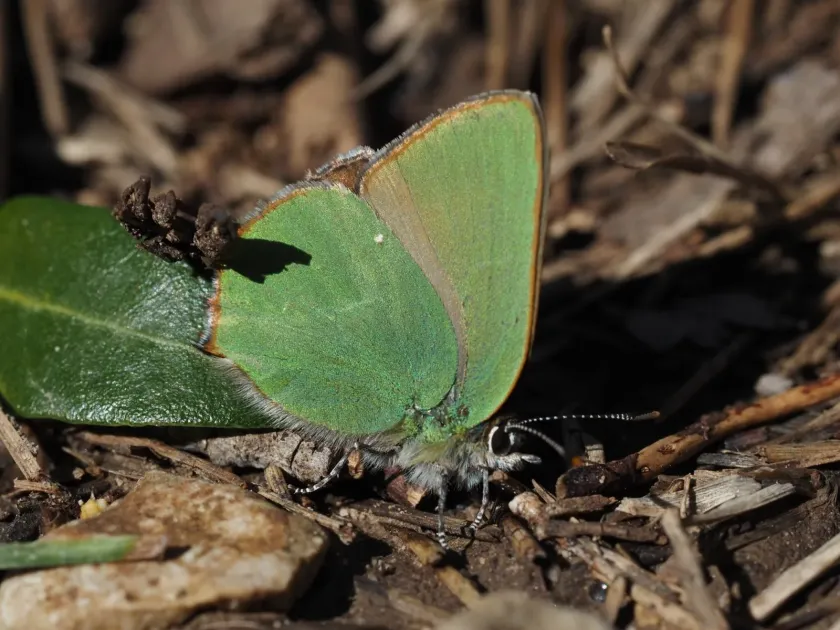
The Green Hairstreak (Callophrys rubi) is a butterfly species within the Lycaenidae family. The adult butterfly features unique camouflage: the upperside of the wings is brown, while the underside is a vivid green, allowing the insect to blend perfectly with foliage.
The wingspan of the adult butterfly ranges from 20 to 30 millimeters. The body is covered in dense hairs, and unlike many other hairstreak species, this one lacks the distinct "tails" on the hindwings, which is a key identifying feature.
The larva of this species reaches a length of 15–18 millimeters. It has a characteristic woodlouse-like shape and is colored light green, featuring oblique pale side stripes and a yellowish line along the back.
The pupa is compact, dark brown, and marked with small black spots. It overwinters in the soil or leaf litter, possessing high cold tolerance, which enables the species to thrive across various temperate zones.
Development typically occurs in a single generation per year, though in warmer southern regions, an occasional second generation may emerge. The adult flight period begins in early spring and lasts through early summer.
What it damages
The Green Hairstreak is a polyphagous insect, meaning it feeds on a diverse range of host plants. In an agricultural context, it poses a notable threat to various berry crops found in orchards and gardens.
The most frequently damaged crops include members of the Rosaceae family, such as raspberries, blackberries, and strawberries. The pest is also commonly found on blueberries, cranberries, and several types of decorative shrubs.
Young larvae feed primarily on the generative organs of the plants. They hollow out buds, flowers, and developing fruit, which leads to a direct reduction in the yield of berry-producing crops.
During their active growth phase, the larvae may shift to feeding on young leaves, skeletonizing them or creating large holes. This weakens the overall vigor of the plant, especially during drought stress or periods of nutrient deficiency.
- Bud damage leads to a decrease in fruit quantity.
- Damage to the ovaries causes premature fruit drop.
- Foliage consumption reduces the bush's photosynthetic capacity.
Signs of infestation
The first indicator of the pest's presence is the sight of butterflies with bright green wing undersides fluttering around berry bushes on sunny days.
When inspecting buds, one may notice small entry holes created by the larvae. Dark, granular frass (excrement) is often visible around these holes, signaling active feeding.
The premature shedding of unopened buds or the wilting of fruit ovaries without an apparent cause often suggests the hidden presence of larvae within the flower receptacle.
Leaves may show areas of missing tissue. If a curled leaf is carefully unrolled or an inflorescence is inspected, the larvae themselves can often be spotted, as their color provides excellent camouflage against the plant tissues.
The presence of ants visiting specific plants can also be an indirect sign, as the larvae produce a sweet secretion that attracts them.
Control measures
Agricultural management includes regular weeding around berry patches, as many weeds serve as alternative host plants. Timely soil cultivation in the root zones is essential for destroying pupae hiding in the ground.
During mass blooming, if the pest population exceeds the economic threshold, biological insecticides based on bacteria may be used, as these are typically safe for pollinators and beneficial insects.
Chemical insecticides should be used with extreme caution. It is recommended to apply them before the blooming season or after the harvest is complete to prevent bee poisoning and chemical residues on the berries.
For small-scale plots, manual removal of larvae during the morning hours is an effective control method. Consistent monitoring of bud health allows for the early detection and localization of infestations.
Promoting a healthy environment for natural predators, such as predatory bugs, parasitic wasps, and insectivorous birds, helps maintain Green Hairstreak populations at levels that do not cause significant economic damage.
Taxonomy
- Latin name
- Callophrys rubi
- Order
- Lepidoptera (butterflies)
- Family
- Lycaenidae
- EPPO code
- CAOHRU
Discussion
No discussions yet — be the first.