
Moss's Elfin
Callophrys mossii
Description
How to identify
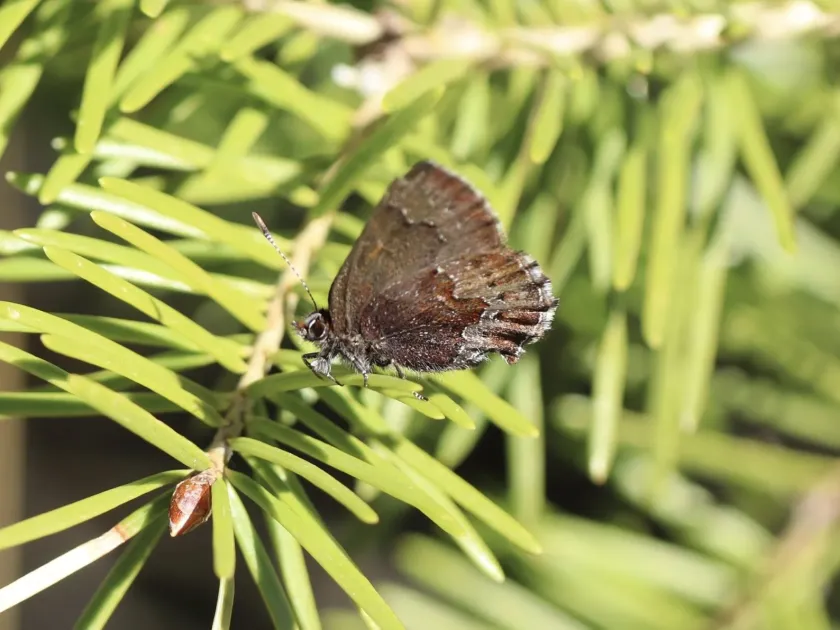
Moss's Elfin (Callophrys mossii) is a butterfly species within the Lycaenidae family, order Lepidoptera. It is a small diurnal butterfly typically measuring 20–30 mm in wingspan.
The dorsal side of the wings is generally gray-brown, sometimes featuring a greenish tint at the base, which aids in camouflage when the insect is perched.
The ventral side exhibits intricate patterns ranging from olive to reddish-brown, mimicking the surrounding vegetation and dead leaves in its natural habitat.
The body is covered with dense hair, providing insulation against the cool environments where this species often resides, particularly in mountainous or rocky regions.
The life cycle involves complete metamorphosis, and in many populations, it undergoes a single generation per year, spending the winter as a pupa.
What it damages
The larvae (caterpillars) of Moss's Elfin feed primarily on plants within the Crassulaceae family, specifically targeting various species of Sedum (stonecrops).
The feeding activity involves consuming the fleshy leaves and stems, which directly impairs the plant's photosynthetic capacity and structural integrity.
Heavy infestations can result in significant foliage loss, leading to the overall weakening of the succulent plant and stunted growth patterns.
The wounds created by the caterpillars provide entry points for secondary infections, such as bacterial or fungal rot, which can kill the succulent.
While the species is often rare, in ornamental gardens featuring specialized Sedum varieties, it can cause aesthetic damage that renders the plants unsuitable for display.
When it appears
The emergence of adult butterflies usually occurs during early spring, typically from March through May, aligned with the flowering period of their host plants.
During this window, mating occurs, and females lay eggs on the leaves or stems of host Sedum plants to ensure food availability for emerging larvae.
Larvae are active during the late spring months, feeding rapidly to gain the necessary energy reserves for the transformation process.
By early summer, the caterpillars finish their larval stage and pupate, usually finding refuge in the soil or under leaf litter near the host plant.
They remain in this dormant pupal stage throughout the rest of the year, waiting for the return of spring conditions to continue their life cycle.
Signs of infestation
The most immediate indicator of presence is the appearance of irregular "notching" or holes on the edges of succulent leaves caused by the larvae's feeding habits.
Visible frass (caterpillar droppings) accumulating on the leaves or at the base of the plant is a clear sign that larvae are currently active on the host.
Premature yellowing or shriveling of damaged leaf sections suggests internal tissue damage, which can lead to localized necrosis on the plant.
Light silken threads or webs used by the larvae to secure leaves for protection against predators can be spotted during close physical inspections.
During the day, caterpillars can often be found hiding on the underside of leaves or near the stem base, matching the color of the succulent tissues.
Control measures
Manual removal of caterpillars is highly effective for small-scale gardens or when the population density of the pest remains relatively low.
Maintaining garden hygiene by removing wild stonecrops that act as reservoirs for the population can significantly reduce the risk of infestation on ornamental plants.
Biological control using formulations based on Bacillus thuringiensis is considered safe and effective, targeting larvae without harming beneficial pollinators.
Chemical insecticides should be used as a last resort, prioritizing products with low residual activity and ensuring application occurs outside of blooming hours.
- Conduct regular inspections of succulent collections during spring.
- Use fine-mesh netting to prevent egg-laying on susceptible plants.
- Enhance soil drainage to ensure healthy, resilient plant growth.
Taxonomy
- Latin name
- Callophrys mossii
- Order
- Lepidoptera (butterflies)
- Family
- Lycaenidae
- EPPO code
- CAOHMB
Discussion
No discussions yet — be the first.