
Green Hairstreak
Callophrys
Description
How to identify
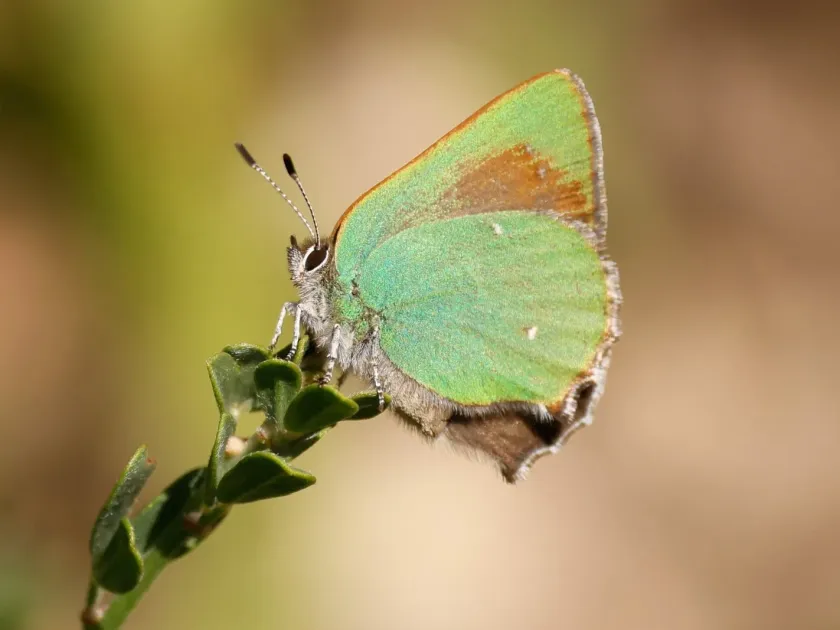
The Green Hairstreak (Callophrys rubi) is a small butterfly belonging to the Lycaenidae family, commonly found across Europe and parts of Asia.
Adults have a wingspan of approximately 25-30 mm; while their upperside is brown, the underside is a distinct vibrant green, acting as perfect camouflage.
This green coloration allows the butterfly to blend seamlessly into leaves and foliage, making them quite difficult to spot in garden environments.
The larvae are bright green with lighter markings, which provides excellent protection against predators while feeding on host plants.
The species prefers habitats with scrub, forest edges, and bushy hedgerows where their host plants are abundant and provide shelter.
What it damages
Green Hairstreak larvae are polyphagous, feeding on a variety of plants, including species from the Rosaceae and Fabaceae families.
In gardening contexts, they are known to damage fruit crops like blackberries, raspberries, and various flowering shrubs by consuming buds.
The larvae bore into developing buds and young fruit, causing them to wither and fall prematurely, which directly reduces the overall harvest.
By feeding on reproductive parts, the caterpillars stunt plant development and can lead to significant economic loss in berry plantations.
The damage caused often leaves the plant susceptible to secondary infections, as damaged tissues are prone to fungal or bacterial growth.
When it appears
The species generally has one generation per year, with adult butterflies emerging in late spring, typically from April through early June.
Mating occurs shortly after emergence, followed by the female laying eggs singly on the host plant's leaves or flower buds.
The larval stage lasts for about a month, during which the caterpillars actively consume plant tissue before moving to the next developmental phase.
Pupation takes place on or near the ground, where the pupa remains in a state of diapause through the winter until the next spring season.
The emergence of the new generation is timed to coincide with the availability of lush, young growth on their preferred host plants.
Signs of infestation
Early signs of infestation include irregular holes in the foliage and the presence of withered, stunted buds that fail to bloom properly.
Frass (larval droppings) left on the foliage is a key indicator of caterpillar presence, often found near feeding sites on the upper plant parts.
Premature fruit drop or fruit that shows signs of tunneling is a common indication that larvae have been feeding within the developing tissues.
Deformed shoots or stunted growth patterns are common indicators, resulting from the larvae targeting the tender growing points of the plant.
Careful visual inspection of buds in the spring can reveal the presence of eggs, which appear as small, whitish spots on the plant surface.
Control measures
Effective management includes removing weeds and alternate host plants from the vicinity of fruit crops to reduce the population density.
Biological control using Bacillus thuringiensis (Bt) sprays can be highly effective in targeting larvae while preserving beneficial insect populations.
For larger infestations, targeted applications of systemic insecticides may be necessary, though they should be applied outside of flowering periods.
Soil cultivation in the autumn can help disrupt the pupation cycle, exposing overwintering pupae to predators and colder temperatures.
- Manual removal of caterpillars in small gardens
- Maintaining healthy soil to boost plant immunity
- Encouraging natural predators like birds and wasps
Taxonomy
- Latin name
- Callophrys
- Order
- Lepidoptera (butterflies)
- Family
- Lycaenidae
- EPPO code
- CAOHSP
Discussion
No discussions yet — be the first.