
Caligo teucer
Caligo teucer
Description
How to identify
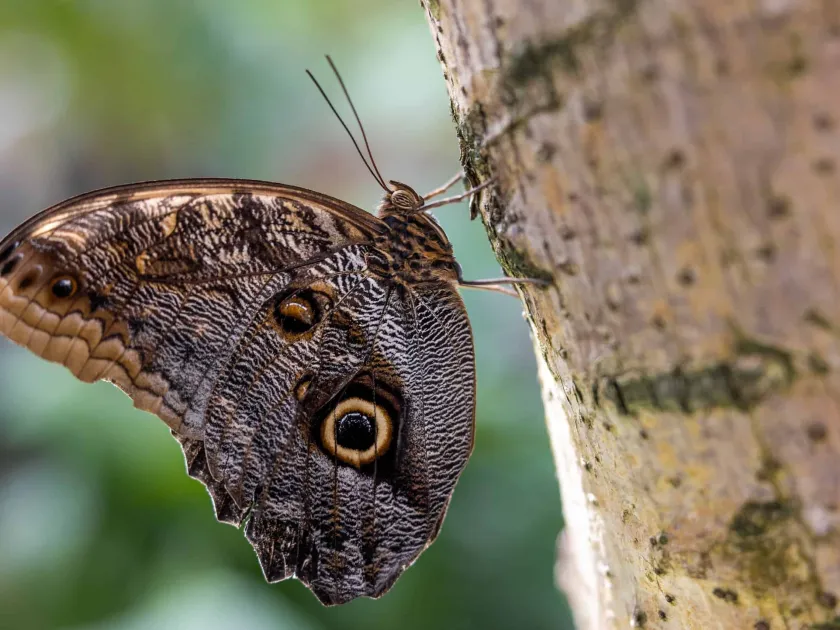
Caligo teucer is a large butterfly species belonging to the Nymphalidae family and the Morphinae subfamily. It is widely recognized for its impressive size and the striking owl-like eyespots located on the underside of its wings.
Adult butterflies typically have a wingspan ranging from 120 to 150 mm. The brownish upper side of the wings contrasts sharply with the intricate, detailed patterns on the underside, which serve as a primary defense mechanism against predators.
The larval stage, or caterpillar, is characterized by a long, cylindrical body with distinct projections on its posterior end. The head features prominent horn-like structures, which become more pronounced as the caterpillar progresses through its growth stages.
As part of the Lepidoptera order, this species undergoes a complete metamorphosis. Its biological development is highly dependent on tropical environmental factors, which influence the duration of each life stage.
Understanding the anatomy and behavior of this insect is crucial for effective identification in the field. Professionals rely on recognizing both the winged adults and the voracious larvae to assess the level of infestation.
What it damages
Caligo teucer is primarily known as a significant pest for banana plants (Musa spp.). The caterpillars are specialized herbivores that feed extensively on the broad, nutrient-rich leaves of these plants.
Damage begins with caterpillars eating the edges of the leaf blades. As they mature, they consume more leaf tissue, working their way toward the midrib, which can result in severe defoliation of the plants.
The loss of leaf surface area significantly reduces the plant's ability to photosynthesize, directly impacting fruit development. Consequently, banana bunches may become stunted, deformed, or fail to meet commercial quality standards.
High caterpillar density can compromise the structural integrity of the plant, leaving it susceptible to wind damage and secondary infections. This weakening effect can shorten the productive lifespan of the entire plantation.
While their host preference is narrow, they can occasionally move to adjacent palm species if primary food sources are depleted, making them a broader threat in certain horticultural environments.
When it appears
The activity and population dynamics of Caligo teucer are closely linked to tropical weather patterns, specifically humidity and rainfall levels. These factors regulate the availability of succulent vegetation needed for caterpillar development.
In equatorial regions, the species can breed continuously, with multiple generations overlapping throughout the year. This lack of seasonal dormancy means that plantations are potentially at risk at any given time.
Adult butterflies are largely crepuscular, meaning they are most active during dawn and dusk. This behavioral trait makes them difficult to observe during the day, complicating early detection efforts.
Temperature serves as a key driver for the rate of development. Warmer conditions accelerate the transition from egg to caterpillar, potentially leading to rapid spikes in population density within a short period.
Ongoing monitoring is necessary because the absence of a distinct winter diapause means that pest management must be a continuous, year-round commitment for growers in infested regions.
Signs of infestation
The most immediate sign of an infestation is the presence of irregular, ragged leaf edges. This "notched" appearance is a classic indicator of caterpillar feeding activity in its early stages.
Egg clusters deposited on the underside of the leaves provide an early warning of a potential outbreak. Regular scouting of the plantation can help identify these clusters before they hatch into larvae.
The accumulation of caterpillar droppings (frass) on leaves and on the ground below the canopy is a definitive sign of an active infestation. The amount of frass can help estimate the severity of the damage.
Skeletonized leaves, where only the tough veins remain, signify advanced damage. Such intense feeding levels require immediate intervention to prevent long-term damage to the plant's vigor.
Pupae attached to the underside of leaves or stems are a sign that a generation has completed its development. Observing pupae indicates that a new wave of adults will soon emerge to continue the cycle.
Control measures
Effective management of Caligo teucer requires an Integrated Pest Management (IPM) approach that balances efficiency with environmental sustainability. Monitoring remains the most critical component.
- Scouting for egg clusters and larvae to implement targeted control early in the life cycle.
- Utilization of biological insecticides, such as products containing Bacillus thuringiensis, which target caterpillars specifically.
- Encouragement of natural predators, including parasitic wasps and ants, to suppress pest populations.
- Physical removal of heavily infested leaves to reduce the larval load in small-scale plantings.
- Strategic application of selective insecticides only when economic thresholds are surpassed, ensuring minimal impact on beneficial species.
Sanitation practices, such as removing plant debris, are essential to reduce available harborages for the pest. Maintaining clean plantation floors helps disrupt the lifecycle of the insect.
Furthermore, education for field workers on recognizing the signs of infestation is vital. Early reporting allows for prompt control measures, preventing the spread of the pest across larger areas of the plantation.
Taxonomy
- Latin name
- Caligo teucer
- Order
- Lepidoptera (butterflies)
- Family
- Nymphalidae
- EPPO code
- CALITE
Discussion
No discussions yet — be the first.