
White Wave moth
Cabera pusaria
Description
How to identify
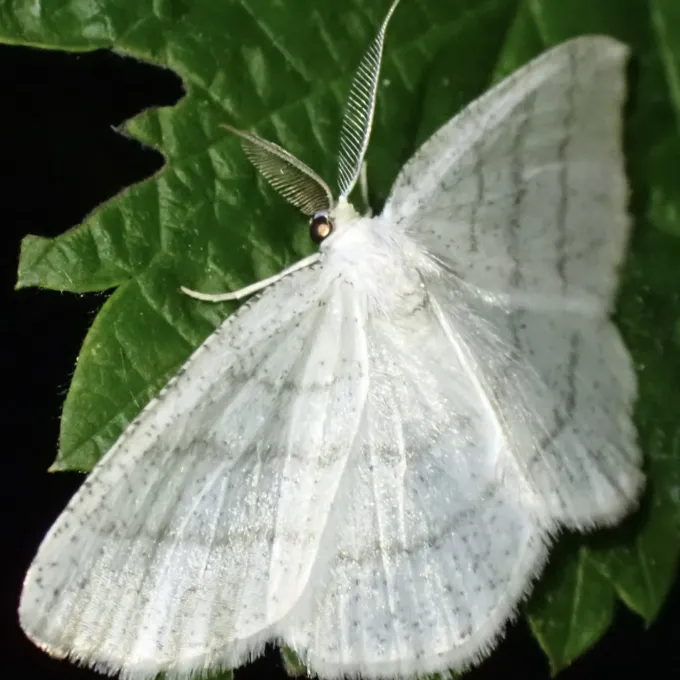
The White Wave moth (Cabera pusaria) is a nocturnal moth species within the Geometridae family. Adult moths feature a wingspan of 28–35 mm and are easily recognized by their white wings, which are marked with three distinct, wavy, greyish-brown lines.
The larvae, known as loopers, have a slender, cylindrical body. They usually exhibit a green coloration with reddish-brown patches or spots, allowing them to blend seamlessly with the foliage of their host plants.
Pupation takes place in a loose cocoon, typically hidden within the leaf litter or just below the soil surface. This stage serves as the overwintering form of the insect, providing resilience against winter cold.
This species is widely distributed across the Palearctic realm. During the day, adult moths remain stationary on tree trunks or the undersides of leaves, keeping their wings folded in a characteristic triangular shape.
The common name of the family, Geometridae, relates to the larvae's method of movement. They possess a limited number of abdominal prolegs, forcing them to arch their bodies into a loop while moving, a trait seen clearly in Cabera pusaria.
What it damages
The primary damage is caused by the caterpillars, which feed aggressively on the leaves of deciduous trees. In cases of significant infestation, they can cause extensive defoliation, leaving the host tree weakened and stressed.
Preferred host plants include various species of birch, alder, aspen, and willow. While they favor forest species, they can also migrate to fruit-bearing trees if they are located near infested woodland edges or thickets.
Early-stage larvae typically create small, localized holes in the leaves. As they mature, they consume larger portions of the leaf tissue, frequently skeletonizing the leaves and leaving behind only the harder, main veins.
Repeated yearly defoliation significantly impairs the photosynthetic capacity of the tree. This reduction in energy production makes the affected tree more vulnerable to opportunistic fungal pathogens and secondary wood-boring pests.
For ornamental gardens and landscaping, the presence of the White Wave moth can degrade the aesthetic value of the trees and slow down their annual growth rate, particularly in young saplings.
When it appears
The flight period for adult moths typically spans from late spring through mid-summer. Depending on the local climate and temperature, the species may produce one or two generations per year.
The larval feeding phase is most intense during the early to mid-summer period. During this time, the caterpillars are highly active, and their feeding damage becomes most apparent in the canopy.
Pupation occurs as the summer season wanes. The insects enter diapause as pupae, remaining dormant in the soil or ground cover throughout the autumn and winter months.
Environmental factors, especially ambient temperature, directly dictate the pace of the moth's life cycle. Warmer summers often result in more rapid development and potentially higher survival rates for the offspring.
Monitoring the emergence of adult moths can provide gardeners and foresters with a crucial window to take preventative measures before the next generation of hungry larvae begins feeding.
Signs of infestation
The earliest signs of an infestation are small, irregular holes scattered across the leaf surface. As the caterpillars grow larger, these holes expand, leading to a jagged or tattered appearance of the leaves.
A careful inspection of the lower surface of leaves often reveals the presence of the caterpillars. They are masters of camouflage, and finding them requires looking closely along the veins and stems where they rest.
The presence of fine, silken threads hanging from branches is another hallmark sign. Caterpillars use these threads to descend from the foliage if they feel threatened or if they fall while moving between branches.
Accumulated frass (caterpillar droppings) on the ground underneath the tree canopy is a clear indicator that a large population of larvae is actively feeding in the tree above.
If you notice the canopy of a tree becoming thin or appearing prematurely ragged by mid-summer, it is a strong signal that a leaf-eating pest like the White Wave moth is currently active.
Control measures
Cultural control practices are highly effective; clearing away fallen leaf litter in the autumn is essential as it removes the primary overwintering sites for the pupae. Turning over the soil under the tree canopy can also destroy developing pupae.
For small-scale infestations, manual collection and removal of the caterpillars is feasible and effective. Simply shaking the branches over a cloth can help to gather the larvae for disposal.
Biological control, using Bacillus thuringiensis (Bt) based insecticides, is highly recommended. These products specifically target caterpillars and are safe for humans, pets, and beneficial predatory insects.
Chemical intervention should be reserved for high-density outbreaks. If pesticides are necessary, choose products that are less harmful to bees and apply them during the evening when pollinators are not active.
- Encourage insectivorous birds to visit the garden by providing nesting boxes.
- Use pheromone traps for early detection of adult moth populations.
- Ensure trees receive adequate irrigation to help them recover from defoliation stress.
- Regularly prune damaged or weak branches to keep trees healthy.
Taxonomy
- Latin name
- Cabera pusaria
- Order
- Lepidoptera (butterflies)
- Family
- Geometridae
- EPPO code
- CABERU
Discussion
No discussions yet — be the first.