
Cabera moth
Cabera
Description
How to identify
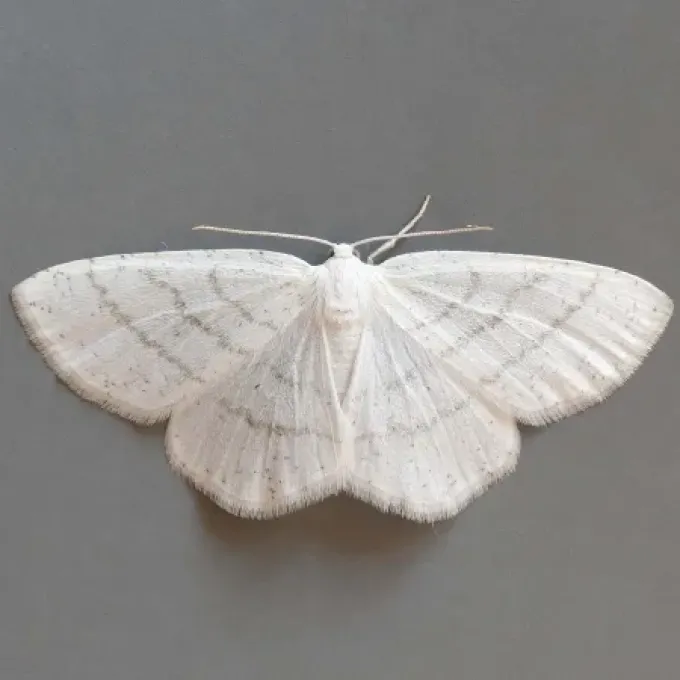
The genus Cabera belongs to the family Geometridae, order Lepidoptera. These moths, often called waves or white moths, are typically medium-sized with a wingspan of 30–40 mm, featuring pale white or creamy wings marked with delicate cross-lines.
Adult moths are nocturnal and remain concealed during the day on bark or the underside of leaves. Their resting posture, often flattened against a surface, provides perfect camouflage as they resemble bird droppings or lichen-covered bark.
The larvae, known as inchworms or loopers, possess the characteristic movement of the Geometridae family, looping their bodies as they move. They are generally slender and smooth, blending in perfectly with the green leaves they consume.
They undergo complete metamorphosis: egg, larva, pupa, and adult. Most species in this genus overwinter as pupae, buried within the topsoil or sheltered in leaf litter beneath the host tree.
Identification at the species level (such as Cabera pusaria) is often based on subtle wing pattern differences and the specific host plants they prefer, which can vary significantly depending on the local ecosystem.
What it damages
The primary damage is caused by the caterpillars, which are foliage feeders. In their natural habitat, they specialize in leaves of deciduous trees, particularly those in the Betulaceae, Salicaceae, and Rosaceae families.
In garden and nursery settings, these caterpillars can cause significant defoliation when outbreaks occur, impacting ornamental trees like birch, willow, and even fruit-bearing trees if they are situated near woodland edges.
Larvae feed by consuming the leaf blade, often starting from the margins. Heavy infestations result in severe skeletonization, where only the tough veins of the leaves remain, significantly reducing the tree's photosynthetic capacity.
Persistent defoliation stresses the tree, leading to stunted shoot growth and reduced vigor. This makes the host plant significantly more susceptible to secondary environmental stresses, droughts, or opportunistic diseases.
In young plantations or commercial nurseries, an unmanaged population of Cabera can lead to substantial economic losses due to the loss of aesthetic value and long-term health decline of the trees.
When it appears
Adult moth activity typically begins in late spring, around May, as temperatures rise. This is the primary period for mating and egg-laying on the leaves of suitable host plants.
The larval stage is active throughout the summer months. Caterpillars reach their peak feeding intensity in June and July, coinciding with the period of rapid foliage development in host trees.
Some regions may experience two generations per year if environmental conditions are optimal, with the second generation of adults emerging in late summer and larvae active into early autumn.
By late summer or early autumn, the caterpillars descend to the soil to pupate. The pupal stage is the critical overwintering phase that ensures the survival of the population through the cold season.
Monitoring the trees from late May through August is essential to detect the presence of larvae before they cause widespread visual and physiological damage to the host canopy.
Signs of infestation
Visible defoliation or ragged leaf margins are the most obvious signs of a Cabera infestation. If you notice branches suddenly thinning out during the summer, larvae may be present.
The presence of frass (caterpillar droppings) on the leaves below the feeding site is a reliable indicator that larvae are active in the canopy, even if they remain hidden from view.
Careful inspection of the undersides of leaves, especially along the midribs, may reveal small, solitary eggs laid by the adult moths, which serve as an early warning for potential infestation.
Larvae are often difficult to spot due to their protective coloration. However, checking the branches during the cool of the early morning may reveal them in a more active feeding state.
- Irregular bite marks on leaf edges.
- Presence of fine silk threads used by larvae for protection.
- Increased bird activity in specific trees, which often signals a caterpillar population.
Control measures
Promoting natural biological control is the most sustainable approach. Encouraging insectivorous birds, parasitic wasps, and predatory beetles helps keep Cabera populations below the economic threshold.
For small-scale home gardens, mechanical removal by hand-picking caterpillars or shaking them off onto a tarp early in the morning is highly effective and safe for the environment.
If chemical control is necessary, choose biological insecticides like Bacillus thuringiensis (Bt). These are highly selective for caterpillars and have minimal impact on beneficial non-target insects.
Chemical insecticides should be reserved for severe outbreaks. Always follow the label guidelines regarding concentration and application timing to prevent harming local pollinators and other beneficial wildlife.
Cultural practices, such as clearing leaf litter and lightly tilling the soil under affected trees in late autumn, can disrupt the overwintering pupae and reduce the population for the following year.
Taxonomy
- Latin name
- Cabera
- Order
- Lepidoptera (butterflies)
- Family
- Geometridae
- EPPO code
- CABESP
Discussion
No discussions yet — be the first.