
Pine looper
Bupalus piniaria
Description
How to identify
The pine looper (Bupalus piniaria) is a moth species belonging to the Geometridae family, order Lepidoptera. It is a well-known defoliator that specifically targets coniferous tree species, primarily pines.
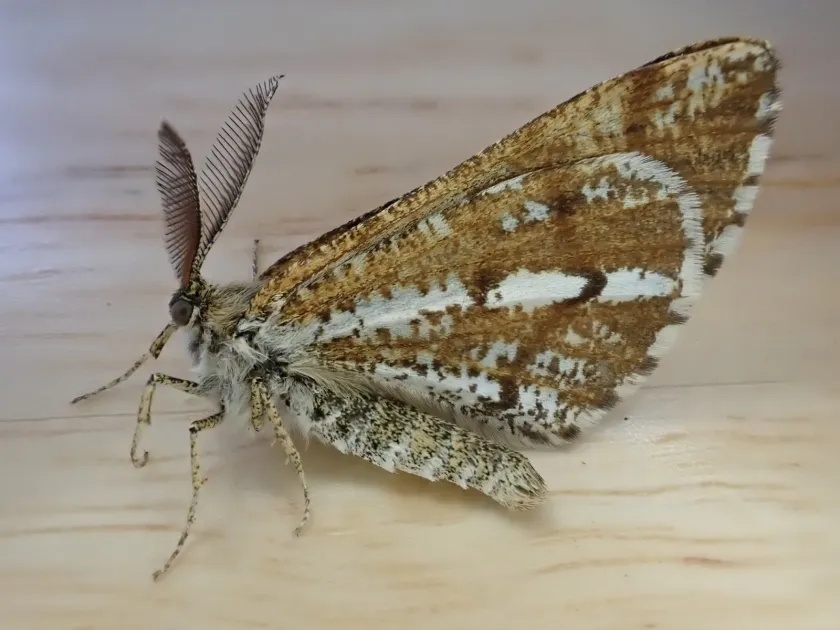
The adult moth exhibits significant sexual dimorphism. Males possess dark brown wings with yellowish spots and have feathered antennae, while females are more uniform in their ochre-brown coloration.
The larvae, known as loopers due to their unique way of moving, can grow up to 30 mm in length. They are typically bright green with distinct white or yellow longitudinal stripes, providing excellent camouflage.
Pupation occurs in the forest litter, where the insects spend the winter months. The pupae are brown and shiny, adapted to withstand cold temperatures while remaining dormant in the soil.
The pine looper typically has a one-year life cycle (univoltine). Environmental factors like temperature and humidity play a critical role in the timing of their emergence and mating success.
What it damages
Pine needles are the primary food source for the larvae. During the early stages of development, they feed on new needles, and as they grow, they move to older foliage.
Heavy infestations lead to severe defoliation of the canopy. When a large percentage of needles is lost, the tree loses its ability to perform photosynthesis efficiently, leading to decline.
Trees weakened by the pine looper are highly susceptible to secondary attacks from bark beetles and wood-boring insects, which often result in the rapid death of the infested trees.
Economic damage includes a significant reduction in timber volume growth, deterioration of wood quality, and the high costs associated with sanitation and forest recovery.
Large-scale outbreaks can alter the forest ecosystem, changing the light penetration to the forest floor and impacting the growth of understory vegetation.
When it appears
The flight period for adult moths generally occurs between late May and June, depending on the geographic location and regional weather patterns.
Following mating, females lay eggs in rows on pine needles. The incubation period lasts approximately two to three weeks until the larvae hatch.
Larval feeding is most intense during July and August. This is the peak time when the caterpillars accumulate energy and grow to their full size before preparing for pupation.
As autumn approaches, typically in September, the larvae descend to the ground, crawl into the moss or needle litter, and form pupae where they remain until the following spring.
Monitoring the seasonal development is crucial for integrated pest management, as timing intervention during the larval stage is key to effective control.
Signs of infestation
The initial signs of an infestation include "notched" or partially eaten needles, as young larvae begin their feeding process along the edges of the needles.
Accumulation of frass (larval excrement) on the forest floor, appearing as small granular pellets, is a clear indicator of a high-density population in the canopy above.
Visual inspection of the canopy may reveal a shift in color, where affected areas appear thinning and brownish as the needles are stripped away by the larvae.
Forest pathologists utilize pheromone traps to capture adult males during the flight season, which helps in quantifying the population size and predicting future outbreak risks.
Excavating the soil and litter layers during the dormant season allows foresters to count the number of overwintering pupae, which is a standard method for estimating population density.
Control measures
Biological control strategies include the use of natural enemies such as parasitic wasps (e.g., Trichogramma species) that target the eggs of the moth, effectively reducing the next generation.
Chemical control is considered a last resort, usually involving the aerial application of insecticides when the population reaches thresholds that threaten the integrity of the forest.
Maintaining a diverse forest structure with healthy bird populations is an essential long-term strategy, as various bird species actively prey on the larvae during the summer.
Silvicultural practices that promote tree health and vigor help the trees withstand lower levels of defoliation without suffering long-term decline.
- Application of microbial insecticides based on Bacillus thuringiensis.
- Monitoring using pheromone-baited traps for adult activity.
- Encouraging insectivorous bird populations with nesting boxes.
- Sanitation harvesting in stands severely damaged to prevent further spread.
Taxonomy
- Latin name
- Bupalus piniaria
- Order
- Lepidoptera (butterflies)
- Family
- Geometridae
- EPPO code
- BUPAPI
Discussion
No discussions yet — be the first.