
Pine looper
Bupalus
Description
How to identify
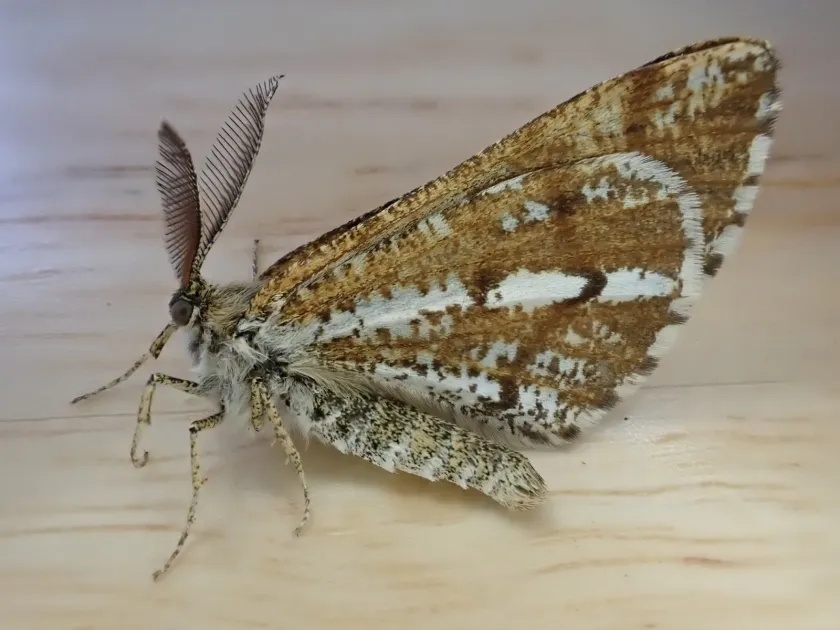
The pine looper (Bupalus piniaria) is a moth belonging to the Geometridae family, well-known for its destructive impact on pine forests. The adult moth has a wingspan of approximately 40 mm. Sexual dimorphism is clearly expressed: males feature dark brown wings with white patches, while females are typically a pale ochre or yellowish-brown color.
The larvae, known as loopers, grow up to 30 mm in length. They are characterized by a vibrant green color with longitudinal white stripes. Their movement, defined by a looping gait caused by the reduction of abdominal prolegs, makes them distinct and easily recognizable upon closer inspection of pine needles.
The pupae are dark brown to blackish, typically found in the leaf litter beneath the host trees. This dormant stage allows the insect to survive harsh winter conditions in the forest soil, emerging as adults once spring temperatures become favorable.
The pine looper is a primary defoliator of Pinus sylvestris. It prefers pure, dense pine stands, which facilitate the rapid spread of the species during outbreak years, leading to significant ecological and economic consequences.
Understanding the moth's identification is crucial for forest health monitors. Adults are primarily nocturnal, making them difficult to spot without light traps, but larval monitoring during the summer months is a standard practice for assessing population density.
What it damages
The damage caused by the pine looper is entirely attributed to the feeding habits of the larvae. They consume the needles of pine trees, which, during severe infestations, can lead to complete defoliation of entire forest compartments within a single season.
Young larvae initially graze on the edges of the needles, creating distinct notches. As they mature, they consume the needles entirely, leaving only small bases behind. This extensive loss of foliage drastically reduces the tree's photosynthetic capacity.
Repeated defoliation over consecutive years prevents the trees from storing enough energy to defend themselves. This weakens the host trees, making them susceptible to secondary infestations by bark beetles and wood-boring insects, which often seal the fate of the tree.
The economic impact involves timber loss and degraded forest quality. Large-scale outbreaks can alter the entire forest structure, leading to increased risk of forest fires and local biodiversity loss due to the sudden exposure of the forest floor to sunlight.
Healthy, mixed forests with diverse undergrowth are more resilient. The pine looper's damage is most pronounced in monoculture plantations, where natural predators are insufficient to control the exploding populations of the moth.
When it appears
The flight period for adult moths typically occurs between late May and early June. During this time, they mate, and females deposit eggs in rows on pine needles in the upper parts of the crown, where the needles are freshest.
Larval development begins in mid-summer, with eggs hatching after approximately two weeks. The larvae feed aggressively throughout the summer and early autumn, passing through several instars to reach full maturity before the cold weather sets in.
In September or October, the mature larvae descend from the branches to the forest floor. They burrow into the leaf litter, undergo pupation, and enter a state of diapause, remaining in the soil throughout the winter months until the following spring.
The survival of the pupae is highly dependent on environmental factors, such as winter soil temperature and moisture, as well as the activity of ground-dwelling predators like carabid beetles and small mammals.
Forest managers conduct soil samples in autumn or spring to count the pupae in the litter. This data is critical for predicting whether the upcoming season will see a population outbreak, allowing for preemptive management actions.
Control measures
Biological control is the preferred method for managing pine looper outbreaks. The use of microbial insecticides containing Bacillus thuringiensis is highly effective against larvae, offering a targeted solution that spares natural enemies and preserves forest integrity.
Chemical control involving systemic or contact insecticides is utilized only in emergency scenarios to prevent total forest collapse. Such operations require precision timing to ensure the spray hits the larvae while they are most vulnerable to chemical exposure.
Silvicultural management focuses on building resilient forests. Encouraging mixed-species plantings and preserving healthy forest floors ensures that natural parasitoids and predators, such as tachinid flies and insectivorous birds, remain abundant to suppress pest numbers.
Maintaining the natural ecological balance is the best long-term defense. By avoiding clear-cutting and promoting forest biodiversity, the environment becomes less favorable for the pine looper to reach mass outbreak thresholds.
- Regular monitoring of pupal density in soil samples;
- Deployment of microbial pesticides during early larval instars;
- Enhancing forest biodiversity to support natural predator populations;
- Promoting habitats for insectivorous birds;
- Reducing the reliance on large-scale chemical applications.
Taxonomy
- Latin name
- Bupalus
- Order
- Lepidoptera (butterflies)
- Family
- Geometridae
- EPPO code
- BUPASP
Discussion
No discussions yet — be the first.