
Bulinus forskalii
Bulinus forskalii
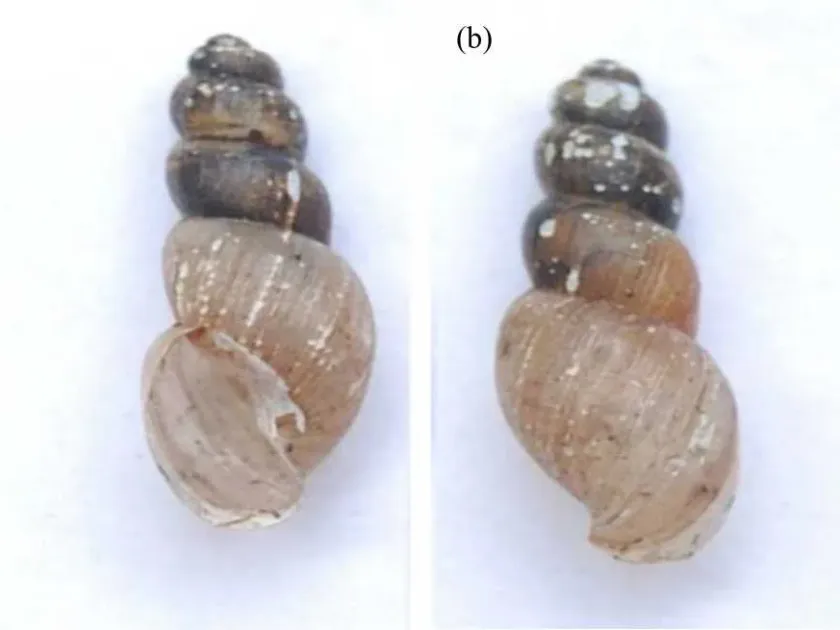
Description
How to identify
Bulinus forskalii is a freshwater pulmonate snail belonging to the family Planorbidae. Its shell has a characteristic conical, elongated shape with a sinistral (left-handed) coil, which serves as a primary diagnostic feature for identifying the species.
Adult individuals typically reach 8 to 15 millimeters in height. The shell color ranges from light horn to brownish, with a surface that is often smooth or marked by fine growth lines.
This species prefers stagnant or slow-moving water bodies, including ephemeral pools, irrigation canals, and rice paddies. Its high adaptability allows the snail to survive temporary desiccation by burying itself in the silt.
Systematically, it belongs to the order Basommatophora, family Planorbidae. Importantly, this species is an intermediate host for dangerous trematodes, making it a significant biological hazard beyond its impact on crops.
Morphologically, they are distinguished from related species by a more slender whorl and the specific structure of the radula, which requires microscopic examination for precise determination.
What it damages
Significant damage occurs during the cultivation of rice and other water-dependent crops in tropical and arid regions. Snails actively feed on young seedlings, damaging the delicate tissues of stems and leaves.
In rice field environments, high population densities can lead to thin stands, necessitating replanting and causing substantial economic losses for agricultural operations.
Beyond direct consumption of plant material, molluscs contribute to mechanical damage to the root system, making the crop more susceptible to fungal infections and water-borne pathogens.
The presence of large numbers of individuals in irrigation systems disrupts hydrological balance and clogs filters, slowing water flow necessary for proper crop development.
Indirect damage is associated with the necessity for intensive chemical control, which may negatively impact harvest quality and the long-term ecological balance of the water body.
When it appears
The activity of this species is directly dependent on water temperature and moisture availability in the substrate. In tropical regions, reproduction can occur year-round if suitable conditions are maintained.
The peak of life activity coincides with periods of field flooding, which creates ideal conditions for mating and egg-laying on submerged plant parts.
In areas with distinct seasonal dry periods, snails enter an aestivation state, burying themselves deep into the soil at the bottom of basins to survive the unfavorable period.
Reproductive processes accelerate when water temperatures rise to 25-28 degrees Celsius, often corresponding with the start of the growing season for major agricultural crops.
Mass emergence of juveniles is observed two to three weeks after the start of the rainy season or artificial flooding, requiring rapid response from agricultural managers.
Signs of infestation
Visual signs of infestation include characteristic focal tissue damage at the water level, resembling eaten-out areas or frayed edges on leaves.
The presence of empty shells or mucous trails on stems protruding above the water surface serves as direct evidence of high snail activity in the area.
Growth stunting and yellowing of young rice shoots often signal that the root system has been damaged due to snail feeding activity in the root zone.
Inspection of irrigation canals may reveal egg masses in the form of transparent or jelly-like clumps attached to submerged parts of aquatic vegetation.
Noticeable reduction in water clarity and a specific odor of decomposing organic matter during excessive accumulation of dead individuals can also indicate high population densities.
Control measures
The primary method of control is land reclamation, which includes timely clearing of irrigation canals of algae and aquatic weeds that serve as a food source for the pest.
The use of molluscicides is effective but requires caution; copper sulfate-based products or specialized compounds must be applied in strict dosages to protect the surrounding ecosystem.
Biological control involves utilizing natural predators, such as specific fish species or waterfowl, which can effectively reduce snail populations in rice paddies.
Crop rotation and field drying during the off-season are critical agricultural practices, as complete soil desiccation leads to the death of most Bulinus forskalii individuals.
- Draining water bodies during critical growth phases.
- Mechanical clearing of irrigation channels.
- Use of selective molluscicides.
- Biological control via natural predators.
- Adherence to strict quarantine measures.
Taxonomy
- Latin name
- Bulinus forskalii
- Order
- Molluscs
- Family
- Planorbidae
- EPPO code
- BULIFO
Discussion
No discussions yet — be the first.