
River limpet
Ancylus
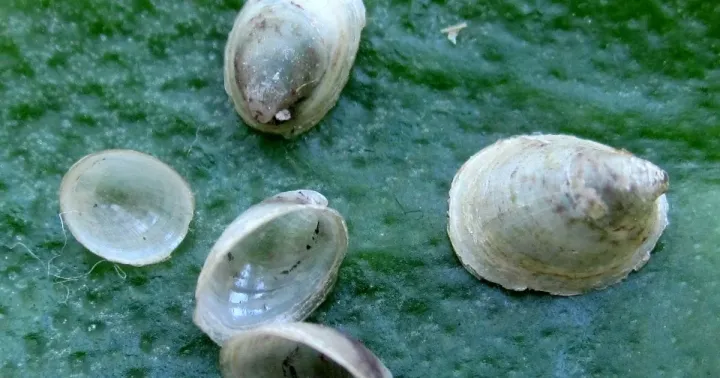
Description
How to identify
The river limpet (Ancylus fluviatilis) is a small freshwater gastropod mollusk belonging to the Planorbidae family. It features a distinct cap-shaped shell that typically measures between 8 and 10 millimeters.
Unlike many spiral-shelled snails, the river limpet's shell is non-coiled and conical, allowing it to adhere tightly to various underwater surfaces such as stones and concrete.
Their coloration is generally greyish-brown, which provides excellent camouflage against their natural habitat of riverbeds and rocky surfaces.
Physiologically, they are well-adapted to well-oxygenated flowing waters, where they utilize their muscular foot to navigate across hard substrates.
Taxonomically, the genus Ancylus is identified by the specific shape of the shell apex, which is slightly hooked and directed towards the posterior side.
What it damages
The river limpet is primarily considered an economic pest in aquaculture and water management systems rather than in traditional agriculture.
These mollusks serve as intermediate hosts for trematode parasites, which can infect fish populations, poultry, and occasionally humans living near contaminated water.
In industrial settings, high populations of river limpets can obstruct irrigation pipes, clog water filters, and interfere with the performance of pump systems.
By grazing on biofilms and algae, they can disrupt the balance of microorganisms in aquaculture tanks, leading to indirect issues in water quality maintenance.
Accumulation of shell debris and waste products can also alter the chemical composition of the water, creating unfavorable conditions for sensitive aquatic species.
When it appears
The life cycle and activity of Ancylus fluviatilis are heavily influenced by water temperature and flow rates, with peaks in spring and summer.
Optimal growth and reproductive rates occur when water temperatures range between 15°C and 22°C. During colder winter months, their activity levels significantly decline.
Reproduction involves the deposition of egg capsules on hard surfaces, which hatch into juvenile snails directly, bypassing the free-swimming larval stage.
High levels of oxygenated water and the presence of organic film are essential for the survival and colonization of new substrates by the population.
Their ability to rapidly colonize new environments makes them resilient in systems where temperature fluctuations are minimal.
Signs of infestation
Infestation is often confirmed by visual observation of the greyish, cap-like shells adhering to the interior walls of water conduits or tank basins.
Characteristic grazing marks, visible as faint, zig-zag lines on surfaces, indicate where the limpet has scraped away algae using its radula.
Reduced flow efficiency in irrigation systems or frequent failure of mechanical filters are common indicators of an underlying limpet infestation.
In aquaculture, the presence of these snails should trigger a diagnostic check for parasitic trematode infections in the fish stock.
The presence of empty shells on the floor of a tank suggests a recent life cycle turnover or the impact of environmental changes on the colony.
Control measures
Physical removal is the most reliable method for controlling river limpets in closed systems and small-scale aquaculture setups.
Biological control, such as introducing mollusk-eating fish or crustaceans, can provide a sustainable reduction in population size.
Routine drainage and drying of water channels or tanks effectively eradicate the population, as these mollusks cannot survive prolonged desiccation.
Chemical control via molluscicides should be performed with caution to ensure the safety of the aquatic environment and the health of cultured species.
- Regular physical scrubbing of water conduits
- Installation of fine-mesh screening on water intake points
- Maintaining high velocity in water systems to discourage settlement
Taxonomy
- Latin name
- Ancylus
- Order
- Molluscs
- Family
- Planorbidae
- EPPO code
- ANCUSP
Discussion
No discussions yet — be the first.