
Biomphalaria glabrata
Biomphalaria glabrata
Description
How to identify
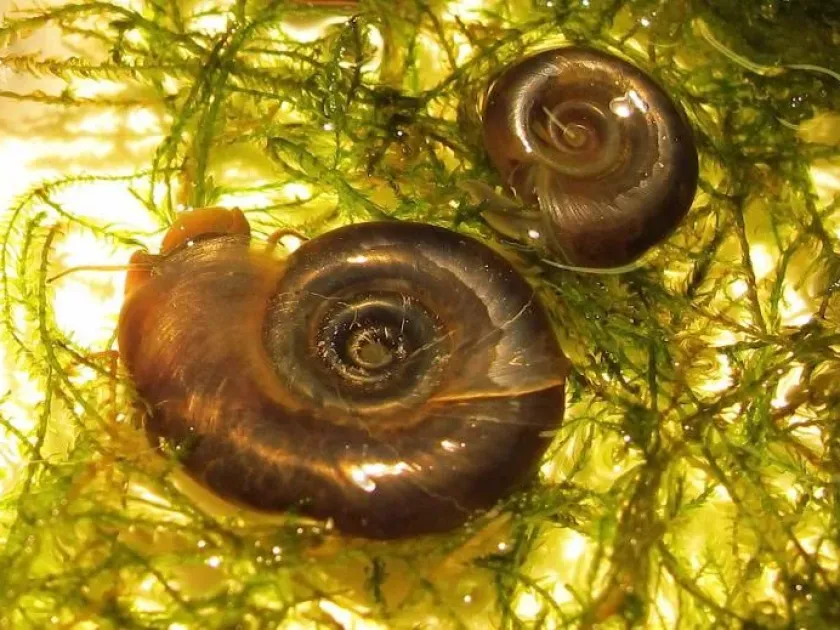
Biomphalaria glabrata is a freshwater air-breathing snail belonging to the Planorbidae family. Its shell has a characteristic discoid shape, coiled in a flat spiral, which makes it look like a small brownish coil, distinguishing it from other aquatic gastropods.
Adult individuals of this species reach a size of 15 to 25 millimeters in diameter. The body is soft, light brown or grayish, and is well-adapted to living in stagnant or slow-moving freshwater bodies with an abundance of aquatic vegetation.
Systematically, the species belongs to the class Gastropoda, order Hygrophila. A key feature is the absence of an operculum and the ability to breathe atmospheric air, allowing them to survive in oxygen-poor environments.
Identification of this species from related coil snails often requires laboratory analysis of soft tissues or the radula. As it serves as an intermediate host for trematodes causing dangerous diseases, its presence near agricultural areas is highly undesirable.
These snails are hermaphrodites capable of both self-fertilization and cross-fertilization. Their high reproductive capacity allows populations to rapidly colonize new water bodies when environmental conditions and food sources are favorable.
What it damages
In an agricultural context, Biomphalaria is not a primary field pest, but it poses a significant threat to hydroponic systems and rice paddies. During periods of flooding, these snails actively feed on aquatic and riparian vegetation.
The snails can damage root systems and tender shoots of crops grown in hydroponics or greenhouses with closed-loop water systems. They scrape the epidermis of young tissues, which leads to plant stress and potential death.
Beyond direct feeding, damage involves clogging filtration systems and irrigation pipes. Massive reproduction leads to the formation of biofilms that restrict water flow and nutrient solution distribution throughout the system.
In rice farming, the presence of these snails is problematic due to their competition with beneficial microfauna and damage to young rice sprouts. They also contribute to the accumulation of organic waste, which alters water chemistry and suppresses crop growth.
A critical concern is that this species acts as a vector for schistosomiasis. Its presence in irrigation water creates a safety hazard for workers, necessitating strict quarantine and sanitation protocols on irrigated plots.
When it appears
Snail activity depends directly on water temperature, which should range from 20 to 30 degrees Celsius. The highest intensity of feeding and reproduction is observed during the summer period when water temperatures reach their peak.
In protected cultivation and hydroponic installations, Biomphalaria can remain active year-round. The optimal microclimate within greenhouses creates perfect conditions for the continuous development of multiple generations of snails.
In winter or during sudden cold spells, snails enter a state of reduced metabolic activity, often burying themselves in bottom sediments. They are capable of surviving unfavorable periods, including the temporary drying of the top layers of water bodies.
The life cycle from egg to mature individual takes about 4 to 6 weeks under optimal temperatures. This allows the population to recover within a very short time frame after cleaning and maintenance procedures.
The population peak usually occurs in the middle of the growing season when organic buildup in water sources is at its maximum. During this time, population control becomes most critical for protecting both the infrastructure and the plants.
Signs of infestation
The first sign of Biomphalaria presence is the appearance of egg clutches on aquatic leaves, tank walls, or irrigation pipes. The clutch appears as a small, transparent, or whitish capsule containing numerous tiny eggs.
Characteristic traces of their activity include holes in the leaves of aquatic or riparian plants with uneven, scraped-off edges. Leaves often turn yellow due to damage to the vascular tissues.
Presence of significant quantities of feces on the bottom or substrate in hydroponic installations indicates an infestation. This is often accompanied by cloudy water and an unpleasant odor due to the decomposition of organic residues.
Reduced growth rates and general stunted appearance of plants, when no pests are visible on the above-ground parts, may indicate root damage by snails in the nutrient solution.
Directly spotting the snails attached to the walls of reservoirs or floating on the surface confirms an invasion. Even a single specimen requires immediate action to disinfect the system.
Control measures
The foundation of protection is prevention, which involves strict monitoring of input water and quarantining all newly introduced plants. Any new aquatic flora must be treated with disinfecting solutions before being placed into the system.
Mechanical removal of individuals and egg clutches is the safest method for hydroponics. Regular cleaning of reservoirs, pipes, and filters helps minimize the snail population to safe levels.
Biological control methods, such as introducing natural predators (e.g., specific fish species that feed on snails), may be effective in larger reservoirs or open water supply systems.
Chemical control using molluscicides should be conducted with extreme caution. Most such agents are toxic to crops as well as pests and can disrupt the balance of the entire ecosystem.
In case of a severe infestation, it is recommended to replace the entire nutrient solution followed by a thorough disinfection of the system using specialized agents permitted in agronomy, followed by extensive flushing with clean water.
Taxonomy
- Latin name
- Biomphalaria glabrata
- Order
- Molluscs
- Family
- Planorbidae
- EPPO code
- BIOMGL
Discussion
No discussions yet — be the first.