
Cotton bollworm
Armiger
Description
How to identify
The cotton bollworm (Helicoverpa armigera) is a highly destructive moth species belonging to the Noctuidae family, known for its extreme adaptability.
Adult moths have a wingspan of approximately 35–40 mm, with coloration ranging from pale yellowish-brown to reddish-brown with distinct wing markings.
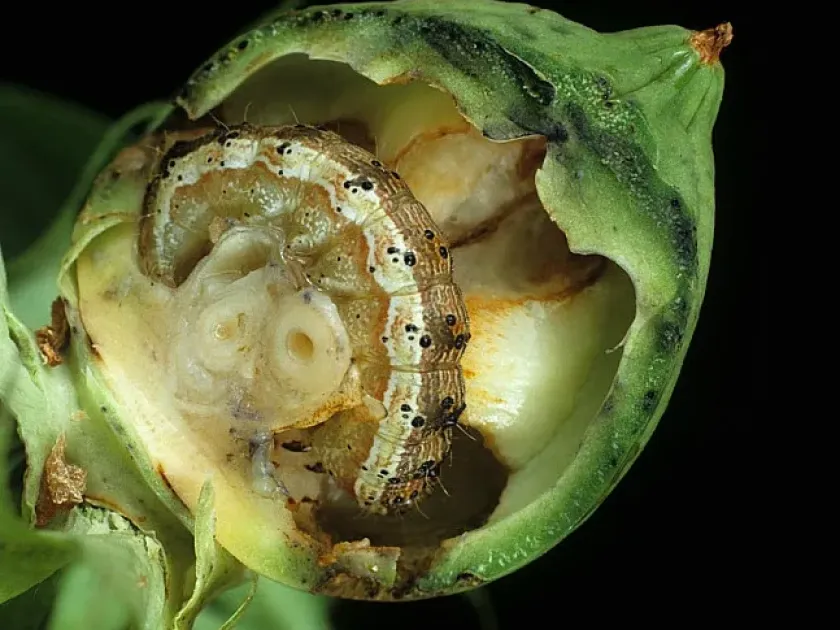
The larvae go through six instars, exhibiting significant color variation from green to dark brown or black, often depending on their diet and population density.
Pupae are usually brown and smooth, typically overwintering in the soil at depths of up to 10–15 cm, protected from extreme environmental conditions.
Eggs are hemispherical and yellowish, laid individually on the upper parts of host plants, including leaves, flowers, and developing buds.
What it damages
This polyphagous pest targets over 250 different plant species, causing significant losses in cotton, tomatoes, corn, chickpeas, soybeans, and tobacco.
Early-stage larvae feed on tender leaves, causing skeletal damage, while older larvae focus on generative organs like buds, flowers, and fruit.
The most severe damage occurs when larvae penetrate the fruit or pods, feeding internally and rendering the produce unmarketable and susceptible to rot.
Loss of flowers and young fruit often leads to premature shedding, which significantly reduces total crop yield and disrupts the plant's growth cycle.
In addition to direct feeding, the wounds caused by bollworms serve as entry points for secondary pathogens like bacteria and fungi, causing further decay.
When it appears
Adult moth activity typically begins in the spring once soil temperatures reach a threshold of 18-20 degrees Celsius, triggering their emergence.
The insect's life cycle is temperature-dependent, usually lasting 25 to 45 days, allowing it to complete several generations during a single growing season.
Peak populations often occur during mid-to-late summer, when high temperatures and abundant food sources favor rapid reproduction and development.
As migratory insects, adult moths can travel long distances, leading to sudden and unexpected infestations in previously unaffected crop areas.
Climate change and irrigation practices often extend the period of peak infestation, as the pest finds favorable conditions throughout the entire vegetation phase.
Signs of infestation
Early signs include small irregular holes and skeletonized areas on leaves caused by the feeding activity of newly hatched young larvae.
The presence of larval excrement, appearing as small dark pellets on leaves or plant stems, is a clear indicator of a growing bollworm population.
Wilting of terminal shoots, sudden dropping of buds, and visible holes in mature fruits are diagnostic indicators of larval internal feeding.
A physical inspection of the crop during the morning or evening often reveals the presence of larvae actively feeding on the plant's reproductive structures.
Using pheromone traps helps farmers detect the onset of adult flights, providing an early warning system before eggs are laid on crops.
Control measures
Cultural control measures, such as deep autumn plowing, are highly effective in disrupting the pupal stage and reducing the next season's pest population.
Biological control through the release of parasitoid wasps, such as Trichogramma, can significantly reduce egg-to-larva survival rates in the field.
Chemical control involving systemic insecticides is necessary when infestation levels exceed economic thresholds, ensuring timing aligns with egg hatching.
Integrated Pest Management (IPM) practices, including the use of trap crops and crop rotation, help to mitigate the impact and spread of this resilient pest.
Regular scouting and the use of light or pheromone traps are essential for informed decision-making regarding the application of plant protection products.
Taxonomy
- Latin name
- Armiger
- Order
- Molluscs
- Family
- Planorbidae
- EPPO code
- ARMESP
Discussion
No discussions yet — be the first.