
Common goldeneye
Bucephala clangula
Description
How to identify
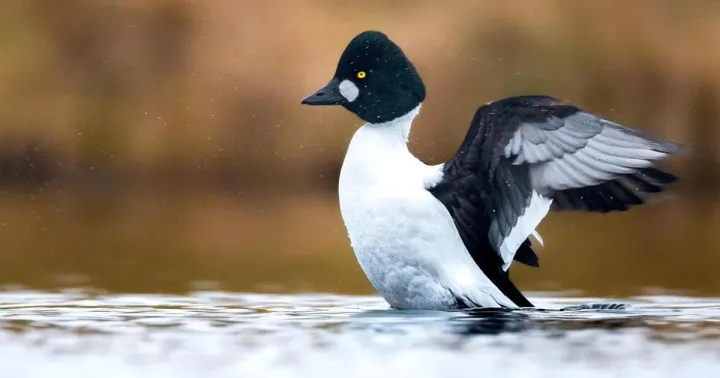
The common goldeneye (Bucephala clangula) is a medium-sized sea duck within the Anatidae family and Anseriformes order. It is easily recognized by its large, rounded head and distinct white patch near the bill.
Males possess a striking black head with a green sheen, while females exhibit a duller brown head. Both sexes are expert divers, capable of submerging for long durations to forage.
These ducks are forest-dwelling species that typically nest in tree cavities near water bodies. Their strong swimming capabilities allow them to navigate diverse aquatic environments effectively.
Identification is further aided by the characteristic whistling sound their wings produce during flight, a signature trait of the species in natural settings.
In an agricultural and aquaculture context, they are viewed as opportunistic feeders that can significantly disrupt the ecological balance of managed ponds.
What it damages
The primary economic damage caused by common goldeneyes in aquaculture is the predation of fish fingerlings. They actively target juvenile fish stocks, leading to substantial losses.
Commercial fish farms experience direct financial impact as the consumption of stocked fish reduces overall yield and requires additional investment in replacement stocks.
Beyond predation, the presence of these ducks contributes to water pollution. Their excrement increases nutrient levels, potentially triggering algal blooms and water quality degradation.
Their constant activity creates high levels of disturbance for the farmed fish, leading to stress, reduced feeding efficiency, and increased vulnerability to aquatic diseases.
The cumulative impact of these birds often forces farmers to implement costly deterrent measures, which significantly influence the operational budget of fish production.
When it appears
The risk of predation is highest during the breeding and brood-rearing season, typically from late spring through early summer, when nutritional needs for chicks are high.
Autumn migration periods bring large flocks of goldeneyes to inland ponds, increasing the predatory pressure on fish populations before the final winter harvest.
Spring migrations create early-season disturbance, where ducks may target overwintering fish populations, particularly when alternative natural food sources are scarce.
Temperature fluctuations drive feeding intensity; warmer water temperatures often lead to higher metabolic rates and more frequent foraging behavior in goldeneye flocks.
Understanding seasonal patterns allows farm managers to optimize the timing of defensive measures, ensuring protection when bird density is at its peak.
Signs of infestation
Frequent, repeated diving activity within confined areas of a pond is a clear indicator that a goldeneye flock is actively hunting fish.
The presence of feathers and droppings near pond banks or hydraulic structures provides physical evidence of regular bird activity and site utilization.
Farmed fish often exhibit signs of behavioral modification, such as avoiding surface waters and remaining in deeper, darker areas to evade avian predators.
Regular visual monitoring of the pond surface during dawn and dusk allows managers to correlate bird density with sudden declines in fish fingerling numbers.
In extreme cases, the disappearance of significant fish cohorts without mortality from disease strongly suggests heavy avian predation pressure.
Control measures
Effective control requires an integrated approach using acoustic deterrents, such as bioacoustic devices that broadcast distress signals to discourage bird nesting and foraging.
Visual deterrents, including predator decoys, reflective tapes, and laser devices, can create an environment that the birds perceive as insecure and dangerous.
Physical exclusion remains the most reliable method, involving the installation of netting over smaller breeding or nursery ponds to prevent access entirely.
Maintaining clear pond perimeters and removing potential landing sites can make a location less attractive to goldeneye flocks searching for resting areas.
- Bioacoustic distress call systems.
- Anti-predator netting for pond coverage.
- Reflective tapes and visual predator decoys.
- Active perimeter monitoring and maintenance.
Taxonomy
- Latin name
- Bucephala clangula
- Family
- Anatidae
- EPPO code
- BUCPCL
Discussion
No discussions yet — be the first.