
Pear leaf miner
Bucculatrix pyrivorella
Description
How to identify
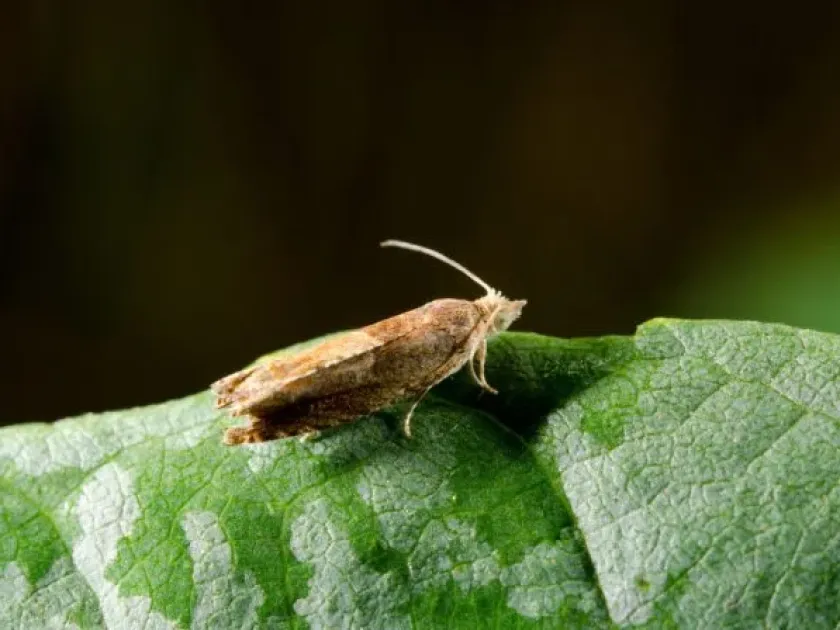
The pear leaf miner, scientifically known as Bucculatrix pyrivorella, belongs to the Bucculatricidae family of the order Lepidoptera. The adult moth is tiny, with a wingspan of only 8-9 millimeters. Its body is covered with fine scales, typically in greyish-brown tones that provide excellent camouflage on tree bark.
The life cycle involves several stages: egg, larva, pupa, and adult. Larvae undergo significant changes as they grow, moving from leaf-mining within the mesophyll to feeding on the leaf surface. This developmental complexity is key to understanding the pest's biology.
Females lay tiny, oval eggs on the undersides of leaves, usually near the midrib. Because of their size and placement, these eggs are extremely difficult to spot during routine garden inspections without magnification.
Pupation occurs inside distinctive, white, ribbed cocoons. These cocoons are typically found on the bark of branches or in crevices, serving as a protective stage during dormancy. Identifying these cocoons is a crucial step in monitoring overwintering populations.
The species is capable of completing multiple generations within a single growing season. This rapid turnover allows populations to explode if environmental conditions are favorable and control measures are not implemented early in the spring.
What it damages
The primary host for Bucculatrix pyrivorella is the pear tree, though it may occasionally affect other Rosaceae members. The main damage occurs to the foliage, which is the engine of the tree's physiological processes.
Larvae create winding mines inside the leaf tissue, destroying the parenchyma cells where photosynthesis takes place. This disruption limits the tree's ability to produce energy, leading to a general decline in vigor and health.
Severe infestations cause massive leaf drop long before autumn. In young orchards or nurseries, this defoliation can significantly stunt growth and lead to the death of weaker saplings during the winter months.
Economic impact is twofold: yield loss and fruit quality degradation. Trees weakened by heavy leaf miner pressure often produce smaller, less nutritious fruit, which reduces their commercial value and storage life.
Chronic infestation weakens the buds and shoots needed for the following year's crop. This creates a cycle of reduced productivity that can persist for years if the pest is not managed effectively.
When it appears
The active season begins in early spring, coinciding with the bud burst phase of the pear tree. Overwintering pupae emerge as adults, ready to mate and initiate the first generation of larvae for the year.
The first generation typically appears in May, when fresh leaves are available. This is the most critical time for monitoring, as keeping the early population low prevents the explosive growth seen in later generations.
Summer months, particularly July and August, see the peak of the pest's activity. During this time, multiple generations may overlap, making it difficult to distinguish between the various stages of the moth's life cycle in the orchard.
As temperatures begin to drop and the photoperiod shortens, the final generation of larvae pupates to overwinter. These cocoons are highly resistant to cold weather and remain attached to the tree throughout the winter.
Favorable weather conditions, such as warm and humid springs, significantly accelerate larval development. Conversely, dry and hot summers may force the pest to slow down, yet it remains a persistent threat to pear health.
Signs of infestation
The most recognizable sign of an infestation is the presence of winding, thread-like mines within the leaf blade. As the larva grows, these mines widen, eventually creating light-colored patches filled with small black frass.
Affected leaves often show premature yellowing and browning. If the infestation is heavy, the entire tree can look sickly, with significant portions of the canopy falling off mid-summer, creating a stark visual impact.
Finding white, ribbed cocoons on the tree trunks and scaffold branches is the definitive sign of a presence. Inspecting these areas after leaf fall provides a clear indicator of the upcoming season's risk level.
- Thin, meandering mines visible on the leaf surface.
- Premature leaf senescence and early autumn-like leaf drop.
- Skeletal patterns where larvae have consumed leaf tissue.
- Small white ribbed cocoons attached to bark crevices.
In some cases, the larva may exit the mine and feed on the surface, leaving behind small, translucent holes or patches. This transition from internal to external feeding is an important behavioral observation for orchardists.
Control measures
Integrated Pest Management (IPM) is essential for controlling this miner. Sanitation is the first line of defense; removing and destroying infested leaves helps break the life cycle by reducing the number of pupating larvae.
Chemical control should be timed with the emergence of larvae. Systemic insecticides are generally more effective because they target the larvae inside the leaf tissue, whereas contact insecticides are best used during the egg-hatching phase.
Biological controls, such as the use of parasitic wasps (e.g., Trichogramma species), have shown promise in reducing population density. These natural enemies provide a sustainable alternative to repetitive chemical applications.
Orchard hygiene, such as removing loose bark or using sticky traps, can help monitor flight activity. Tracking the adult moths with pheromone traps allows for precise timing of spray applications, ensuring high efficacy with lower chemical use.
Consistent pruning practices that open up the canopy not only improve light penetration but also make the tree less attractive to ovipositing females. A healthy, well-maintained tree is always more resilient to leaf miner attacks.
Taxonomy
- Latin name
- Bucculatrix pyrivorella
- Order
- Lepidoptera (butterflies)
- Family
- Bucculatricidae
- EPPO code
- BUCCPY
Discussion
No discussions yet — be the first.